
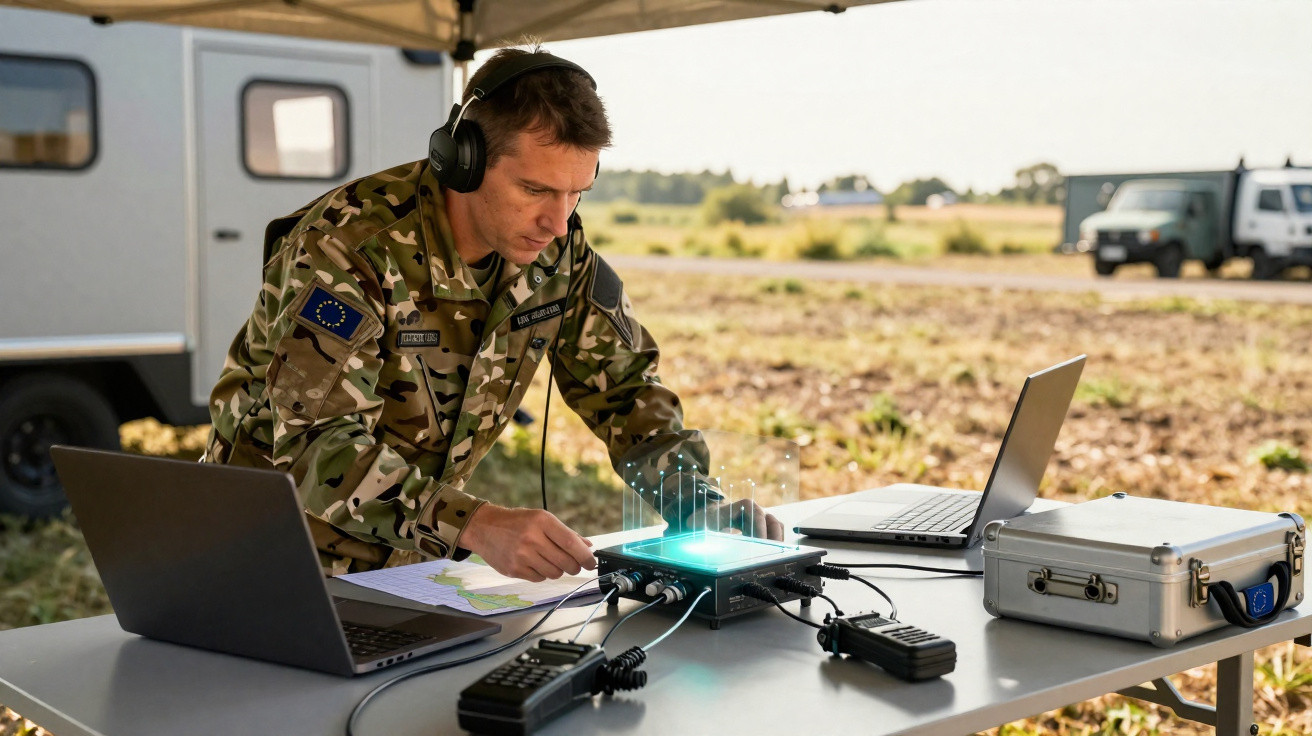
While the war in Ukraine and escalating tensions with Russia fill the headlines, EU officials are pursuing a less visible yet equally strategic goal: a shared, sovereign defence data space that does not depend on American technology.
From strategic convenience to digital dependence
For many years, European armed forces have depended on servers, cloud services and software developed or hosted beyond the continent, frequently in the United States. This arrangement was convenient, quick and comparatively inexpensive, but it also introduced an underlying weakness.
Modern military planning relies on data. Command structures, logistics monitoring, satellite images, targeting tools and even routine secure communications all depend on extensive digital infrastructure. Where that infrastructure falls under foreign jurisdiction, certainty over who controls the information is weakened.
Europe’s defence leaders now see foreign digital infrastructure not just as a business choice but as a strategic weakness.
Brussels has begun describing the situation as “technological solitude”: Europe can deploy personnel and equipment, yet the data infrastructure beneath them is often owned by others. That imbalance is increasingly regarded as unsuitable for modern warfare, in which secure connections and milliseconds can determine results.
A European defence data space on European terms
In early February 2026, the European Commission and the European Defence Agency officially supported a new direction: establishing a sovereign European defence data space whose core does not use American technologies.
Its flagship project is the European Defence Artificial Intelligence Data Space. Despite its dry name, it carries an ambitious objective: a secure digital setting in which EU states can exchange sensitive military, industrial and logistical information while retaining legal and technical control within Europe.
The data space is intended to enable several important functions:
- Combining operational data from exercises and missions
- Exchanging logistics and maintenance data for shared equipment
- Supplying AI systems with high-quality, defence-grade datasets
- Enabling near-real-time coordination during joint operations
The proposal is not to combine every national system into a single enormous EU platform. The design will instead be “federated”: every country retains its own servers, databases and tools, while linking them through common rules, standards and secure interfaces.
The EU wants data to flow between allies without that data ever needing to sit on foreign-controlled clouds.
Legal risk is accelerating the sovereignty push
Technology is only one part of the rationale. In private, European officials frequently cite extraterritorial legislation, including the U.S. CLOUD Act, which may in certain circumstances require American companies to provide data held overseas.
For commercial cloud providers that host defence-related information, this is a warning sign. Even where protections are in place, the possibility of access through foreign legal channels is considered a strategic risk.
Through a European defence data space and parallel work on a sovereign military cloud, Brussels intends to limit exposure to legal frameworks outside the EU. Information would be processed and stored under national or EU law, with European companies and institutions running the systems.
| Goal | What changes for EU defence |
|---|---|
| Data sovereignty | Critical information remains under EU legal and technical control. |
| Operational resilience | Lower risk of disruption or access problems in a crisis. |
| AI development | Shared datasets support European-made military AI tools. |
| Interoperability | Armed forces can exchange data more rapidly on joint missions. |
A 2030 target and a demanding military timetable
The political message is unambiguous: this is not a far-off idea from a think tank. Brussels planning papers identify 2030 as the goal for full deployment of the sovereign defence data space.
An initial stage will test the system in controlled environments, including military exercises at EU level. From 2029, testing is expected to extend into real operations, followed by gradual incorporation into everyday command and planning systems.
By the end of the decade, EU forces are expected to fight, train and plan using a data backbone largely built in Europe.
The wider funding picture is favourable. According to the Council of the EU, defence expenditure across EU member states reached roughly €381 billion in 2025. Digital infrastructure will receive only a share of that sum, but the willingness to dedicate specific funds to data, cloud and software is greater than it was five years ago.
Moving beyond decades of fragmentation
The principal obstacle is likely to be attitude rather than funding. European defence has historically been fragmented, with differing national standards, incompatible systems and parallel programmes that seldom communicate with one another.
That division has also shaped digital capabilities. Defence ministries purchased proprietary products from a range of suppliers, at times from non-European companies, often without much consideration for long-term interoperability.
The new data space is intended to address that inherited problem. It will require shared technical specifications, common security standards and joint governance arrangements if it is to function effectively.
There is a political consideration too. Certain member states remain more at ease with NATO-connected or U.S.-based technology, viewing it as proven in battle and dependable. The EU project is not intended to replace NATO, but it does advocate a stronger European pillar within the alliance.
Balancing NATO links with autonomy
This creates a sensitive issue: can Europe establish its own defence data ecosystem without weakening its relationship with Washington?
Brussels officials maintain that the purpose is not to exclude the United States, but to provide European countries with an option. In practical terms, this involves ensuring NATO operations and EU systems can communicate while core infrastructure remains controlled by Europe.
For many policymakers, strategic autonomy no longer means military self-reliance in every circumstance. It means having the ability to decide, case by case, what to share, when to share it and under which rules.
How the European defence data space could change warfare on the ground
The consequences of a sovereign defence data space would be experienced far from Brussels, wherever European forces are deployed.
Consider a future joint mission in Africa involving French, Italian, German and Polish contingents. At present, sharing information among those forces can be slow and complicated because they use different secure networks, encryption systems and formats.
Under the proposed model, units could connect to a shared data fabric using common protocols:
- Drone footage from one nation’s assets could become immediately available to another nation’s ground units.
- Logistics information - fuel, ammunition and spare parts - could be updated in near real time across national command posts.
- AI tools trained using joint datasets could identify patterns in attacks or supply routes more quickly than any human analyst.
The battlefield advantage no longer comes only from better tanks, but from who can link information fastest and safest.
At the same time, every country would keep complete control over the information it shares, using detailed rules and access that can be withdrawn. This combination of sovereignty and connectivity is what EU planners are seeking to create.
Key concepts behind the project
A number of technical and political ideas underpin this change, with several becoming increasingly important in EU defence discussions.
What “federated” means in practice
When officials call the data space “federated”, they do not mean a single centralised super-database. National systems would remain distinct yet compatible. Common standards, software layers and identity management would allow authorised information to travel without requiring states to give up their own infrastructure.
This approach limits the danger of a single point of failure. Should one country’s system be struck by a cyberattack, other states could isolate it while the broader network continues operating.
Why AI requires shared defence data
Artificial intelligence can only perform as well as the data from which it learns. For military applications - recognising objects in drone footage, predicting vehicle maintenance needs and analysing patterns in signals intelligence - high-quality labelled data is both limited and sensitive.
The European Defence AI Data Space is designed to address this by providing a controlled environment in which datasets can be combined, anonymised where necessary and reused. This could accelerate the creation of European-made AI tools instead of relying entirely on software suppliers outside the EU.
Risks, trade-offs and possible failures
Creating a system of this kind carries risks. Experts and officials are already concerned about several potential problems.
First comes cybersecurity. A shared defence data space would be an appealing target for hostile states and sophisticated criminal organisations. To keep pace, the EU would need continuous red-teaming, independent audits and rapid patching cycles.
Second, industrial politics may slow progress. Major defence contractors, cloud providers and smaller technology firms will all compete for contracts. If national priorities outweigh technical reasoning, Europe could produce another patchwork rather than a unified system.
Third, disagreements about data governance are probable. Decisions over who may access each dataset, under what conditions and for how long will need detailed agreements. Tensions could emerge where national-security concerns conflict with EU-wide ambitions.
Nevertheless, the possible gains are considerable: a more resilient military position, improved value from existing defence expenditure and a stronger European role in defining global norms for military data and AI use.
For the moment, the project is progressing through Brussels’ familiar network of technical pilots, working groups and funding programmes. This time, however, time is short. As warfare becomes increasingly driven by data, the EU’s technological solitude is looking less like an abstract concern and more like a strategic deadline.






Comments
No comments yet. Be the first to comment!
Leave a Comment