
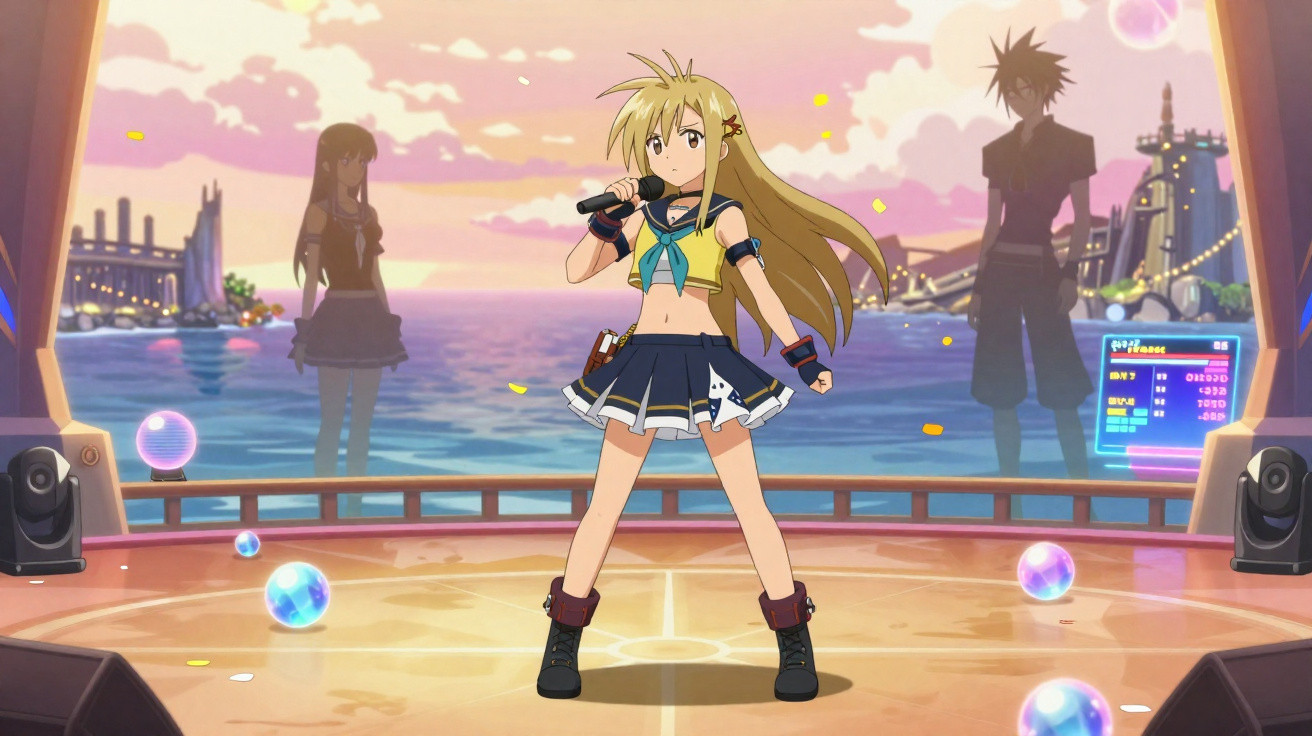
For many fans, it was a culture shock.
When Square Enix released Final Fantasy X-2 for the PlayStation 2 in 2003/2004, the formula appeared straightforward: the same engine, a familiar world and recognisable characters, but in the unusual form of a direct sequel. Yet rather than the anticipated return to Spira, players received a colourful pop spectacle packed with J-pop, pink outfits and comic set pieces. On paper, it promised an intriguing glimpse of life after the grand finale; for many, though, it felt like a direct assault on their own “good taste”.
From tragic epic to pop party
Final Fantasy X closed on a bittersweet farewell, weighty music and a world that had only just survived an apocalyptic threat. Its drama, restraint and emotion were what players remembered Spira for. X-2 discards that atmosphere almost immediately.
Rather than prayers and funerals, X-2 begins with a loud pop concert, spotlights, dance choreography and a screaming crowd.
The point is clear: Spira is celebrating. Sin, the all-powerful monster, has gone. The ever-present fear, religion and logic of sacrifice have disappeared with it. Society has to find a new order, while barely knowing what it now represents. That is fundamentally the story X-2 wants to tell: a period of transition in a world looking for fresh meaning.
Yuna, who faced her own death as a devout summoner in the previous game, suddenly has no predetermined destiny. She can live, travel, laugh and make mistakes. The martyr becomes a young woman making her own choices for the first time. There is genuine dramatic potential in this premise, because the question, “Who am I when my mission is over?”, carries considerable narrative power.
The tone shifts: from quiet grief to loud embarrassment
This is precisely where the divide that remains controversial today emerges. Players return to Spira still carrying the emotional weight of its predecessor, only for the game to greet them with feather boas, revealing outfits and exaggerated comedy. There is scarcely any transition or gradual introduction to the change in mood.
Instead, the screen is flooded with bright colours, bawdy jokes and slapstick. The line between light-heartedness and second-hand embarrassment repeatedly becomes blurred. Many veteran gamers remember the exact moments when they hoped nobody was looking into the living room as Yuna and company bounded across the screen in questionable scenes.
The presentation screams: “Relax, it’s all fun!” – while many players are still emotionally stuck on Tidus and Yuna’s ending.
From melancholy Spira to a garishly colourful fashion catalogue
Visually, too, Spira seems almost unrecognisable. Where Final Fantasy X used muted shades, misty coastlines and sacred temples, X-2 is dominated by a fairground aesthetic:
- vivid pinks and pastel shades in costumes and menus
- striking poses and camera angles more reminiscent of idol anime
- a design blend of pop concert, fashion shoot and teen series
A fantasy world that once felt coherent becomes a patchwork of stylistic experiments. Bold, some would say; almost tasteless, others argue.
Music between J-pop and a break with the series
The soundtrack is especially divisive. In place of Final Fantasy X’s subtle, melancholic compositions come pop beats, upbeat melodies and rhythmically charged tracks. Composers such as Noriko Matsueda and Takahito Eguchi deliberately broke away from the series’ established musical direction.
For a standalone pop-fantasy series, the music might have been perfectly suited. Set directly against its predecessor, however, it frequently feels out of place. Many players describe a persistent sense that the game is trying to force “good cheer” on them, despite their remaining emotionally attached to the previous game’s tragedy.
The music reinforces the stylistic rupture: less delicate pain, more colourful karaoke night.
Yuna, Rikku and Paine: a girl group with role-playing duties
Narratively, X-2 turns Yuna, Rikku and the new character Paine into something akin to a fantasy girl group. As Sphere Hunters, they travel through Spira, stumble into political disputes and personal tragedies, yet the presentation and marketing strongly foreground their stage and idol appeal.
There is plenty of substance at the core: a heroine who has lost her role; a country without a guiding religion; factions competing over power, authority to define events and identity. But the game overloads these ideas with comedy, fan service and costume changes that seem designed for posters and merchandise.
The combat system as Final Fantasy X-2’s hidden star
While its presentation and humour put off many fans, X-2 excels in a traditional Final Fantasy strength: its combat system. The turn-based battles move at a notably faster pace, almost like a dance across the battlefield. Actions flow into one another smoothly, while characters switch roles in seconds.
- a significantly accelerated ATB system
- role changes through so-called Dresspheres
- a greater emphasis on combos and timing
The transformations of the three protagonists are not merely a visual gimmick. Each form represents a different class: mage, warrior, thief and many others. Mechanically, this feels like a modern take on the series’ familiar job system. In narrative terms, it also reflects Spira’s condition remarkably well: every character is trying out roles, and nobody is entirely sure which one truly fits.
If X-2 shines anywhere, it is in its combat core – fast, flexible and eager to experiment.
The central question: what remains of a heroine after the happy ending?
Its most compelling idea sits beneath the surface: what happens to a heroine once the great epic has ended? Once the ancient prophecy has been fulfilled, the villain defeated and the sacrifice made? Final Fantasy X-2 attempts to explore that question through Yuna, but its loud pop exterior often obscures the serious theme beneath.
This is where its opportunities and shortcomings sit side by side. Numerous conversations and side quests suggest how difficult it is to settle into an “ordinary” life after carrying the burden of the world. At the same time, the game gets lost in side activities, dance routines and mini-games that repeatedly undermine its tone.
Why Final Fantasy X-2 remains relevant despite everything
Despite its missteps, Final Fantasy X-2 appears surprisingly often in discussions of JRPGs. There are several reasons for this:
- It was the first direct sequel to a numbered Final Fantasy instalment.
- It demonstrated early on how profoundly tone and presentation can reshape the experience of a story.
- It opened the door for Square Enix to make less expensive productions using existing technology.
At the same time, X-2 is often used as a negative example of a “stylistic break with no regard for fan expectations”. Many publishers internally point to cases like this when considering whether to radically reposition a popular brand.
How to approach Final Fantasy X-2 sensibly today
Anyone catching up with the game now benefits from adjusting their expectations. Rather than anticipating a second tragic epic, a different approach is helpful:
- treat X-2 more as a spin-off-style pop fantasy
- concentrate on the combat system and job experimentation
- view embarrassing scenes as products of their era – early 2000s, fan service included
From that perspective, strengths emerge that were overshadowed at the time by the shock of the stylistic change. Players who enjoy experimenting with systems will find a surprisingly deep game in its countless role combinations, one that invites trial and error.
It is also striking how clearly X-2 reflects its cultural orientation towards the Japanese market. Idol aesthetics, the J-pop concert and slapstick humour all draw heavily on trends that were flourishing in Japan in the early 2000s. Seen today, it functions as a period document: a major publisher testing how far it can push a global brand towards its domestic market without losing its fanbase.
Anyone studying role-playing game history more closely can take a great deal from Final Fantasy X-2: how deeply tonal choices can divide a franchise, the risks inherent in direct sequels, and why mechanical quality alone is insufficient when style and narrative voice alienate the intended audience. That is exactly why this bright, contradictory game remains a subject of discussion today – a textbook example of how narrow the line is between bold reinvention and a perceived stylistic break.




Comments
No comments yet. Be the first to comment!
Leave a Comment