
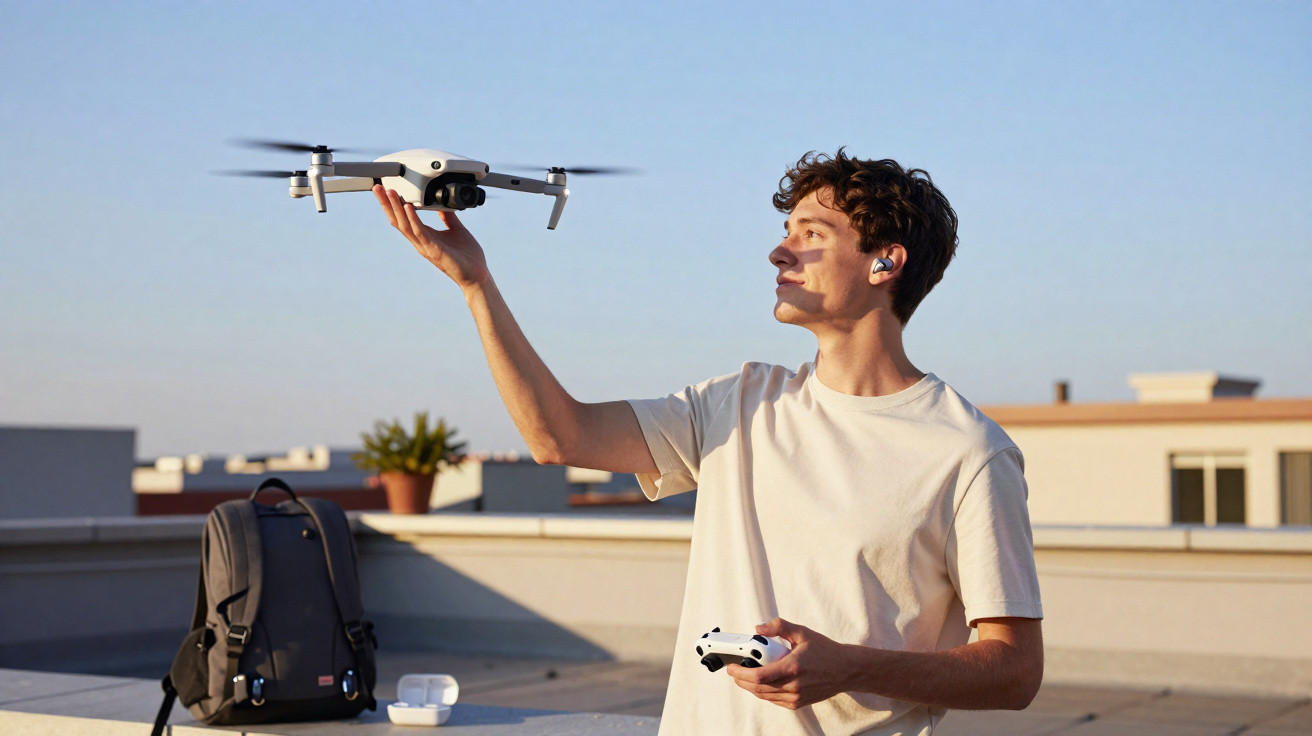
That is, in essence, the promise on offer.
DJI’s newest pocket-sized drone aims to make flying feel as effortless as taking out your phone. There is no large controller or difficult stick input: simply raise a hand or give a brief voice command and it springs into action.
What makes the DJI Neo 2 different
DJI’s new Neo 2 retains the compact dimensions of the earlier Neo and remains far lighter than a typical smartphone. At 151 grams, it is light enough to disappear into a jacket pocket. Although it is still designed for newcomers and casual creators, its feature list now enters a space normally reserved for bigger drones.
Its ambitious premise is that a remote control is not essential. The Neo 2 reacts to gestures and voice commands, while taking care of much of the flight itself. For anyone intimidated by a pair of joysticks, that significantly reduces the entry barrier.
Raise your hand, speak a command, and the drone lifts, frames, and tracks you with almost no piloting skills required.
DJI does, however, charge more for the improved intelligence and optics. In Europe, the basic kit rises from 199 to 239 euros, while a Fly More-style bundle costs more again. For a device aimed at first-time users, this moves it beyond simple toy territory and makes it more comparable with buying a “real camera”.
Gesture and voice: flying without really flying
The principal feature is its control system. Rather than mastering complicated stick movements, users engage with the drone almost as they would a robotic pet.
How gesture control works
Using forward-facing sensors and onboard processing, the Neo 2 can identify basic hand gestures and positions. Hold up your hand in front of its camera and it recognises you as the subject. If you move, it readjusts to keep you within the shot.
- Raised arm: starts take-off or tracking, depending on the situation.
- Hand wave: may begin or end video recording.
- Specific gesture: can activate a programmed move or QuickShot-style effect.
Rather than manually piloting it through full three-dimensional space, you chiefly select a style or flight pattern. Provided the surroundings remain within the limits of its sensors, the drone manages its own height, pace and safety buffer.
Voice control for quick shots
In calmer settings, voice operation provides an additional means of control. Basic spoken commands can begin recording, take a photograph or activate follow mode without requiring you to touch the phone. This is particularly useful for solo vloggers wishing to speak to the camera while controlling it simultaneously.
The Neo 2 behaves more like a smart camera companion than a classic radio-controlled aircraft, which matches the TikTok and Reels generation.
Camera upgrades and image quality
Within its miniature body, DJI retains the earlier Neo’s 1/2-inch, 12-megapixel sensor, a familiar specification in many compact cameras and premium smartphones. The developments instead concern the lens and stabilisation.
The camera is now fitted with a 16.5 mm f/2.2-equivalent lens. This focal length delivers a broad angle of view, which is useful for close self-shooting, group footage and striking landscape scenes. Its wider aperture is beneficial as light levels fall, helping to maintain workable shutter speeds and limit blur.
Stabilisation has increased from one axis to two, pairing mechanical adjustment with digital smoothing. That is important during rapid changes in direction and in gusty conditions. Video ought to appear steadier, particularly while the drone carries out automated movements around a subject.
Video recording reaches 4K resolution. For creators producing short-form material, the Neo 2 records natively in a vertical format, removing the need to crop later and retaining detail across the sensor’s entire height. This is well suited to Instagram Reels, YouTube Shorts and comparable services dominated by portrait video.
Smarter obstacle avoidance in a tiny shell
Traditionally, small drones have found obstacle avoidance difficult because their bodies cannot accommodate extensive sensor arrays. The Neo 2 attempts to address this through a combination of technologies.
| Component | Role |
|---|---|
| LiDAR module | Measures the distance to objects, particularly ahead of the drone. |
| Infrared sensor | Monitors the space beneath it, assisting with low-level flying and landings. |
LiDAR emits pulses of light and calculates the time they take to return. It therefore supplies real-time depth data, allowing the drone to assess when a tree, wall or person is getting too near. Paired with an infrared sensor beneath the aircraft, it can gauge its distance from the ground and hold itself more effectively during take-off, landing and low passes.
Together, LiDAR and infrared give the Neo 2 a much clearer sense of where it is, a key condition for “almost” autonomous flight.
This does not make it immune to crashes, particularly near slender branches or reflective surfaces, but it reduces the risk for beginners who have not yet developed good spatial awareness in the air.
Speed, range and typical use cases
The Neo 2 can now achieve a maximum speed of roughly 44 km/h. That is sufficiently fast to track a cyclist on level terrain, follow a runner or orbit a moving car in controlled settings. Even so, users need to respect that pace, as reaction times reduce sharply when flying low around obstacles.
DJI quotes a 19-minute flight duration per battery in ideal test conditions. In everyday use, wind, cold weather and frequent full-throttle acceleration will generally reduce this to around 14–16 minutes of practical filming time. For trips or sporting activities, three batteries are more sensible than relying on one pack.
Who this drone suits best
The Neo 2 is intended for those who value the resulting footage more than the experience of flying itself:
- Solo creators seeking straightforward tracking while running, cycling or hiking.
- Families who want holiday videos without having to master complex controls.
- Beginners viewing the drone as an airborne smartphone camera.
- Social-media content creators who mainly shoot in vertical orientation.
For pilots who enjoy exact manual handling, the gesture controls could feel limiting. DJI nevertheless provides an alternative for them.
Yes, you can still use a smartphone or controller
Although its key message is “no remote needed”, the Neo 2 can still connect to a smartphone app and more conventional DJI-style controllers. The app enables pilots to view a live feed, alter camera settings, arrange shots and check battery status.
When used with a dedicated RC unit, the drone operates much more like a standard mini quadcopter. This will appeal to those wanting more exact framing, intentional manoeuvres or greater confidence in windy conditions. By combining beginner-friendly automation with optional manual controls, the device caters for a wide audience rather than forcing users into one operating style.
The Neo 2 can act as a nearly hands-free flying camera, then switch personalities into a more conventional drone when you plug in a controller.
Regulation, classes and what users must know
DJI places the Neo 2 in the C0 class under European regulations, within the Open A1 category. This classification generally applies to drones below 250 grams that meet specified safety and noise requirements. The less restrictive framework allows users to fly closer to people, subject to national rules, making it suitable for creators filming in towns or tourist locations.
Despite that lighter category, registration is still compulsory in many areas. In France, owners must open an account on the AlphaTango platform and complete free online certification before flying. Other European countries, as well as the UK and US, have comparable requirements in different forms, often involving registration identifiers and basic knowledge tests.
- Check local height limits and no-fly restrictions before every flight.
- Keep the drone within visual line of sight, particularly at greater heights.
- Stay away from crowds, private gardens and sensitive locations including airports.
Failure to follow these requirements can result in fines, equipment confiscation or, more seriously, incidents involving aircraft or people on the ground.
Price, bundles and what you actually get
The standard Neo 2 costs 239 euros across European markets. It will usually come with the drone, one battery and basic charging equipment. Anyone planning to film more than an occasional short clip is likely to find the Fly More-style combo better value.
The larger bundle includes three batteries and a conventional DJI RC-N3 controller for 399 euros. This allows users to carry out several brief filming sessions in a day without recharging, while also giving them precise physical sticks when gestures alone are not enough for a difficult shot.
Why “almost” autonomous matters for the drone market
The Neo 2 represents a wider change in consumer drones: the true product is no longer the aircraft itself, but the social-media clip posted an hour afterwards. Automation, intelligent tracking and gesture control all support the same aim: effortless content creation.
Rather than training every user to become a pilot, manufacturers are building more decision-making into the drone. The aircraft interprets its surroundings, follows faces, manages exposure and proposes creative moves. This has implications not only for beginner models but also for higher-end drones used by professionals who need dependable automated routes around buildings or vehicles.
As drones gain awareness through LiDAR, computer vision and AI, the line between “pilot” and “director” shifts. Users direct the shot, the drone handles the flying.
There are advantages and drawbacks to this approach. On the positive side, novice crash rates decrease and more people can capture aerial footage safely. Conversely, automation may encourage a misplaced sense of security. Users may believe the drone will invariably avoid wires, birds or complicated urban hazards, and then exceed safe limits.
For anyone considering the Neo 2, the most sensible approach is to combine its autonomous abilities with a strong sense of responsibility. Gesture controls and self-flying modes lower technical barriers, but they do not remove accountability. Understanding local rules, practising in open fields and setting personal limits for speed and distance remain part of the hobby, even if one gesture appears to handle everything.


Comments
No comments yet. Be the first to comment!
Leave a Comment