
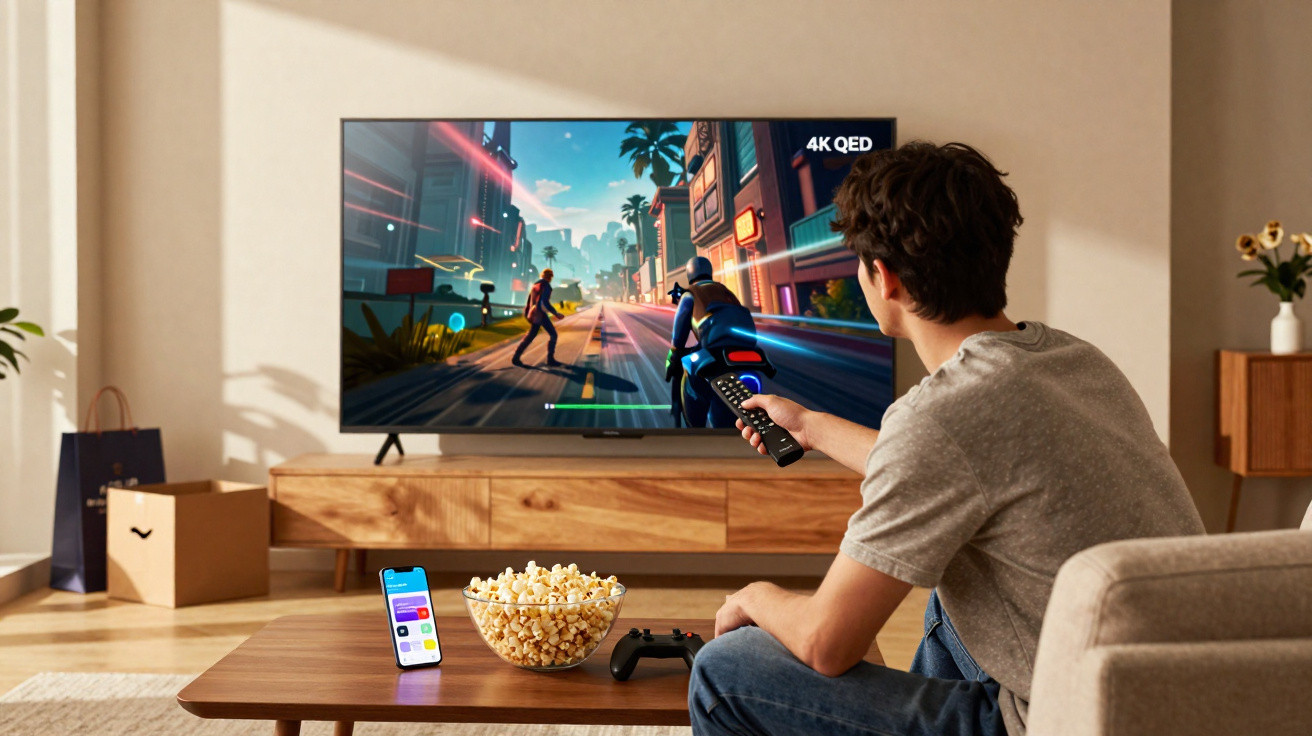
Throughout November, leading brands are cutting the cost of 4K televisions, yet one technology is particularly prominent in the offers: QLED. From enormous 98-inch home-cinema screens to smaller sets designed with gaming in mind, discounted QLED models are everywhere, prompting an obvious question: why choose anything different?
Why QLED is taking centre stage this Black Friday
QLED - meaning “quantum dot LED” - is more than a marketing label. It is a variation on LCD technology, using a quantum-dot layer to increase colour and brightness well beyond what standard 4K sets can achieve.
QLED TVs combine bright images, vivid colours and falling prices, which makes this Black Friday unusually good for anyone eyeing an upgrade.
For shoppers, this brings three major benefits: better HDR performance, more vibrant colour in bright rooms and extensive mid-range choice. OLED still has the advantage for truly deep blacks, but QLED is now a practical choice for many homes, where lights are switched on, curtains remain open and gaming can last for hours.
Mini LED and Neo QLED: the understated game-changers
A major factor behind the latest deals is the wider adoption of Mini LED backlighting. Samsung commonly calls it Neo QLED, while TCL and other brands tend to use the term Mini LED QLED.
- Mini LED places thousands of very small LEDs behind the screen, allowing more precise lighting control.
- This improves contrast and limits blooming when compared with older edge-lit LCD televisions.
- Paired with quantum dots, it gives HDR films and games a considerably more dramatic appearance.
Premium televisions such as Sony’s Bravia 9 and Samsung’s QN90F rely heavily on these technologies. They deliver enough brightness to remain clear in daylight while retaining detail in darker scenes.
Flagship QLED TVs: cinema and gaming in a single set
This year’s leading Black Friday offers across Europe focus on large, premium QLED televisions that would usually be beyond typical household budgets. The proposition is straightforward: advanced picture processing, capable audio and comprehensive gaming features, all at reduced prices.
Sony Bravia 9: Mini LED QLED home cinema
Sony’s Bravia 9 is a 4K Mini LED QLED television powered by its XR processor and Triluminos Pro colour technology. This combination produces polished contrast and highly accurate colour, alongside sufficient brightness for challenging HDR standards such as Dolby Vision.
For gamers, its 120 Hz refresh rate, VRR (variable refresh rate) and ALLM (auto low latency mode) make it a capable match for PS5 and Xbox Series consoles. Its audio specification includes an integrated 5.1.2-channel system with Dolby Atmos support, intended to lessen the need for a standalone soundbar.
High-end QLED sets are no longer just about picture quality; they increasingly bundle competent Atmos audio and full gaming support.
TCL giant screens: 98 inches without a six-figure budget
Chinese manufacturer TCL has established itself as a leading name for exceptionally large televisions. Its 98-inch Mini LED QLED models, including the Q8C/98C8K, offer very high brightness figures of up to roughly 5,000 nits, alongside 4K resolution at 144 Hz with VRR and AMD FreeSync Premium Pro.
That fast refresh rate is significant for both sports viewers and PC gamers. Movement appears more fluid, while VRR reduces tearing when frame rates vary. These televisions also offer Dolby Vision IQ and HDR10+, which alter HDR brightness according to room conditions, and use Google TV to provide simple access to Netflix, Disney+, Apple TV+ and other streaming services.
Mid-range QLED TVs: the new standard upgrade
A 98-inch television is not for everyone, particularly if it takes over an entire wall. The strongest Black Friday value is concentrated in the 50–75-inch range, where QLED is no longer confined to flagship-level pricing.
Xiaomi and TCL: large displays at restrained prices
Xiaomi’s 75-inch F Pro QLED demonstrates just how competitive pricing has become. Introduced at close to four figures, it has already been reduced by hundreds of euros in early Black Friday offers. It employs quantum dots for fuller colour, supports HDR10+ and has a Filmmaker Mode that limits motion smoothing to retain the director’s intended presentation.
In a more compact format, Xiaomi’s A Pro range offers QLED at 55 inches for a budget-conscious price. It covers approximately 94% of the DCI-P3 colour gamut - the standard used for digital cinema - while also including HDR10+ and Filmmaker Mode. As a Google TV model, it offers Chromecast-style casting and app compatibility without requiring a separate streaming stick.
TCL’s C79K and C8K ranges provide comparable value in 50- and 75-inch sizes. Each uses Mini LED QLED panels with high peak brightness and a 144 Hz refresh rate, as well as HDMI 2.1 connections and FreeSync Premium Pro. For people using one screen for working from home, watching sport and console gaming, these specifications help limit blur and stutter across different types of content.
Samsung and Philips: useful smart features for everyday viewing
Samsung’s Neo QLED televisions, including the QN90F and QN80F, combine Mini LED backlighting, QLED technology and fast refresh rates. A notable feature this year is 165 Hz support on certain sizes, directly appealing to PC gamers seeking high frame rates on a television rather than a monitor.
HDR10+ Adaptive and Filmmaker Mode are intended to give films a more natural look, while Dolby Atmos compatibility adds 3D audio through suitable sound systems. Samsung’s Tizen OS integrates smart-home management through SmartThings and works with voice assistants including Alexa and Google Assistant, as well as the Matter standard for connected devices.
Philips differentiates its models through Ambilight: rear-mounted LEDs create a coloured glow on the wall that corresponds with the on-screen image. Televisions such as the PUS9000 combine QLED panels, 144 Hz with VRR and FreeSync, plus the Titan smart TV system, with this lighting feature.
Ambilight doesn’t change the actual image, but many viewers feel it makes long film sessions and gaming marathons more immersive and less tiring on the eyes.
Why QLED performs so well for gamers
Black Friday QLED TV offers are particularly appealing to anyone creating or improving a gaming setup. Many reduced-price models now share a group of specifications that were once uncommon:
- 4K resolution with a 120 Hz or 144 Hz refresh rate
- HDMI 2.1 ports for PS5, Xbox Series and high-powered PCs
- VRR (variable refresh rate) to reduce tearing
- ALLM (auto low latency mode) to minimise input lag
- Compatibility with AMD FreeSync Premium or Premium Pro
QLED’s high peak brightness and resistance to image retention make it a reassuring option for extended sessions involving static HUDs in shooters, sports titles or MOBAs. OLED still produces darker blacks, but some players remain concerned about burn-in from fixed on-screen elements; QLED largely avoids that issue.
What “HDR”, “VRR” and other buzzwords really mean
Black Friday product listings are packed with acronyms, and knowing the meaning of a few can help avoid costly errors.
| Term | What it changes for you |
|---|---|
| HDR10 / HDR10+ | Brighter highlights and greater shadow detail; HDR10+ adjusts from scene to scene. |
| Dolby Vision / Dolby Vision IQ | Dynamic HDR that modifies image data, with IQ also responding to ambient room light. |
| Dolby Atmos | Object-based audio that can create a height effect when used with compatible speakers. |
| VRR | Matches the display refresh rate to a game’s frame rate, helping to cut screen tearing. |
| ALLM | Switches the television automatically to its low-latency game mode when it recognises a console. |
| Filmmaker Mode | Disables aggressive smoothing and picture “enhancements” to produce a more cinematic image. |
How to choose the right QLED during Black Friday
Late-November price reductions can distract from the essentials, so begin by considering a few basic points:
- Room and lighting: In a bright living room, favour high peak brightness and Mini LED; this is where QLED excels.
- Usage balance: Frequent gaming makes 120/144 Hz panels and VRR worthwhile. Film enthusiasts may prefer Dolby Vision or HDR10+ compatibility and strong built-in sound.
- Screen size and distance: In typical UK and US living rooms, a 55–65-inch screen works well at a viewing distance of roughly 2–3 metres.
- Smart platform: Google TV, Fire TV, Tizen and Titan OS all offer somewhat different interfaces and app selections.
A practical method is to set a maximum spend, then identify the televisions within it that meet three requirements: at least one next-generation gaming feature, a recognised HDR format such as HDR10+ or Dolby Vision, and a platform carrying the apps you genuinely use. This straightforward check can often reduce dozens of offers to two or three convincing options.
Scenarios: who gains most from a QLED upgrade?
A family watching television in a bright, open-plan kitchen and living area could benefit greatly from QLED’s brightness and vivid colour. Sport, daytime news and streamed programmes remain visible without drawing the blinds, which mid-range OLED models can find difficult in direct sunlight.
A PC gamer connecting a desktop tower with a current graphics card is likely to notice the benefits of 144 Hz and VRR even more clearly. Fast shooters appear smoother, while screen tearing and judder almost disappear on televisions supporting FreeSync Premium Pro or comparable standards.
Film fans, although often considered committed OLED users, may also find QLED appealing when it is combined with Mini LED, Dolby Vision/HDR10+ and Filmmaker Mode. The difference in perceived contrast has become smaller, while the likelihood of static subtitles or channel logos leaving marks on the screen is far lower.




Comments
No comments yet. Be the first to comment!
Leave a Comment