
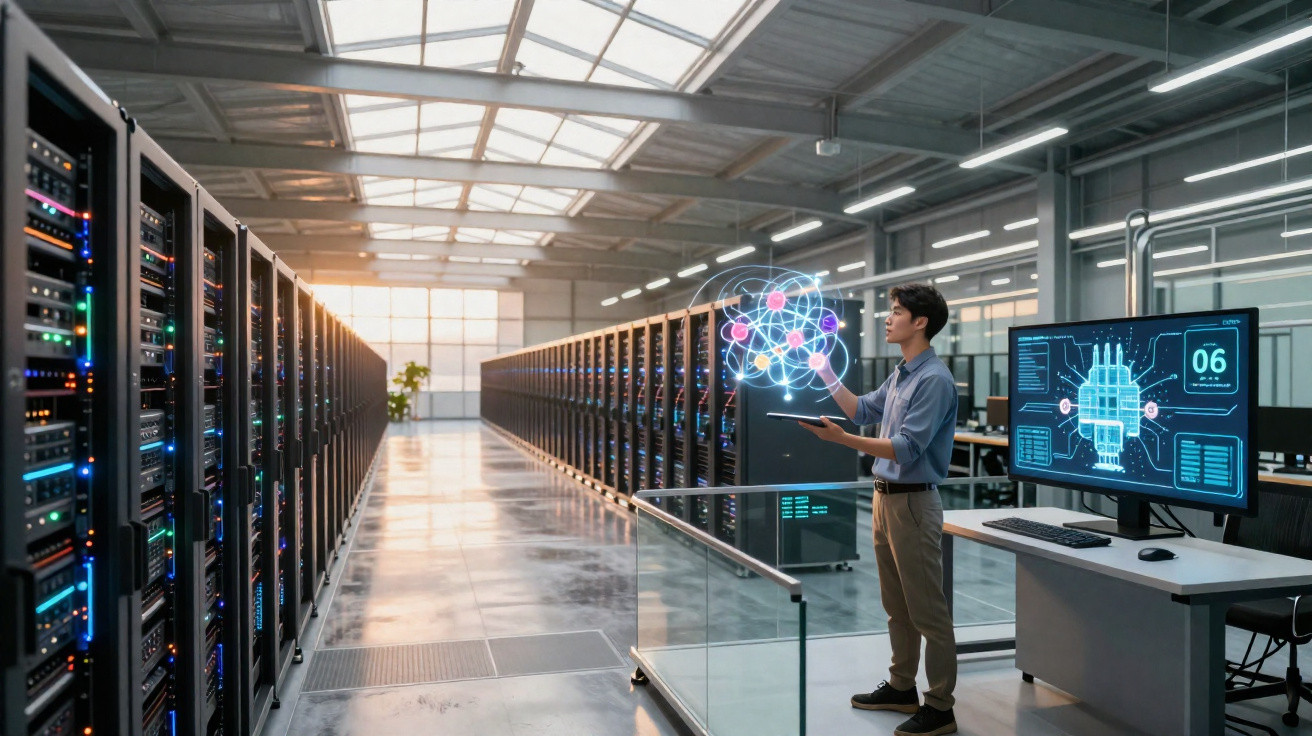
Microsoft is introducing its first “AI superfactory”, a specialised site designed to complete enormous model-training runs in weeks rather than months. It is an ambitious proposition, the implications are substantial, and, unusually, time may be working in our favour.
On the evening I toured one buzzing corner of Microsoft’s cloud campus, the air was unexpectedly cool for summer. Fluorescent light rings traced the pipes and pumps, catching on stainless steel, as a forklift passed by with the slow presence of a whale in shallow water. Technicians exchanged measured, quiet remarks that sounded equally like a software stand-up and a power-station handover.
Beyond a window sat a line of tanks, with coolant flowing through them as gently as steady rain. Greens and ambers flickered across a dashboard that monitored each watt and packet. Rather than resembling a data centre, it looked like a factory floor whose language was tensors instead of steel. Then somebody remarked, almost offhandedly: “This is where models go from impossible to inevitable.” After a pause, the room became stiller.
Inside Microsoft’s AI superfactory: weeks instead of months
You can call it a data centre, but its operating rhythm is distinct. This superfactory is arranged around training runs rather than conventional cloud availability. Compute, storage, networking, cooling and even the sequencing of power are all configured to keep an immense training job supplied and stable for days at a time.
Microsoft relies on custom silicon and current-generation accelerators, deployed in clusters so large that seeing them end to end requires a walk. The interconnect fabric is every bit as important as the chips, reducing latency so gradients are not left queueing. The objective is easy to describe but exasperating to deliver: eliminate every cause of delay so a trillion-parameter model runs like a smoothly maintained production line.
Engineers discuss “wall-clock time” much as chefs discuss temperature. Save 3 percent through improved checkpointing and another 5 percent through more intelligent placement, and a week suddenly appears in a timetable that cannot be extended. One manager showed me a graph indicating that a flagship training run once requiring two months now takes under four weeks. It is not wizardry; it is orchestration.
Picture model training as a city at rush hour, with data arriving continuously while gradients attempt to find their way home. The superfactory expands the “roads” through high-radix switches and removes diversions with topology-aware schedulers. Should a node falter, the job does not fail outright: it takes another route, checkpoints quickly and continues.
More rigorous data hygiene is part of the equation as well. Poor-quality or repetitive samples impede progress just as potholes hold up traffic. During one run, removing low-signal segments and interleaving curated multilingual datasets improved token efficiency sufficiently to eliminate millions of training steps. This is not a marketing presentation; it is simply what happens to throughput when waste is removed.
Energy poses another challenge. A frontier model can consume as much electricity as a small town, and the facility treats power as the primary input it is. Electricity is supplied in large, predictable blocks, while liquid loops calibrated like racing cars carry heat away. Renewable sourcing is not an afterthought surrounding construction; it is integrated into the scheduling of training runs.
How Microsoft aims to shorten time-to-train
The first element is co-design. From chip and compiler through to cluster topology, the entire stack is adjusted as one instrument. This includes mixed-precision calculations with forceful but validated loss scaling, fused kernels that reduce memory traffic, and sharding approaches suited to the model layout instead of working against it. That combination helps maintain high utilisation when the graph becomes complicated.
Then comes operational discipline. Curriculum schedules begin with simpler material and become more demanding as the model reaches stability. Checkpoints are written to storage that handles bursts, meaning an interruption costs minutes rather than hours. More intelligent sparsity and MoE routing also contribute. Let’s be honest: nobody really does that every day. Yet with seven figures of GPU time at stake, “later” turns into “now.”
The conversations in the corridors reflect this shift too: there is less hype and more execution.
“Speed is a feature, but repeatability is the product,” an architect told me. “The run you can do twice is the one you can ship.”
- Secure the data path before anything else; diagnosing a starved pipeline is like adjusting an engine with no fuel.
- Define failure budgets for every stage to prevent minor faults from becoming full job restarts.
- Build energy constraints into the planner rather than treating them as a posthoc report.
- Promote configurations instead of folklore-one successful recipe is worth ten heroic recoveries.
What the next model means for everyone else
Beneath the constant hum is a human reality. We have all watched a job crawl forward while a deadline presses closer and wondered whether the machines were mocking us. The superfactory changes that dynamic by returning time to the working week. Shorter iteration cycles create more chances to succeed, and that reshapes behaviour more effectively than any keynote slogan.
For start-ups, it represents both an opportunity and a higher standard. The opportunity is access to an environment where large models are not fragile museum exhibits. The higher standard is that product teams will anticipate weeks, rather than quarters, between a model concept and a real outcome. Once training becomes a sprint rather than an expedition, the competitive landscape is redrawn.
There is also unavoidable arithmetic to consider. Power, water, land and chips are limited resources, while the industry cannot continue scaling if it exhausts its social licence in the process. Microsoft presents the superfactory as efficiency-led: more useful tokens per joule, greater heat reuse and closer matching of workloads to green hours. That is the proper direction, although whether it goes far enough will be judged publicly.
Look slightly further ahead and the boundaries begin to soften. If weeks become standard, model families could be trained like seasonal collections, each tailored in cut and fabric for search, code, images or agents. Teams could prototype using smaller siblings before moving successful candidates to a full-scale run that does not consume a quarter.
Research culture would shift as well. Experiments that seem too risky when a job takes an entire summer become worth considering when they require a fortnight. There would be more ablations, more unusual branches and fewer cautious adjustments. Progress is not always about being bigger; at times, it is about being bolder.
The term “AI superfactory” will irritate purists, and perhaps reasonably so. Still, standing on that floor amid whispering coolant and breathing dashboards, the comparison seemed deserved. Factories accelerated the 20th century by standardising the awkward, resistant stages of making things. This facility seeks to apply that approach to intelligence. What matters is what we choose to make with the time it creates.
| Key point | Detail | Why it matters to readers |
|---|---|---|
| Weeks, not months | An orchestrated hardware-software stack reduces training wall-clock time | Quicker iteration and product delivery cycles |
| Reliability as a feature | Checkpointing, topology-aware scheduling and failure budgets | Fewer failed runs and more predictable results |
| Energy-aware design | Liquid cooling, workload timing and renewable alignment | A lower footprint per model and steadier costs |
FAQ
- What is an “AI superfactory”, exactly? It is a data centre optimised end to end for training, with compute, networking, storage, cooling and energy planning designed for prolonged, large-scale runs.
- Does it replace standard Azure regions? No. It sits alongside them. General workloads remain in traditional regions, while extended AI training moves towards the superfactory footprint.
- How can it reduce training time to weeks? It raises utilisation through improved kernels, sharding and scheduling, cleans up data pipelines, and limits delays through rapid checkpointing and recovery.
- What is the environmental cost? The design seeks more useful tokens per joule, liquid cooling and closer alignment with renewable supply. Scrutiny will continue, and it should.
- Can smaller teams benefit? Yes, through managed access and smaller-scale tiers: teams can prototype on a small scale, advance promising runs and adopt factory discipline without owning the infrastructure.




Comments
No comments yet. Be the first to comment!
Leave a Comment