
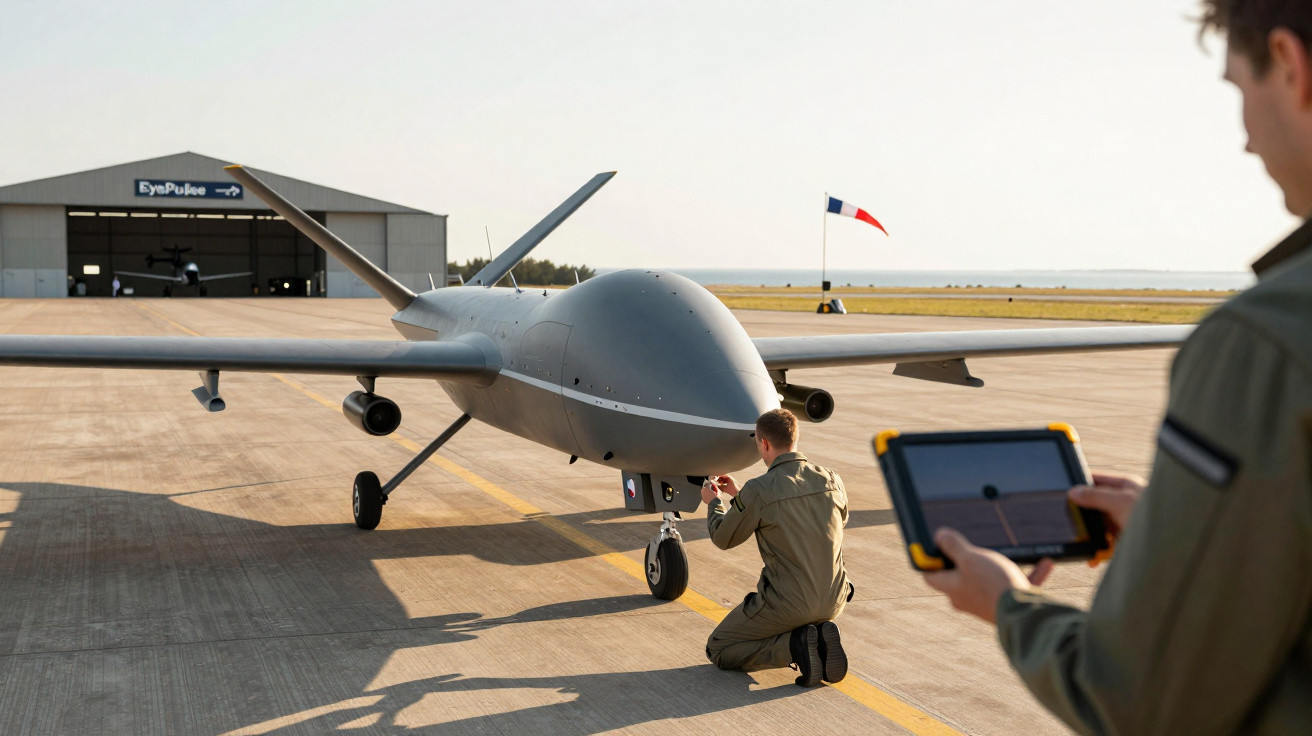
France’s defence industry is discreetly trialling a new category of military drone that may reduce Europe’s reliance on systems supplied from abroad.
On a clear winter morning in the Pyrenees, a streamlined aircraft formerly used for business travel departed Tarbes airport. Converted into a completely autonomous military drone named EyePulse, it lifted off, followed a programmed flight path and landed independently while senior French procurement officials observed. Beneath the technical label of a “MALE demonstrator” is a significant strategic objective: providing France and Europe with an indigenous long-endurance surveillance drone rather than leasing or purchasing one from allied nations.
From business aircraft to a military drone
EyePulse is classified by engineers as a MALE system, meaning medium altitude, long endurance. Put simply, it is a drone built to remain at altitude for extended periods, observing, listening and transmitting information continuously.
The demonstrator uses Daher’s TBM as its basis: a rapid, single-engine turboprop business aircraft recognised for its efficiency and range. Instead of designing an aircraft from scratch, Daher removed the premium cabin and redesigned the airframe for unmanned operations.
By turning a proven TBM airframe into a drone, Daher cuts both development risk and time to field a European MALE capability.
This is a practical selection. The TBM already offers the wingspan, fuel capacity and flight characteristics required for lengthy sorties. Its conversion into a remotely piloted aircraft enables Daher to concentrate spending on sensors, autonomy and protected communications.
A rapid programme for the French defence ministry
The Tarbes flight of EyePulse was more than a private demonstration. It was part of an official trials campaign supervised by France’s Direction générale de l’armement (DGA), the influential organisation responsible for procuring and approving equipment for the armed forces.
During mid-2023, the DGA began a competitive initiative intended to speed up French MALE concepts. It selected five industrial teams: four agile start-ups and Daher, the established aircraft manufacturer. In under a year, Daher could ask the DGA’s senior leadership to attend a complete autonomous flight cycle.
Daher argues that its background as an aircraft manufacturer allowed it to move far faster than smaller newcomers, completing the demo in roughly six months.
For the French defence ministry, this short turnaround is about more than prestige. It demonstrates that domestic industry can respond swiftly to urgent operational requirements rather than waiting a decade for a conventional, slow-paced programme.
Why France needs a sovereign MALE drone
France already flies MALE drones, particularly US-built MQ-9 Reapers. These have seen extensive use in the Sahel, the Middle East and maritime surveillance operations. However, they are foreign-made systems, subject to export and operational restrictions, with France retaining limited influence over upgrades.
EyePulse represents another path: a sovereign capability created and controlled by a French company within French legal and security arrangements.
- Strategic autonomy: authority over software, data and future upgrade routes.
- Industrial benefits: retaining high-technology employment and expertise in France and Europe.
- Operational flexibility: simpler adaptation to French doctrine and particular theatres of operation.
With tensions involving Russia increasing, instability continuing across Africa and maritime routes receiving greater attention, a national MALE solution is becoming more appealing to Paris.
Technical ambitions behind EyePulse
Autonomous take-off and landing may attract most attention, but EyePulse is intended to combine several functions in a single airframe. Although precise specifications are classified, the demonstrator is built around an open architecture capable of accepting a variety of military payloads.
A modular surveillance platform
The TBM-derived fuselage can accommodate numerous sensors and systems. On a standard MALE mission, these could include electro-optical cameras, infrared sensors and secure communications relays. Surface-search radar is particularly important for border and maritime operations. In areas of crisis, electronic intelligence aerials could identify hostile emissions.
| Feature | Potential role on EyePulse |
|---|---|
| Electro-optical/IR turret | Day/night surveillance, target tracking |
| Maritime radar | Detecting ships, small boats and low-flying aircraft |
| Satcom antenna | Beyond-line-of-sight command and live data feed |
| Electronic support sensors | Locating communications and radars without emitting |
Flexibility is the intended outcome. Operators could alter the aircraft’s configuration overnight, moving from counter-terrorism surveillance in the Sahel to anti-smuggling patrols in the Mediterranean.
Autonomy with people firmly in control
Although autonomous take-off and landing make headlines, EyePulse is not designed as an independently roaming robot. Current doctrine still demands that human operators approve critical decisions.
The drone is able to fly planned routes, operate its engine and flight controls, and deal with basic contingencies. Ground-control crews monitor flight information, receive video streams and amend the mission plan as events unfold.
Automation on EyePulse aims to reduce crew workload, not remove human judgment from surveillance and targeting decisions.
This model reflects a broader Western military direction: greater autonomy for navigation and routine activity, while people remain accountable for any use of force.
Competition and cooperation in Europe
EyePulse is not being developed in isolation. Europe has debated a shared MALE drone for years, referring to it through various acronyms and project titles. Development has advanced slowly, while national schedules frequently conflict with complicated multinational structures.
Daher’s demonstrator gives France a domestic alternative or supplementary option. A TBM-based drone might also have a role in wider European initiatives, especially for nations seeking a lighter and more adaptable choice than large, heavy MALE platforms.
Smaller EU member states may prefer a platform able to operate from existing regional airports, needing fewer support personnel and offering lower whole-life costs. From this perspective, EyePulse could be presented as a “European Reaper-lite” carrying sovereign credentials.
Potential missions: from the Sahel to French skies
Should EyePulse, or a derivative version, enter service, it could undertake a broad range of missions. French officers regularly identify several priority fields in which more sustained aerial surveillance could have a material effect.
External operations and counter-terrorism
Across overseas theatres including the Sahel, MALE drones have become an unobtrusive foundation of military operations. They can observe compounds over several days, follow suspicious convoys on desert routes and deliver live video to commanders and special forces.
A drone designed in France would provide additional discretion. Encryption for communications, data storage and sensor settings could all be tailored to national needs, limiting dependence on outside assistance for upgrades and fault-finding.
Maritime security and border control
France has substantial maritime surveillance requirements, spanning the Channel, the Atlantic coastline and its overseas territories. Equipped with maritime radar and long-range optical equipment, EyePulse could monitor exclusive economic zones, observe fishing activity or search for small migrant boats travelling towards Europe.
Within France, interior and customs authorities could potentially seek a model for long-distance border surveillance, anti-smuggling operations or environmental observation, provided that the legal rules governing privacy and data processing are clearly established.
Key concepts: what MALE means
Defence terminology can appear difficult to penetrate. MALE is among the acronyms used routinely by military planners but rarely clarified for civilians.
“Medium altitude” generally refers to roughly 10,000 to 30,000 feet: above small-arms fire, yet below airspace normally assigned to most commercial jet aircraft. “Long endurance” describes flights lasting between 12 and more than 24 hours without landing.
Flying within this range enables drones such as EyePulse to survey very large areas while using comparatively modest amounts of fuel. They are designed neither to outpace fighter aircraft nor evade advanced air defences, but to remain airborne and gather information discreetly.
Risks, benefits and future scenarios
Bringing a new MALE platform into service involves compromises. Extended sorties raise airframe fatigue and engine wear, requiring dependable maintenance networks. Dependence on satellite connections exposes the system to jamming and cyber attacks. As with every drone, EyePulse also prompts questions about responsibility for incidents and the psychological separation between an operator and the battlefield.
The advantages are just as tangible. A single aircraft can monitor a section of border throughout the night, transfer coverage to another airframe without interruption and maintain ongoing observation of patterns of life. For personnel on the ground, that persistence may offer earlier indications of ambushes, clearer views of complex urban terrain and improved coordination during evacuations.
In a plausible operating scenario, EyePulse-type drones could form teams with small quadcopters and crewed aircraft. A MALE drone would circle at high altitude over a wide area, identifying suspicious activity. It could then direct a small tactical drone to inspect it more closely while sending information to a crewed patrol aircraft able to react rapidly if needed. This layered model is already starting to appear in NATO exercises.
For France and possible European partners, the EyePulse demonstrator is not so much a completed product as an indication of capability. It demonstrates that an established aircraft manufacturer can rapidly transform a civil platform into a credible military drone while retaining critical technologies domestically. Whether the French armed forces procure it in significant numbers will rest on budgets, political choices and Daher’s ability to develop the demonstrator into an operational system.





Comments
No comments yet. Be the first to comment!
Leave a Comment