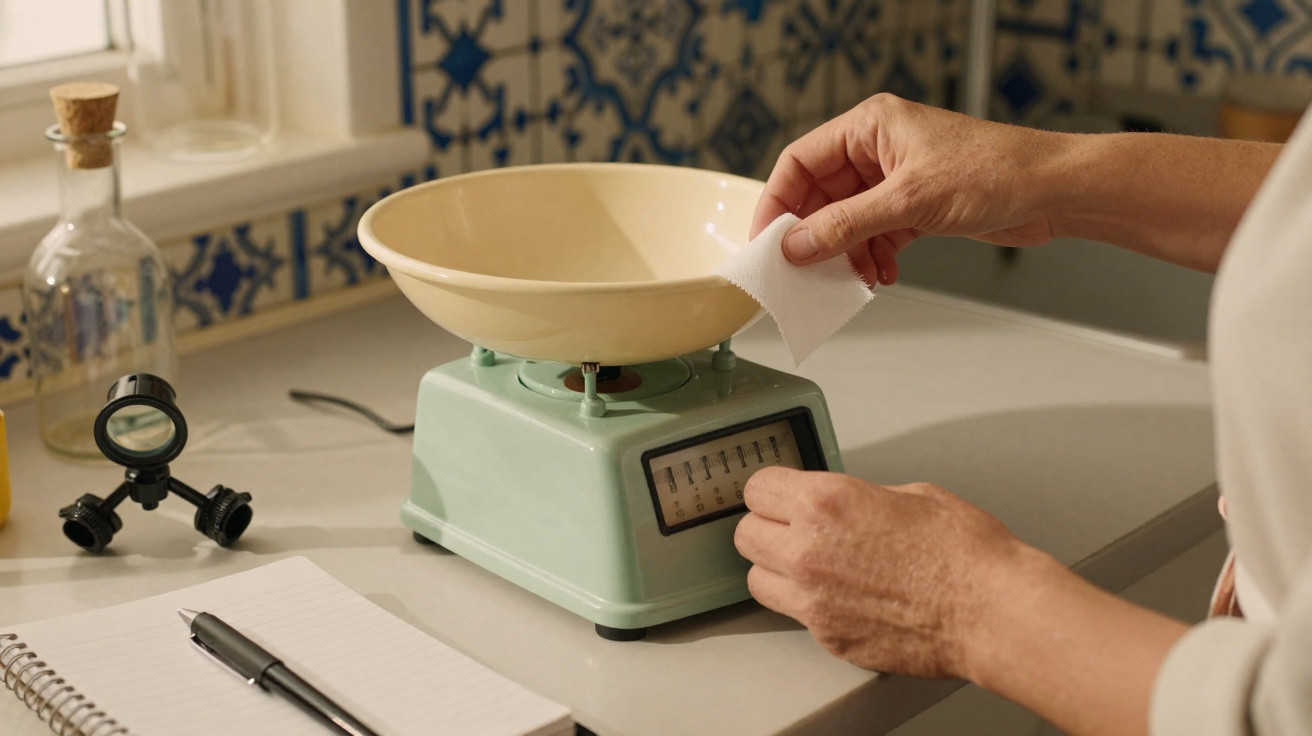
The old kitchen scale was meant for the tip.
Its yellowed plastic tray was cracked, its dial clouded by flour dust, and half its numbers had worn away. My friend lifted it up and laughed, “My grandmother used this for everything. Who would want this now?” He listed it on a second-hand app, almost as a joke, for the cost of a coffee. Two hours later, a message appeared on his phone: “Is this still available? I can pick it up today. I collect vintage scales.”
That was the moment it made sense.
In countless kitchens, objects tucked behind modern digital gadgets quietly hold the story of a different time.
Some of those objects, including chunky old kitchen scales, are now beginning to command real money.
Why that dusty kitchen scale is suddenly interesting
At flea markets, shoppers generally spot the gleaming items first: mirror-polished copper pans, immaculate enamel signs, and plates decorated with neat little flowers. Kitchen scales are usually pushed to one side, seeming almost apologetic, their needles crooked and their trays marked by too many sugar bags. Recently, though, observant visitors will notice some people making directly for them. They handle them with care, inspect the brand on the dial, and run their fingers over chipped paint as though deciphering a tale.
A Paris dealer told me of a woman who arrived at the Saint-Ouen flea market at dawn carrying a photograph on her phone. She wanted precisely the mechanical scale her mother had used every Sunday to make apple tart: a green metal body, a circular cream dial, and a logo sitting slightly off-centre. After the dealer eventually located one, he put it online at a higher-than-normal price “just to test”. Within 24 hours, it had sold to a German buyer for three times the price comparable scales achieved a few years earlier. Suddenly, nostalgia had a figure attached to it.
There is a straightforward reason for this modest surge in interest. Classic mechanical scales from the 50s to the 80s sit where three major trends meet: vintage kitchen décor, sustainable living and childhood memories. Digital scales can fail, malfunction and feel throwaway. Older versions seem sturdy, easy to understand and almost reassuring. They look excellent on Instagram kitchen worktops, are simple to post, and, unlike many collectables, remain affordable enough for someone to begin a collection “by accident” without taking out another mortgage. That’s exactly the kind of sweet spot that usually signals a future collector market.
What turns an ordinary scale into a collectible
If an old kitchen scale is sitting at home, the first step is uncomplicated: inspect it closely. Do not view it through the lens of “is this rubbish?”, but with the interest of someone looking for evidence. Examine the brand printed on the dial, the body material-metal, Bakelite or plastic-the tray shape and the colour. Turn it over to see whether there is a small stamp, code or country of origin. Such minor details can distinguish a €5 curiosity from a €150 “find” shared by serious collectors in private groups.
The kitchen scales that repeatedly arise in collector discussions generally have a few shared features. Particular European brands, including Terraillon, Soehnle and Salter, especially 60s and 70s models in vivid orange, avocado green or dark red, are attracting considerable interest. American chrome countertop models from the 50s, featuring atomic-style lettering and glass fronts, are also selling quickly. Then there are the unusual examples: pharmacy-style precision scales converted for kitchen use, or promotional versions produced for flour or sugar brands. As these were not made in vast quantities, collectors tend to act fast when one turns up.
Design plays a part, too. The analogue dials, their slender black needles and delicate calibration markings, belong to a period before digital displays made everything look flat. Rounded typefaces, carefully positioned logos and light catching the curved glass all recall mid-century clocks and car dashboards. People styling kitchens in a “modern farmhouse” or “retro industrial” look discreetly seek out these items because they ground the space. They suggest that this is somewhere people genuinely cook rather than merely warm up a takeaway. Honestly, hardly anyone buys a vintage scale solely to weigh flour every day. They choose one because it makes a kitchen feel authentic.
How to spot value and avoid costly mistakes
The first useful action is to test the scale. Working order still affects resale value, even when you mainly want it for decoration. Place an unopened packet of pasta, bag of sugar or another item with a stated weight on it, then check the dial reading. See whether the needle settles back at zero smoothly. Next, examine the full item for serious damage, including cracks in the casing, a missing tray or broken glass. Patina is acceptable; flakes of rust are not. Minor surface rust on screws is manageable, while deep structural rust in the base is a warning sign for both value and your worktop.
Many people unknowingly discard value by cleaning too aggressively. There is no need to make your grandmother’s scale appear brand new. Collectors normally favour careful cleaning: warm soapy water for the tray, a soft microfibre cloth for the dial and perhaps a little white vinegar on greasy marks. Strong chemicals may remove printed logos and wear away those fragile numbers. We have all experienced that moment when we realise we have scrubbed off the one feature somebody would have paid for. Take your time, appreciate the scratches, and stop once it looks cared for again rather than abandoned.
Some collectors even insist that a little flour dust in the corners is a sign of authenticity, not neglect.
- Check the brand and era – Search for the name plus “vintage kitchen scale” on resale sites for a quick, realistic guide to prices.
- Look for original parts – For serious buyers, a replacement tray or repainted body can halve the value.
- Photograph smartly – Daylight, an uncluttered backdrop and a close-up of the dial can greatly increase interest.
- Track repeating colours and styles – If the same orange or cream models repeatedly sell out, that is a trend worth following.
- Start a simple record – Write down where each scale came from, what you paid and either what it sold for or what it is worth to you.
From forgotten tool to small treasure on your counter
Once you begin spotting them, kitchen scales seem to be everywhere: in parents’ cupboards, at the back of charity shops and beneath piles of miscellaneous Tupperware at car boot sales. Before long, their shapes become recognisable from across a room: the heavy square base likely dating from the 50s, the plastic dome from the diet-focused 80s, or the broad glass plate that immediately suggests early-2000s minimalism. Each piece represents a separate chapter of domestic history, whether you sell it on or arrange it on a shelf as a quiet witness.
Some people will resell them rapidly, turning modest margins into additional income. Others will retain only one, perhaps one that recalls childhood weekend baking. Then there are those who eventually discover they have become collectors without meaning to, carefully dusting and rearranging their kitchen scale “family” every spring. The boundary between clutter and treasure is narrow and always shifting. The real question is not whether an old scale has an official online price. It is what story, and what future, you are prepared to give that slightly crooked needle.
| Key point | Detail | Value for the reader |
|---|---|---|
| Recognisable brands and eras matter | Brands such as Terraillon, Soehnle and Salter, along with 50s–80s models, attract collector interest | Lets you quickly separate potential treasures from ordinary clutter |
| Condition beats shine | Original parts and gentle patina are favoured over heavy-handed restoration | Prevents cleaning errors that quietly wipe out resale value |
| Everyday checks can reveal value | Straightforward tests, online searches and strong photographs are enough to begin | Makes it simple to turn a forgotten tool into décor, a keepsake or extra cash |
FAQ:
- Question 1: Are all old kitchen scales collectable, or are only certain types sought after?
- Question 2: What is the quickest way to estimate the value of a scale found in my loft?
- Question 3: Should a scale be fully restored before it is sold?
- Question 4: Which places offer the best chance of finding inexpensive vintage kitchen scales?
- Question 5: Can a scale that no longer works still appeal to collectors or decorators?















Comments
No comments yet. Be the first to comment!
Leave a Comment