
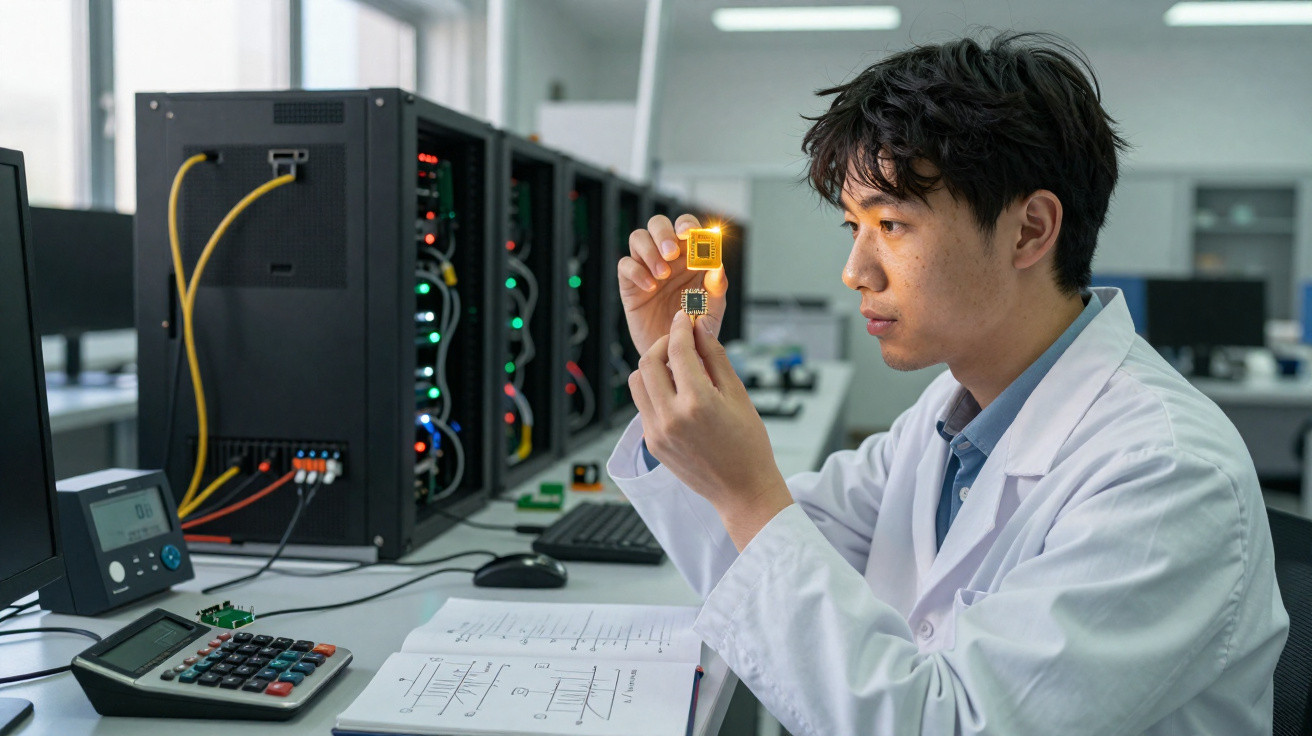
While everyone is talking about billion-pound GPUs and enormous cloud platforms, a group of Chinese researchers has chosen to look backwards in order to move forwards.
Rather than simply boosting familiar digital chips, they have revived a concept largely forgotten since the pre-microprocessor era and placed it at the core of a new generation of artificial intelligence.
An old idea returns to the centre of the AI race
Researchers at Peking University have unveiled an analogue AI chip that can perform calculations 12 times faster than advanced digital processors while consuming 200 times less energy. The work was published in the scientific journal Nature Communications and has already begun attracting the technology industry's attention.
“A single generation of chips will not solve AI’s energy problem. Bringing analogue computing back is, in practice, a game changer.”
The real surprise lies not only in the figures, but also in the reasoning behind the innovation. Instead of following the conventional route of bits, zeroes and ones, the Chinese team returned to analogue computing, a method that predates the personal computer.
What exactly is an analogue AI chip?
Before digital technology became dominant, engineers used analogue computers to tackle physical problems, including modelling rocket trajectories and temperature changes in reactors. Rather than relying on discrete numbers, these machines worked with continuous quantities such as electrical voltage and current.
The new Chinese chip follows the same principle, but enhances it with modern materials and highly precise circuits. Instead of merely using software to imitate the brain, the hardware itself behaves like a physical system that “solves” equations almost naturally.
- Digital chips: split every operation into a sequence of steps, carried out one line at a time.
- Analogue chips: allow physics itself to complete multiple calculations simultaneously, in parallel.
For decades, this approach was regarded as impractical. Electrical noise, limited precision and programming difficulties kept major companies away. However, combining AI with analogue circuits changes the equation. Most machine-learning models can accommodate small inaccuracies, provided the overall result remains reliable and fast.
Energy: AI’s Achilles’ heel
The recent growth of generative AI depends on GPUs such as the Nvidia H100, which are designed to carry out billions of operations each second. Yet that raw computing power comes at a cost: extremely high electricity use and heat that is difficult to disperse.
Much of this expenditure comes not from the calculation itself, but from data travelling between memory and the processing unit. Each time an AI model accesses weights, parameters and examples, bits move back and forth within a chip and between multiple chips.
The Chinese analogue chip directly addresses this weak point. It uses what is known as “in-memory computing”: calculations take place in the same location where the data is stored. Less information movement means less energy loss and less heat.
“Calculating where the data is stored may sound like a technical detail, but it becomes a saving on the scale of a power station.”
How China is reviving a mathematical technique from the 1990s
At the centre of the analogue chip is a technique called Non-negative Matrix Factorisation (NMF). The name may sound intimidating, but the underlying concept is straightforward: it breaks down a large data table into smaller components that expose hidden patterns.
NMF is widely used in:
- recommendation systems for films, music and products;
- image compression and reconstruction;
- analysis of user behaviour;
- separation of audio signals, such as speech and noise.
On digital hardware, this technique requires numerous iterations and millions of multiplications involving enormous matrices. The cost rises dramatically when data volumes reach the scale of Netflix or major social networks.
Peking University’s engineers took a bold approach: rather than running NMF as software, they turned the method into a physical phenomenon. The chip’s circuit is designed so that, once it receives inputs, its own electrical behaviour performs the factorisation in a single step, where a conventional processor would need thousands.
Tests with real data, not just elegant equations
To avoid the familiar criticism that it “only works in the laboratory”, the team led by Sun Zhong applied the chip to practical problems. In recommendation systems, simulating workloads similar to those used by platforms such as Netflix or Yahoo, the analogue chip produced results of comparable quality, but far more quickly and with almost no energy use.
In image processing, tests showed that the chip could compress and then reconstruct photographs with visual quality very close to that achieved by high-precision digital methods, while halving storage requirements.
| Chip type | Speed | Energy consumption |
|---|---|---|
| Advanced digital processor | Comparison baseline | 100% |
| Peking University analogue chip | ≈ 12x faster | ≈ 0.5% (200x less) |
One reviewer of the scientific paper even referred to “several orders of magnitude” in gains in speed and efficiency, an unusual remark in cautious academic reviews.
Why this affects technology geopolitics
China had already been investing heavily in supercomputers, long-distance networks and AI chips. Its bet on analogue computing adds a strategic layer to this race.
If the technology can scale, entire data centres could be redesigned, reducing both energy spending and dependence on Western GPUs. Internal reports cited by the Asian press suggest that, for certain highly specific tasks, the chip could deliver up to one thousand times the performance of some GPUs when speed and energy use are considered together.
“Revisiting ideas from the 1970s with 2026 technology is both a sign of pragmatism and an act of geopolitical ambition.”
Limitations, risks and likely applications
Analogue computing will not replace every use of digital computing. It is particularly effective for repetitive, structured mathematical operations, such as matrix multiplications, which are central to modern AI.
Experts have highlighted several points requiring attention:
- Precision: analogue systems are affected by noise. Medical or financial applications may therefore require digital correction layers.
- Programming: developing for analogue hardware requires new tools and languages, creating a learning curve.
- Industrial scalability: turning a laboratory prototype into mass production is a challenge in its own right.
- Standardisation: there is no established software and library “ecosystem” designed for this type of chip.
On the other hand, the opportunities are clear in areas including:
- real-time recommendations with low energy costs;
- edge devices, such as intelligent cameras, industrial sensors and robots;
- data centres with demanding carbon-reduction targets;
- local processing in countries with limited electricity infrastructure.
Terms worth translating into everyday language
Two technical expressions appear repeatedly in this debate.
What is “in-memory computing”?
In most computers, memory and the processor are separate. With every operation, data is copied from memory to the computing core and then sent back again. “In-memory” computing effectively merges these functions: the place that stores the information also processes it.
Think of a factory. In the traditional model, raw materials are moved repeatedly from one warehouse to another. With in-memory computing, the factory is reorganised so that almost everything happens in the same warehouse. There is less transport, less waste and less delay.
Why NMF suits recommendation AI
In a streaming service, every user and every film can be represented as rows and columns in an enormous matrix. NMF breaks this matrix into factors that “explain” hidden preferences: a taste for action, romantic comedies or documentaries, for example.
By carrying out the factorisation directly in hardware, the analogue chip turns vast quantities of clicks and views into patterns that other algorithms can use, delivering a dramatic increase in speed.
Possible scenarios for the coming years
If the technology matures, a hybrid architecture is likely to emerge. Analogue chips would handle the intensive work of matrix multiplication and numerical decomposition, while digital processors would manage the flow, make fine adjustments and deal with more logical tasks.
In a plausible scenario, major cloud companies could offer dedicated “analogue nodes”, just as they currently rent GPUs and TPUs. AI start-ups would then choose between training models on conventional digital clusters or on infrastructure combining analogue and digital systems, depending on the application type and local energy costs.
Regulatory and environmental questions also arise. Emissions-reduction targets may push governments and businesses to prioritise architectures that consume less electricity. In that context, the “revival” of analogue technology stops being a historical curiosity and becomes a tangible element of industrial policy.






Comments
No comments yet. Be the first to comment!
Leave a Comment