
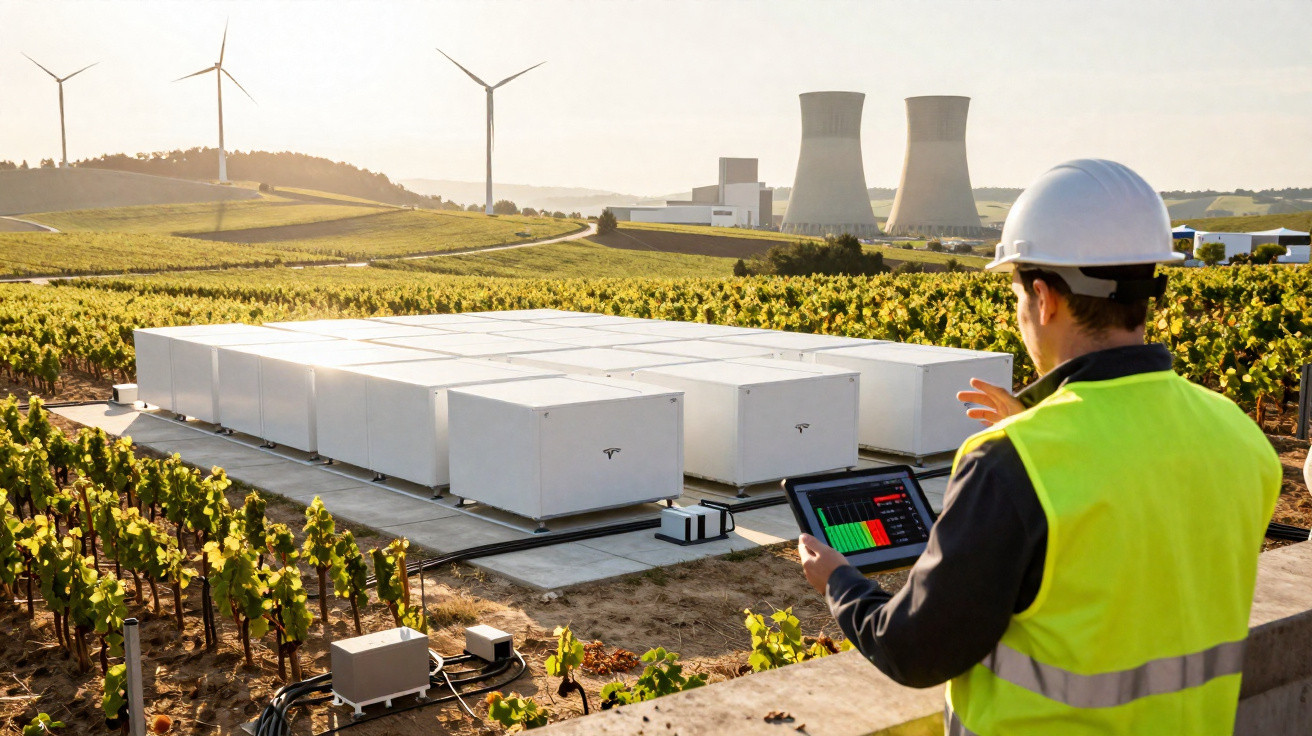
At first sight, the development resembles an industrial estate: lines of white containers standing in a field outside the Champagne capital. Behind fencing near Cernay-lès-Reims, however, Tesla equipment and a rapidly expanding energy company are preparing to test the extent to which utility-scale batteries can transform the operation of a national electricity grid.
A giant battery arrives in Champagne country
TagEnergy, a renewable energy developer operating throughout Europe, has purchased 140 Tesla Megapacks for France’s largest grid-scale battery so far. Due to begin operating in early 2026, the facility will provide 240 megawatts (MW) of power and 480 megawatt-hours (MWh) of storage.
Put simply, the installation will be able to supply 240 MW of electricity continuously for around two hours. TagEnergy estimates that, during brief demand peaks, this would be sufficient to meet roughly 20% of the power demand of the Marne department, which has a population of more than half a million.
This single site will act as a shock absorber for the French grid, stepping in during sudden peaks and dips in supply.
Its location beside major transmission lines is an essential factor. Batteries benefit the grid only when they can absorb or supply electricity extremely quickly at the points where it is needed. Connected to high-voltage infrastructure near Reims, the Megapack site will be able to react within seconds to instructions from France’s grid operator.
Why France is turning to batteries now
France depends extensively on nuclear energy. While it delivers low-carbon electricity, it offers less flexibility than gas-fired power stations. Meanwhile, additional wind and solar capacity is being brought online, particularly in northern and western France. Together, these trends are increasing the need for technology that can match electricity supply and demand from one minute to the next.
Grid-scale batteries such as this facility can provide three principal functions:
- Frequency control: maintaining the grid at close to 50 Hz by immediately supplying or taking in power.
- Peak shaving: releasing electricity during evening demand surges, reducing the need to start fossil-fuel power stations.
- Renewable smoothing: storing surplus wind and solar generation when output is strong, then supplying it when clouds arrive or winds weaken.
For French policymakers, this contributes to two strategic objectives: lowering greenhouse gas emissions and cutting dependence on imported fossil fuels, particularly gas. Batteries do not produce electricity, but they allow low-carbon power to be used more effectively instead of being wasted or supported by coal- and gas-fired generation.
Tesla’s quiet second act: energy, not just cars
Tesla built its reputation through electric vehicles, but energy storage has become one of its most rapidly expanding operations. The Megapack, a utility-scale battery unit roughly the size of a shipping container, is central to that approach.
Tesla’s specialist Megafactory is capable of assembling about 40 GWh of storage annually, a scale that was simply unavailable in the market only a few years ago. A second Megapack plant in Shanghai, expected to begin production shortly, indicates that Tesla anticipates continued sharp growth in worldwide demand for large batteries.
Tesla’s hardware gives TagEnergy access to a proven industrial product, while Tesla gains a flagship site in a key European power market.
Although this is not Tesla’s first grid battery project, it carries considerable symbolic weight. France is the EU’s second-largest economy and is often viewed as a model for electricity systems with a large nuclear component. Should major batteries be integrated successfully into this type of grid, the argument for comparable projects will strengthen in countries seeking to combine dependable baseload generation with variable renewables.
How the Tesla Megapack project will operate
From the outside, each Megapack looks like an enlarged shipping container. Within it are thousands of lithium-ion cells, power electronics, fire-protection equipment and control technology. TagEnergy’s facility near Reims will bring together 140 units as one coordinated asset linked to the high-voltage grid.
| Project element | Details |
|---|---|
| Location | Cernay-lès-Reims, Marne, north-eastern France |
| Technology | Tesla Megapack lithium-ion battery system |
| Installed power | 240 MW |
| Storage capacity | 480 MWh |
| Number of units | 140 Megapacks |
| Commissioning target | Early 2026 |
The facility will charge when electricity is plentiful or inexpensive, commonly in sunny or windy periods. It will then discharge when prices rise sharply or when the grid operator requests stability services.
This commercial model depends on fluctuations in electricity prices. The wider the gap between low-price and high-price periods, the greater the potential revenue available to batteries. France’s increasing proportion of intermittent renewable generation, alongside nuclear reactors being taken offline for maintenance or unexpected faults, generally makes such price swings more pronounced.
What it means for French consumers and the grid
Marne residents will not find a separate “Tesla battery” charge on their energy bills. Instead, the effects are likely to be indirect: fewer emergency electricity imports from neighbouring nations during pressured periods, marginally smaller wholesale price spikes and stronger resilience if generating plants fail suddenly.
Big batteries will not eliminate price shocks or blackouts on their own, yet they can make both less frequent and less severe.
For RTE, France’s grid operator, the development introduces a resource that can be controlled with exceptional precision. Batteries can move from zero output to maximum power in seconds, whereas conventional power stations may require minutes or even hours. This rapid response makes large battery facilities especially valuable for keeping frequency stable after unforeseen disruptions, including a large industrial consumer unexpectedly disconnecting or a major power plant going offline.
Environmental gains – and the caveats
The scheme is intended to lower indirect emissions from the French electricity system by reducing the use of fossil-fuel backup generation. A gas-fired plant operating for only a few hours each year has both a high carbon footprint per unit of useful service and costly operations. Batteries can serve that role by releasing stored low-carbon electricity rather than burning fuel whenever demand arises.
However, lithium-ion battery systems bring environmental considerations of their own, including mineral extraction, manufacturing emissions and end-of-life processing. TagEnergy and Tesla will require reliable recycling routes to recover materials including lithium, nickel and cobalt once the project reaches the end of its 15–20 year operating life.
Local authorities are also focused on noise, visual impact and fire safety. Modern Megapack projects incorporate several levels of fire detection and suppression, physical spacing between individual units and remote monitoring. Even so, residents understandably scrutinise any major energy infrastructure proposed for their local area.
A glimpse of France’s future energy mix
The Reims development forms part of a wider strategy. TagEnergy has indicated that it plans to speed up solar deployment and storage development in France from 2025 onwards. The rationale is simple: as more solar and wind farms are built, batteries become more valuable because they determine when that electricity reaches the grid.
This represents a change in policy discussions. For many years, energy debates concentrated almost entirely on generation: nuclear against renewables, or gas against coal. Storage was frequently treated as secondary. Large battery sites demonstrate that flexibility can itself be considered infrastructure, in the same way as substations and power lines.
Key terms: MW, MWh and why they matter
Projects of this scale can seem abstract, so the distinction is worth setting out:
- Megawatt (MW) measures power – the amount of electricity a battery can provide at any particular moment.
- Megawatt-hour (MWh) measures energy – the amount it can supply over a period before it is depleted.
The Reims battery is rated at 240 MW and 480 MWh. In practical terms, it could power 240,000 homes each using 1 kW for approximately two hours. Alternatively, it could provide half that power for around four hours. Grid operators will determine how to deploy this flexibility according to market signals and system requirements.
Scenarios: how the Tesla battery might be used on a tough winter day
Imagine a cold January evening with no wind, a situation that regularly places the French electricity grid under strain:
- Midday: Nuclear stations continue producing steadily while solar output reaches its peak. Prices decline, and the battery charges to full capacity.
- Early evening: People arrive home and switch on heating and cookers. Demand rises sharply. The battery begins discharging at high output, limiting the need to start additional gas turbines.
- Sudden plant failure: A nuclear reactor unexpectedly trips offline. Grid frequency becomes unstable. The battery instantly increases output to stabilise the system as other plants respond.
During nights of this kind, the financial and climate advantages combine: fewer emergency imports, lower gas consumption and greater value extracted from every unit of low-carbon electricity generated earlier that day.
If schemes such as the facility near Reims fulfil their potential, France’s energy discussion could gradually move beyond a simple “nuclear versus renewables” divide to a more nuanced issue: how to coordinate a complex set of low-carbon energy sources, with storage and flexibility at its core. The Tesla Megapacks outside Reims are expected to provide an early and closely monitored test of that new equilibrium.






Comments
No comments yet. Be the first to comment!
Leave a Comment