
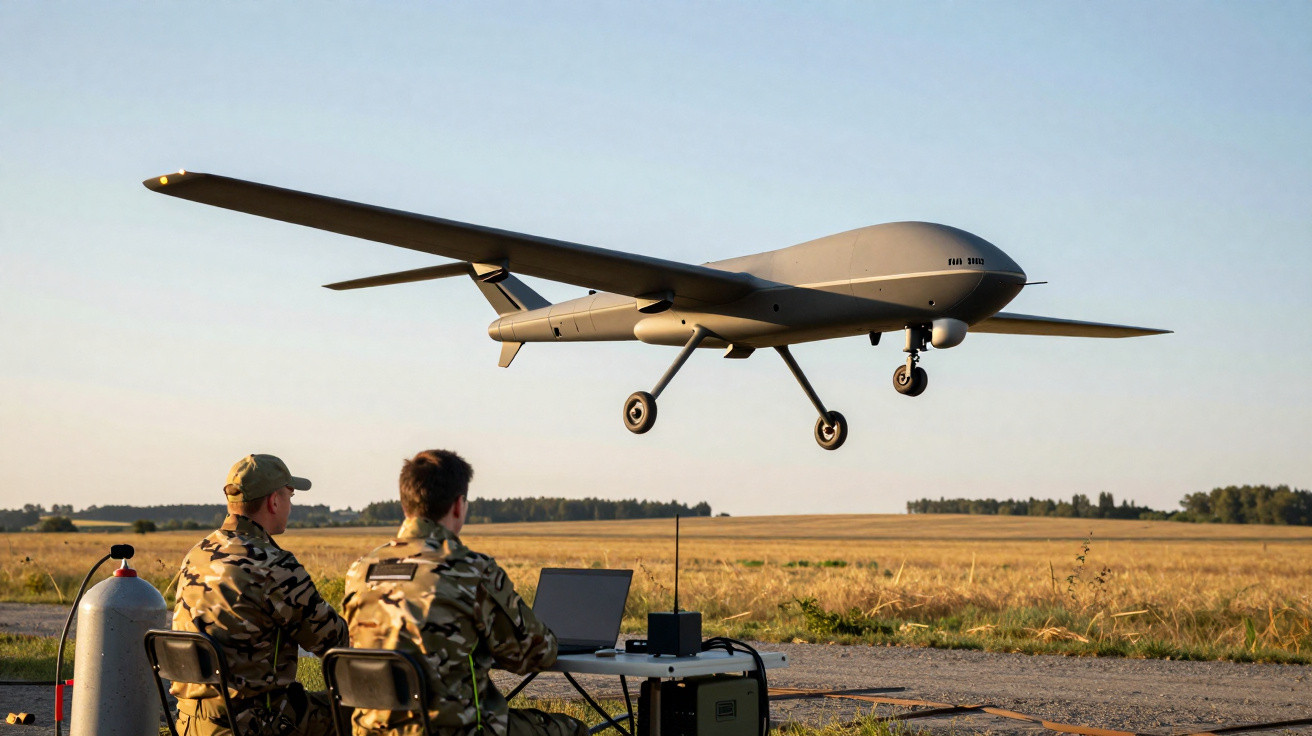
Ukraine has started deploying a hydrogen-hybrid military drone in active combat, a development that could alter unmanned aviation and concern defence planners from Moscow to Washington.
A silent battlefield breakthrough
Officials in Kyiv say they have achieved a global first: a hydrogen-powered hybrid drone derived from the Ukrainian-built Raybird platform by manufacturer Skyeton has flown above active combat areas. This is not an experimental model confined to a test site. It is already being used where air-defence systems are active and the danger of being brought down is genuine.
Hydrogen-powered drones have existed in concepts and laboratories for almost two decades. Their use has largely been limited to research programmes, technology demonstrations and small-scale civilian trials, including environmental observation and pipeline inspections. Before now, they had not become a routine asset in high-intensity warfare.
Ukraine’s Raybird variant appears to be the first hydrogen-propelled unmanned aircraft confirmed to operate in a large-scale, ongoing conflict.
By contrast, the American-Israeli Heaven Aerotech Z1, among the most prominent hydrogen drone projects, remained a prototype or demonstrator. It did not progress to regular deployments in a war zone.
Hydrogen propulsion and its tactical advantages
Most military drones still use either petrol engines or lithium-ion batteries. Ukraine’s latest Raybird version instead relies on hydrogen-fed fuel cells to supply an electric motor. This approach offers a combination of tactical advantages that conventional systems struggle to match.
- Reduced heat signature: Fuel-cell systems produce less surplus heat than combustion engines, making them less visible to infrared sensors.
- Quieter operation: Electric propulsion is generally less noisy than piston engines, particularly while cruising.
- Longer endurance: Hydrogen offers high energy density by weight, enabling longer flights than many battery-only configurations.
On a front crowded with radar, acoustic sensors and thermal cameras, these attributes may determine whether a drone completes its task or is intercepted by surface-to-air missiles or electronic warfare.
Lower noise and heat make these drones harder to track, buy them more time in contested airspace and complicate enemy targeting.
Combat-relevant performance figures
Skyeton states that the current hydrogen-hybrid Raybird configuration has technical specifications suited to long-range intelligence, surveillance and reconnaissance (ISR) missions:
- Maximum take-off weight: 23 kg
- Wingspan: 4.7 m
- Maximum payload: 10 kg
- Cruise speed: around 110 km/h
- Endurance: up to 12 hours
- Operational ceiling: roughly 5,500 m
These figures put the Raybird in the light tactical UAV class, although its time aloft is more comparable with that of larger and costlier platforms. An endurance of 12 hours enables the drone to remain above an area throughout an entire night, follow troop and vehicle movements, and transmit coordinates to artillery units or loitering munitions.
Inside the Raybird engineering change
The conversion to hydrogen involved more than replacing an engine. Skyeton redesigned the Raybird airframe to accommodate a larger hydrogen tank while retaining the aircraft’s balance and stability.
For an equivalent amount of energy, hydrogen storage requires more space than conventional jet fuel or petrol. Engineers therefore altered the fuselage arrangement, relocated structural features and redistributed internal equipment. Their objective was to keep the centre of gravity within tight parameters, ensuring that the drone remains controllable during every phase of flight.
| Component | Traditional Raybird | Hydrogen-hybrid Raybird |
|---|---|---|
| Propulsion | Combustion engine or battery-electric | Hydrogen fuel cell + electric motor |
| Energy storage | Liquid fuel tank or batteries | Hydrogen tank and fuel cell stack |
| Mission focus | Short to medium ISR missions | Long-endurance ISR in contested airspace |
Skyeton describes the system as hybrid because electricity generated from hydrogen powers an electric propulsion system, rather than hydrogen mechanically driving an engine directly. This lets the company retain the benefits of electric motors-low maintenance, fewer moving components and more predictable reliability-while extending endurance far beyond what batteries alone can provide.
Built for serial production, not merely demonstration
One of Skyeton’s more important assertions is that this Raybird variant is already suitable for serial production. Ukraine’s armed forces require quantity as well as prototypes, so the engineers considered logistics alongside aerodynamic performance.
The drone can be refuelled with replaceable hydrogen cartridges or generators that produce hydrogen at the site. Although this still requires a specialist supply chain, it lessens reliance on vulnerable fuel infrastructure near the front line.
The emphasis on scalable manufacturing signals that hydrogen-powered drones may shift from exotic one-offs to standard items on wartime procurement lists.
Strategic messages for allies and rivals
The deployment communicates more than technical capability. For Kyiv, it demonstrates an ability to innovate under pressure and adapt its drone fleet more rapidly than many larger armed forces. For Western allies, it provides a proving ground for emerging defence technology, with genuine battlefield feedback.
For Russia and other countries investing heavily in anti-drone defences, the development makes planning more difficult. Missiles and sensors configured to detect the heat and sound of small combustion engines must now contend with targets that are cooler and quieter, and therefore more difficult to acquire.
Skyeton chief executive Roman Knyazenko has described the aircraft as a “new platform” rather than a minor enhancement, emphasising that the hydrogen-powered model retains a similar weight to existing versions while fundamentally changing its energy system. This is important to operators, who can incorporate the drone into established launch and recovery processes without having to redesign every supporting vehicle or installation.
What hydrogen drones may mean for future wars
Should Ukraine’s experiment prove dependable over months of fighting, it could speed up a shift away from petrol engines in light and medium UAVs. Armed forces seeking increased endurance without increasing acoustic and thermal signatures are likely to examine fuel-cell technology closely.
Hydrogen drones could be used for:
- Persistent surveillance of front lines and logistics corridors
- Maritime patrols over coastal waters without frequent returns to base
- Border-monitoring missions in remote places with restricted fuel access
- Communications-relay operations when satellites are jammed or unavailable
However, hydrogen is not an uncomplicated answer. Its storage, compression and safe use in field conditions present demanding engineering and training challenges. Ground crews must handle high-pressure tanks, while any leak can form a flammable cloud in enclosed areas.
Hydrogen extends range and reduces signatures, but forces militaries to rethink how they handle fuel, logistics and safety at the tactical level.
Key terms and operational implications
Two concepts are central to this development: fuel cell and ISR. A fuel cell converts chemical energy from a fuel-hydrogen in this case-straight into electricity, producing water and heat as by-products. Unlike a battery, it continues generating electricity for as long as it receives fuel. ISR means intelligence, surveillance and reconnaissance: in effect, missions that provide commanders with the information needed to decide where troops should move and where strikes should be directed.
In operational terms, a hydrogen-enabled ISR drone could allow commanders to keep one aircraft observing a target zone for half a day rather than cycling through several shorter-range drones. Fewer launches and recoveries reduce accident risk and make operations less predictable for an adversary, which can no longer wait for a regular replacement pattern before moving its forces.
There may also be cumulative benefits when these drones fly alongside traditional systems. A mixed fleet could see battery-powered drones conducting rapid, close-range tasks while hydrogen-hybrid aircraft remain further away, relaying targeting information and serving as communications links. Such layering can strengthen the sensing and communications network above the battlefield, even amid intense jamming or shelling.
As the conflict in Ukraine continues, every incremental advance in unmanned systems affects both ground tactics and the aerial arms race. Hydrogen-powered drones are the latest development, and their true test has only just started.





Comments
No comments yet. Be the first to comment!
Leave a Comment