
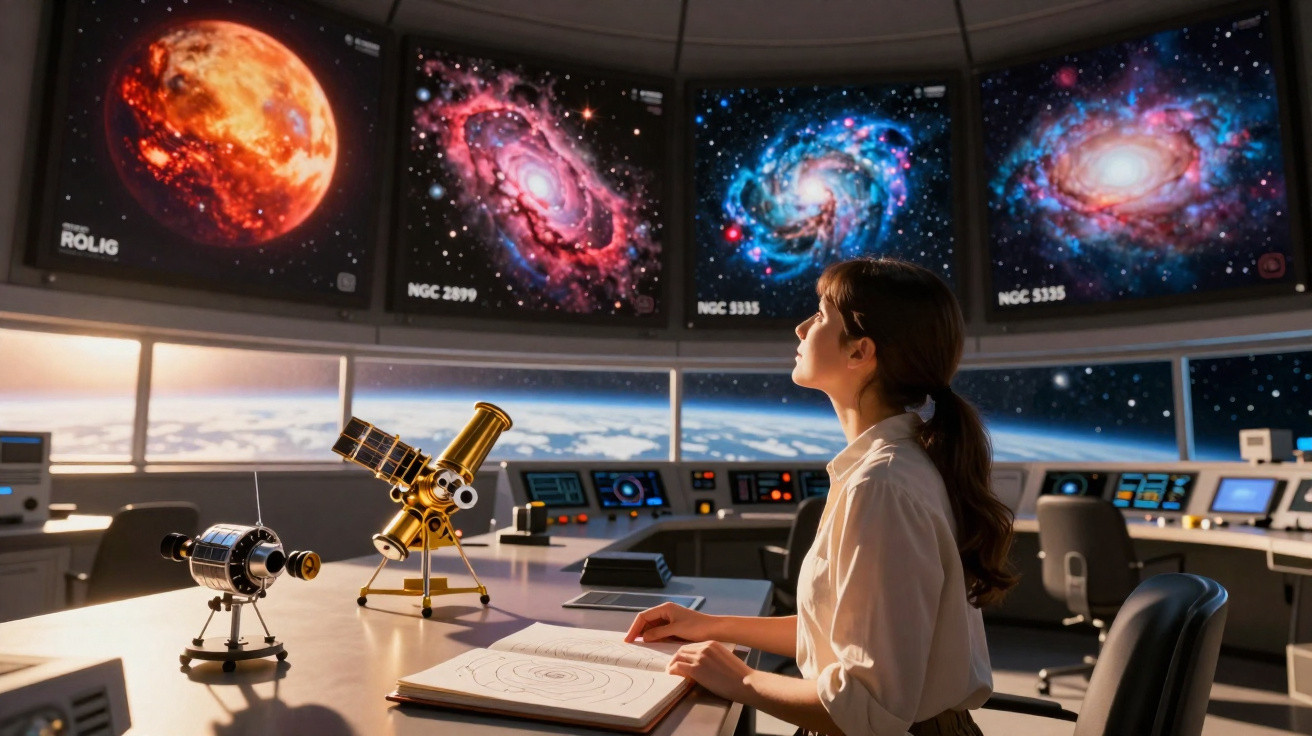
This week marks the Hubble Space Telescope’s 35th birthday - and, rather than receiving gifts, the Hubble team is handing them out: four fresh views of the universe, from a close look at Mars to a sparkling image of a distant galaxy.
The release continues a long-running tradition. For decades, NASA and the Space Telescope Science Institute have published anniversary images to commemorate Hubble’s launch into Earth orbit aboard the space shuttle Discovery on 24 April 1990.
"Hubble opened a new window to the universe when it launched 35 years ago," Shawn Domagal-Goldman, acting director of the Astrophysics Division at NASA Headquarters, said today in an image advisory marking the occasion.
"The fact that it is still operating today is a testament to the value of our flagship observatories, and provides critical lessons for the Habitable Worlds Observatory, which we plan to be serviceable in the spirit of Hubble."
The Hubble Space Telescope at 35: from early setbacks to landmark science
Hubble’s early days were far from trouble-free. After the 24,000-pound (about 10,900 kg) observatory was deployed, researchers found that its mirror - nearly 8 feet (about 2.4 metres) across - had been built with a flaw. In 1993, during the first of five servicing missions, astronauts fitted equipment that dramatically improved the clarity of Hubble’s images.
In the decades since, Hubble’s data have transformed astronomy. Its observations have underpinned major findings involving exoplanets, black holes, the nature of the early universe, the existence of dark energy, and the universe’s accelerating expansion.
According to NASA, Hubble has now carried out nearly 1.7 million observations, targeting roughly 55,000 astronomical objects and producing more than 22,000 research papers.
That scientific legacy - along with the steady stream of striking photographs - has made Hubble a public favourite.
Following the loss of the shuttle Columbia and its crew in 2003, NASA paused plans for repairs that the telescope urgently needed. However, an intense public reaction to the prospect of losing Hubble ultimately led the agency to approve a final servicing mission, which took place in 2009.
At the time, NASA anticipated that the telescope would keep delivering spectacular views for another five to 10 years. Once again, Hubble outperformed expectations, chalking up 16 more years of operations without any on-orbit repairs.
Four anniversary images: Mars, Rosette Nebula, NGC 2899 and NGC 5335
The new images released today highlight just how wide Hubble’s reach remains.
Mars was imaged between 28 and 30 December, close to the period when Mars came closest to Earth along its orbit. The set shows the planet’s bright orange Tharsis plateau and its dormant volcanoes, the north polar ice cap, and thin water-ice clouds.
Another Hubble picture from last December zooms in on a small section of the Rosette Nebula, an enormous star-forming region around 5,200 light-years from Earth.
Across the scene, dark gas clouds threaded with dust stand out in silhouette.
To place that close-up in context, the Hubble team also released a wider-view image of the nebula.
In January, Hubble captured the planetary nebula NGC 2899, appearing to flutter like a cosmic moth some 4,500 light-years away.
Those colourful swirls of gas and dust have been sculpted by radiation and stellar winds streaming from the star at the centre of the image.
Hubble also produced a new view of the spiral galaxy NGC 5335 in March.
The photograph shows a bar-like feature cutting across the galaxy, funnelling gas inwards towards the core and feeding the formation of new stars.
Around the galaxy’s outskirts, uneven streamers of star formation curl and sweep.
Shifting focus: James Webb Space Telescope and the Habitable Worlds Observatory
In recent years, Hubble has suffered intermittent hiccups, and it is only a matter of time before a fault takes it out of service for good.
At the same time, attention has increasingly moved to NASA’s James Webb Space Telescope (JWST). Launched in 2021, it has seven times Hubble’s light-gathering power.
JWST differs from Hubble in key ways. It studies the cosmos mainly in infrared light, rather than spanning the broad range from infrared through to ultraviolet that Hubble can observe. And because JWST sits at a gravitational balance point a million miles (about 1.6 million km) from Earth, it cannot be serviced in space in the way Hubble was.
By contrast, the planned Habitable Worlds Observatory would examine the universe in visible and ultraviolet light, delivering images expected to be markedly sharper than Hubble’s.
One of the mission’s central aims would be to find potentially habitable, Earth-like planets orbiting distant stars. The HWO is also being designed with robotic servicing in mind.
NASA’s current plans envisage launching the Habitable Worlds Observatory as early as the 2040s.
This article was originally published by Universe Today. Read the original article.


Comments
No comments yet. Be the first to comment!
Leave a Comment