
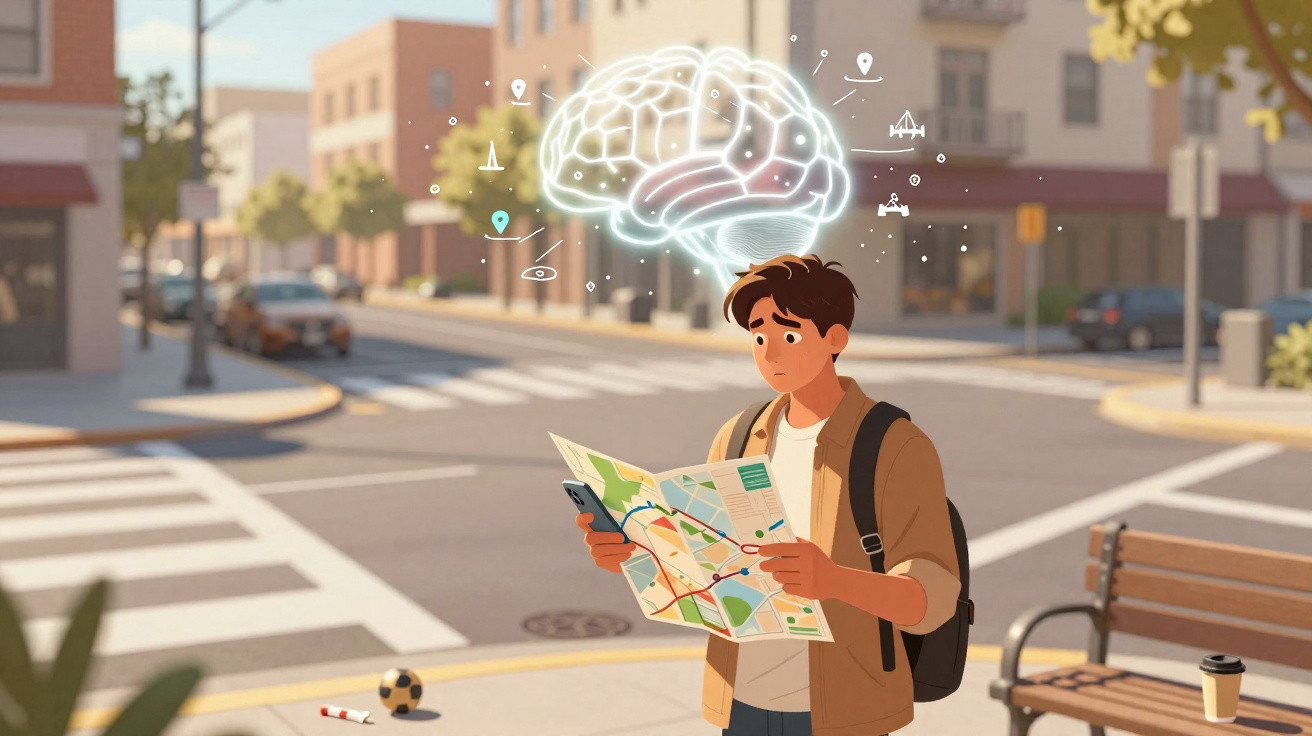
A fresh study reports that cortisol can interfere with the brain’s internal navigation system, weakening the neural patterns that support spatial orientation.
As those signals deteriorate, people become worse at keeping track of where they are, even in straightforward settings-showing how stress can undermine everyday navigation.
Testing navigation skills
In a virtual meadow, participants travelled towards targets and then tried to head straight back to a concealed starting point, relying only on their own sense of direction.
By combining performance measures with brain activity, Dr. Osman Akan at Ruhr University Bochum (RUB) showed that cortisol reduced navigational precision while disturbing the brain’s spatial signalling.
Mistakes rose in every condition, including paths that contained landmarks, indicating the impairment was not driven by how complex the surroundings were.
Because the effect was so consistent, the results pointed to a basic breakdown in the brain’s internal mapping-prompting a closer look at what happens when external cues are missing.
Navigation without cues
When the trees disappeared and there was no map-like structure to rely on, participants had to use path integration, estimating position by monitoring their own turns and distance travelled.
This relies on continual updating, as the brain calculates location from self-motion information rather than from features in the environment.
On longer journeys, small inaccuracies can accumulate rapidly, which helps explain why sparse landscapes reveal problems that cluttered spaces can mask.
Once the internal position estimate drifts, each subsequent turn is computed from the wrong starting point, allowing minor slips to compound into major errors.
Fixed points help navigation
Introducing a lighthouse altered the task by providing a single stable reference in an otherwise featureless scene.
With that cue available, participants could limit drift by comparing their route against a consistent point.
Although cortisol still harmed accuracy, it did not lead volunteers to depend more on the landmark during the return phase.
That pattern implied the hormone was not merely pushing a different strategy, directing attention instead to deeper neural disruption.
Brain signals blur
Brain imaging highlighted the entorhinal cortex-a memory-related area near the hippocampus-where navigation signals are typically organised with clear structure.
In this region, grid cells-neurones that represent position through repeating spatial patterns-looked far less distinct after cortisol exposure.
The reduction was most pronounced on the first testing day and during landmark-free trials, when internal guidance had to do most of the work.
As the pattern lost definition, the brain had poorer coordinates for converting movement into a dependable sense of place.
The backup route
Cortisol also increased activation in the caudate nucleus, a deep brain region linked to habits and cue-driven decisions, when the lighthouse was available-suggesting greater use of an alternative navigation system.
This structure, which supports choices guided by cues, can be useful when people follow landmarks rather than rely on internal estimates.
“This indicates that the brain is trying to compensate for the loss of the main navigation system in the entorhinal cortex through alternative strategies,” said Dr. Akan.
Even so, this compensation was limited, because performance still declined despite the presence of a stable landmark for the stressed brain to use.
Cortisol disrupts circuits
Cortisol may affect this pathway especially strongly because the entorhinal cortex contains many glucocorticoid receptors-proteins that respond to stress hormones.
When these receptors are highly activated, the local balance between excitation and inhibition can shift, changing the quality of the signal.
The authors suggest that the comparatively high dose could be why navigation worsened throughout the task rather than only in the most demanding trials.
This connects a brief laboratory intervention to everyday situations in which stress comes on abruptly and a person’s sense of direction falters.
Stress and dementia
Attention to this region extends beyond simply getting lost, because Alzheimer’s disease often affects the entorhinal cortex early in its course.
Such early damage can impair path integration before many standard memory tests show deficits, particularly for tasks that depend on self-motion.
“Because chronic stress is a risk factor for dementia, our study reveals a critical mechanism for how stress hormones destabilize this sensitive region,” Akan said.
Even so, a stressful week does not cause dementia, although population studies associate stress with a higher risk of dementia.
Caveats in the data
Key limitations remain, beginning with the sample: the scanning sessions involved healthy young men, so the findings cannot be assumed to apply to all groups.
Because each participant completed both conditions, the design improved precision but also introduced potential confounding from the order of testing.
The grid signal was also strongest on day one, meaning later sessions had to be interpreted with more caution.
These constraints leave unanswered how chronic stress, repeated exposure, or sex-related hormonal differences might alter the results.
What comes next
The new article aligns with earlier work from the same team indicating that chronic stress is associated with poorer path integration.
This time, the scans contribute a plausible mechanism by linking reduced performance to a disrupted navigation code within entorhinal tissue.
Further studies can examine whether longer exposure produces lasting effects, or whether training and environmental landmarks can reduce the hormone’s impact.
Clinicians are interested in this relationship because navigation difficulties often appear first in situations where people cannot depend on signage.
Where this leads
In this experiment, stress appears to do more than divert attention, because it seems to blur the neural code that keeps a person oriented.
That provides a clearer route for investigating who is most susceptible, how long the impairment persists, and whether it can be prevented.






Comments
No comments yet. Be the first to comment!
Leave a Comment