
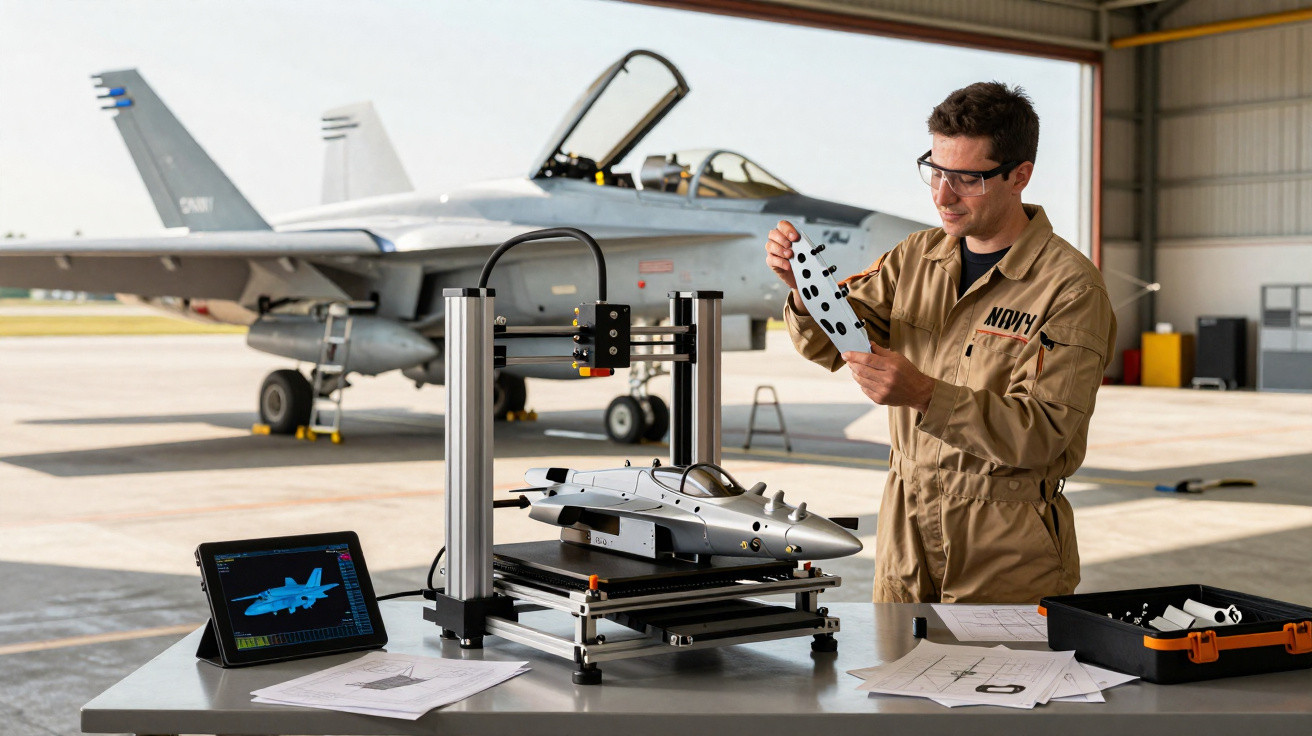
The US Navy has recently confirmed it is pushing ahead with the assessment of new 3D-printing techniques designed to cut the repair time for F/A-18 Super Hornet fighters. The effort, led by the Aircraft Division of the Naval Air Warfare Center Aircraft Division (NAWCAD) together with the Fleet Readiness Center Southwest (FRCSW), aims to reduce maintenance time for composite components by roughly 50%, enabling repairs to be carried out directly at forward operating bases.
According to the US Navy, the approach centres on producing high-performance composite patches via 3D printing and fitting them straight onto the aircraft. In parallel, engineers have drawn up dedicated application procedures and quality checks so that repaired parts meet the safety requirements needed for flight operations.
How 3D-printed composite patches are applied
Under the new method, the repair patch is manufactured to specification using additive manufacturing, then installed on the aircraft without the lengthy processes typically associated with composite repairs. The programme also includes defined inspection steps and acceptance criteria, intended to ensure the structural integrity of the repaired area before the aircraft returns to service.
A system designed to speed up F/A-18 Super Hornet maintenance
Rear Admiral Todd Evans, Commander of NAWCAD’s Aircraft Division, outlined what the programme is meant to deliver. “Our goal is to put this capability directly in the hands of the Fleet. By simplifying a complex repair so it can be performed in forward positions, our engineers would get aircraft back into the fight faster. It’s a smart solution that makes our squadrons more self-sufficient and directly improves operational readiness,” he said.
With laboratory testing and ground trials successfully completed, the joint team plans to conduct flight tests of the system this summer on an operational F/A-18 Super Hornet. These sorties are intended to confirm how the printed repairs perform under real-world conditions before any potential move into service use. This represents a new way to keep F/A-18 Super Hornets available, following the announcement that production would be ended, which we reported in February.
Cutting delays and strengthening operational capability
At present, when an F/A-18 Super Hornet suffers damage to composite parts-such as engine bay doors-the repair process typically demands highly specialised personnel and extended maintenance periods. As a result, aircraft can remain out of service for long stretches, while the logistics chain responsible for supplying spares faces added strain.
The updated technique is intended to change that model by leveraging a network of 22 3D printers already deployed across US Navy maintenance facilities worldwide. This would allow repairs to be completed closer to where the aircraft are operating, avoiding the need to ship components back to maintenance depots in the United States and significantly reducing waiting times.
NAWCAD and FRCSW: the organisations behind the project
NAWCAD’s Aircraft Division, based at Patuxent River, Maryland, brings together military personnel, civil servants and contractors who run test ranges, laboratories and aircraft. Their work supports testing, evaluation, research, development and sustainment across all air platforms operated by the US Navy and the United States Marine Corps.
FRCSW, located in San Diego, is one of the principal maintenance sites for US naval aviation.





Comments
No comments yet. Be the first to comment!
Leave a Comment