
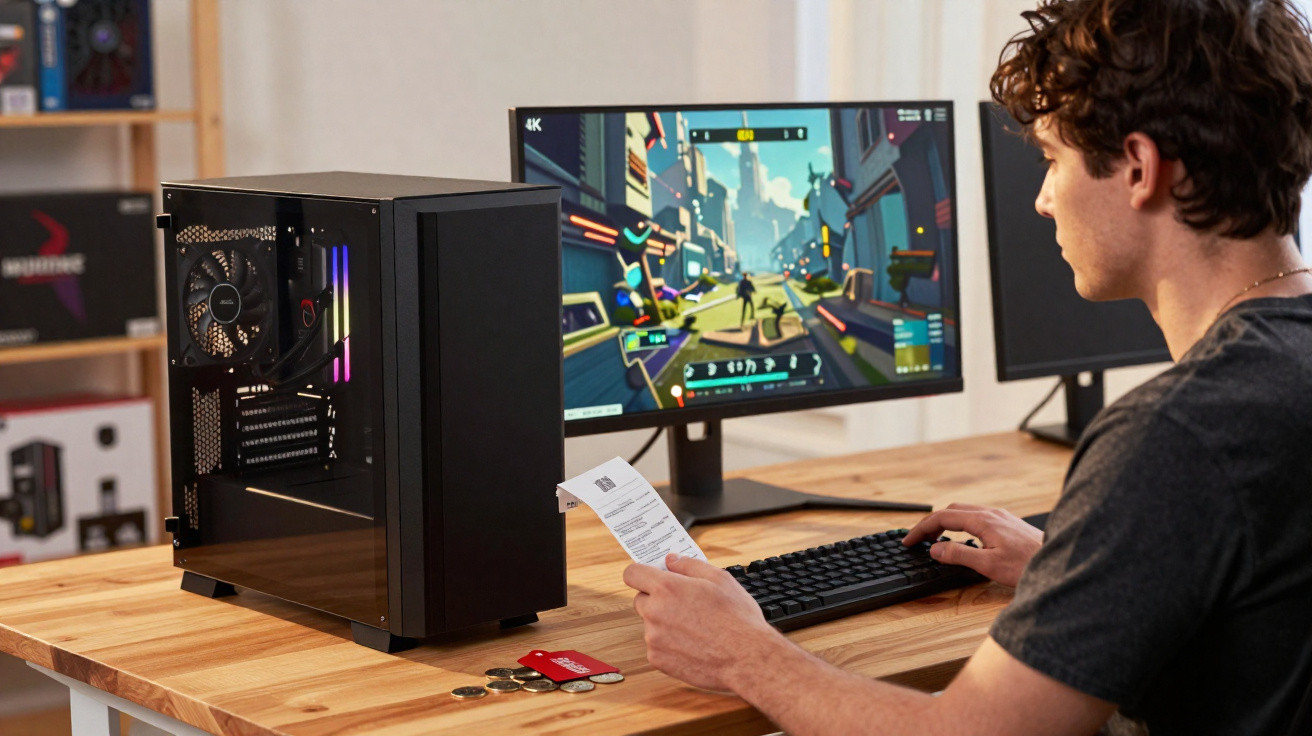
This gaming tower looks, at least on the spec sheet, like it should tear through 4K games and demanding productivity tasks.
Even so, its asking price has suddenly dropped.
Cybertek, a French retailer, has quietly placed its Black Platinum gaming PC into a sizeable promotion, which naturally raises a question: what’s behind a sharp price cut on a desktop with hardware of this calibre?
What kind of beast are we talking about?
This is firmly not an entry-level build. The Black Platinum centres on an Intel Core i7‑14700KF, matched with an Nvidia GeForce RTX 5080 and 32GB of DDR5 RAM running at 6000 MHz. For storage, you get a 2TB PCIe 4.0 NVMe SSD intended for both big game libraries and creative workloads.
The configuration screams high‑end: Core i7‑14700KF, RTX 5080, 32GB DDR5‑6000, and a 2TB Gen4 NVMe SSD, all in a turnkey desktop.
Cybertek positions it as a ready-to-play tower aimed at gamers and power users who would rather avoid building a PC themselves. As part of the current promotion, the price is reduced from €2,499.99 to €2,199.99, representing a straightforward €300 saving.
In practical terms, that budget bracket is designed for people chasing high-refresh 1440p or 4K gaming, a touch of streaming, and enough performance for content creation-without stepping up into true workstation pricing.
Why a €300 discount on such a fresh configuration?
A €300 reduction on a system featuring an RTX 5080 alongside a recent Intel processor can look questionable at first. However, there are several ordinary, non-alarming reasons this can happen, and none of them require assuming there is something wrong with the machine.
Component pricing and competitive pressure
Shops and system builders commonly secure parts well in advance, then revise finished-system pricing as market rates shift. CPU and graphics card pricing, in particular, can move quickly.
- When GPU prices soften, prebuilts can suddenly appear overpriced.
- Rival brands frequently launch hard-hitting deals during seasonal sales periods.
- To stay appealing, prebuilts often need to be priced competitively against DIY builds.
Cybertek could simply be repositioning the Black Platinum to match competitors, or responding to lower-priced RTX 5080 options becoming available. In a €2,500 class desktop, a €300 reduction still fits within the usual margin patterns for this category.
The discount says more about the pace of the gaming PC market than about any weakness in the machine itself.
A strategic price for “4K‑ready” branding
Pricing strategy plays a part as well. At roughly €2,200, a tower like this sits in an attractive sweet spot: enthusiasts who want close-to-flagship performance, but still want to feel they’re getting decent value.
By moving the system under the psychological €2,500 line and nearer to €2,000, Cybertek makes the purchase easier to rationalise-particularly for buyers who also need to budget for a monitor and other peripherals.
What the Black Platinum actually delivers in games
A specification list only tells part of the story. With the Core i7‑14700KF paired to an RTX 5080, the Black Platinum is clearly built for high-frame-rate 1440p and credible 4K play.
1440p: the comfort zone
At 1440p, the majority of current AAA games should run at very high or ultra presets while still achieving frame rates suitable for 144 Hz (or higher) on a capable gaming monitor. DLSS or comparable upscaling features can lift performance further with only a modest hit to image quality.
Fast-paced competitive games-shooters and MOBAs, for example-stand to gain from the strong CPU and quick DDR5 memory. You can expect tighter frame times, which helps keep micro-stutter in check when used with a high-refresh display.
4K gaming with ray tracing on the table
At 4K, the graphics load rises significantly. The RTX 5080 is designed with high-resolution play in mind, but it’s not guaranteed that every game will run with everything maxed out, ray tracing enabled, and still remain above 60 fps.
| Target resolution | Expected settings | Experience focus |
|---|---|---|
| 1080p | Ultra, high frame rates | Esports and very high refresh |
| 1440p | High / Ultra + upscaling | Balanced visuals and smoothness |
| 4K | High + ray tracing tuned | Visual fidelity first |
Because ray tracing is still demanding, many players will end up balancing native resolution against upscaling and slightly lowered settings to maintain smooth gameplay. This is exactly where DLSS and frame generation-style tools can make a noticeable difference.
Beyond gaming: who else benefits from this rig?
With 32GB of DDR5 at 6000 MHz, there’s plenty of overhead for heavier multitasking. Anyone running Chrome with an excessive number of tabs alongside messaging, a streaming client, and editing software will notice the extra headroom compared with 16GB systems.
The 2TB NVMe SSD also improves everyday use. Large open-world games with sizeable asset loads start up more quickly, and big media folders remain snappy. For video editing, Gen4 bandwidth helps speed up imports, rendering, and timeline scrubbing on high-bitrate footage.
Gamers get faster load screens; editors get quicker media workflows; streamers gain enough headroom to keep everything running at once.
A range of 3D and creative applications can also push work to the RTX 5080, boosting viewport responsiveness or enabling GPU-accelerated rendering. It’s not a substitute for a dedicated workstation on massive studio-grade jobs, but for freelance work and side projects, the balance here is strong.
Where Cybertek saves money – and what buyers should watch
One point worth noting is that the PC includes a trial version of Windows rather than a permanently activated licence. It will start up and function normally, but you’ll need to pay separately to activate it permanently.
This tactic helps the system builder keep the upfront price lower while still providing something that feels “ready to play”. If you already have a Windows licence, or you’re intending to install another operating system, this arrangement may even suit you.
Cybertek also puts emphasis on presentation, including RGB memory and a gamer-styled case. While these details can boost perceived value, they don’t really account for a €300 cut. The more likely explanation is a blend of bulk component purchasing, promotional timing, and a desire to shift inventory as newer CPUs and GPUs arrive.
How this deal compares to a DIY build
PC enthusiasts often measure any prebuilt against the cost of assembling an equivalent system themselves. Building from individual parts can be better value, but at the high end the gap is not always dramatic.
- Purchasing an RTX 5080, Core i7‑14700KF, 32GB DDR5‑6000 and a 2TB Gen4 SSD on their own consumes most of the spend.
- Once you add a solid PSU, motherboard, case, cooler and a Windows licence, the overall total can creep towards the Black Platinum’s promotional price.
- The extra money in a prebuilt typically covers assembly, testing, warranty logistics and the time you save.
With a €300 reduction, the prebuilt proposition becomes more persuasive. For anyone prioritising convenience, or who simply doesn’t want the hassle of putting together a high-power system, the Black Platinum starts to look like a sensible alternative to choosing each component individually.
Tips before jumping on this kind of promo
A discounted high-end gaming tower is easy to get excited about, but it’s still worth doing a few checks. Confirm the exact power supply model, the cooling setup, the motherboard chipset, and how many M.2 slots are available. Those specifics influence your upgrade options far more than the headline CPU/GPU list.
It’s also sensible to calculate the full ownership cost: factor in a Windows licence, an appropriate monitor, and at least a decent keyboard and mouse. A system like this is best paired with a fast 1440p or 4K screen with a strong refresh rate; using a basic 1080p 60 Hz display leaves a lot of performance on the table.
If you’re weighing up a laptop versus a desktop, think about how you’ll use it. The Black Platinum-style tower generally wins on outright performance, upgradeability and noise management, while gaming laptops remain the better choice for portability. If the PC is going to stay on a desk most of the time, a tower with these specifications usually makes more long-term sense.
Lastly, consider lifespan and resale. A 14700KF paired with an RTX 5080 should stay relevant for several years at 1440p, with respectable 4K results even as games become more demanding. If you plan for at least one future GPU upgrade, this discounted tower can serve as a long-term platform rather than a short-lived indulgence.






Comments
No comments yet. Be the first to comment!
Leave a Comment