
Russia makes basic UAS training compulsory from 1 September 2026
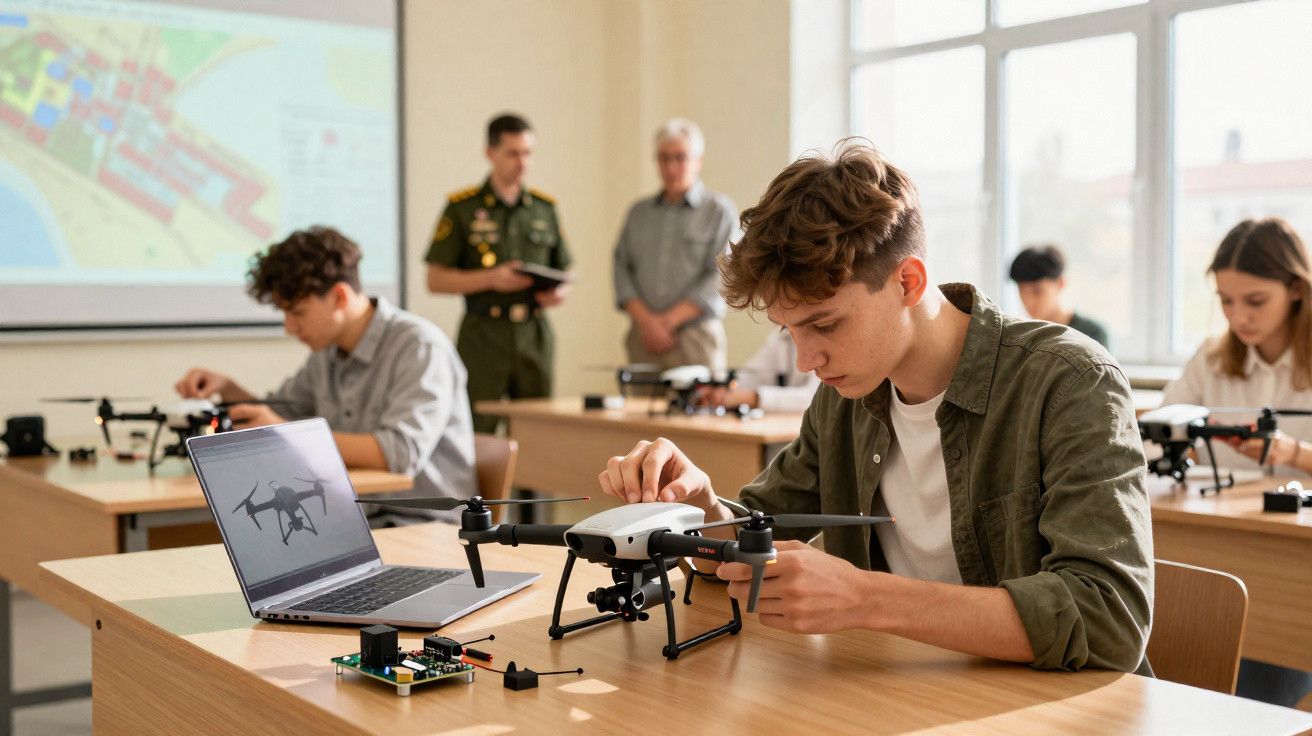
From 1 September 2026, the Russian Federation will require basic training in Unmanned Aerial Systems (UAS) across more than one hundred transport universities and other higher-education institutions nationwide. The policy is expected to cover over 250,000 students, underscoring the weight Moscow now places on drones after lessons drawn from the Russia–Ukraine war.
Kyiv calls it the “militarisation of higher education”
According to Ukraine’s Center for Countering Disinformation, the move is another stage in what Kyiv describes as the “militarisation of higher education”. The curriculum will be rolled out at 19 specialist universities and 86 affiliated units, where students will be required to complete a course focused on unmanned systems. At the same time, recruitment schemes remain under way to bring university students into Russian Armed Forces drone units.
Unmanned Systems Forces (USF) and the wider defence-industrial effort
This education overhaul comes as Russia has formally established the Unmanned Systems Forces (USF) as a dedicated structure within its Armed Forces. The new body is tasked with centralising the production, testing, operation and doctrinal development of unmanned systems across air, land and surface domains-mirroring the model used by Ukraine’s USF, created in early 2024. In parallel, Russia’s defence industry is working alongside the military to expand UAV operational availability and strengthen electronic-warfare capabilities.
How drones have shaped operations since February 2022
Since the start of the war in February 2022, drones have taken on a pivotal role in Russian military operations. Swarms of unmanned aircraft have been used to breach Ukrainian defensive lines, carry out reconnaissance tasks and conduct precision strikes. Key systems in use include the Forpost-R, the Shahed-238, and a range of First-Person View (FPV) drones.
Ukraine, for its part, has also built a major portion of its military approach around FPV technology, using lightweight attack drones capable of delivering explosive payloads with a high degree of precision. Their blend of low cost, strong manoeuvrability and operational flexibility has made these systems one of the conflict’s most widely employed tools.
Limits to integration and the push to train enough operators
The rapid spread of unmanned systems-alongside other dual-use technologies-has fundamentally reshaped tactical and strategic planning on both sides. While both continue to increase investment in drone production and to refine operational capabilities, specialists note that technical and organisational constraints still hinder full integration.
Samuel Bendett, a researcher at the Center for Naval Analyses, said: “Currently, there are no official standards for much of the tactical development and use of drones in the Russian armed forces”, and he also noted that Russia’s Armed Forces struggle to train a sufficient number of qualified operators. Against that backdrop, making UAV education mandatory highlights Moscow’s effort to align higher education with the operational needs of its Armed Forces-particularly by preparing specialists for today’s multidomain warfare environments.





Comments
No comments yet. Be the first to comment!
Leave a Comment