
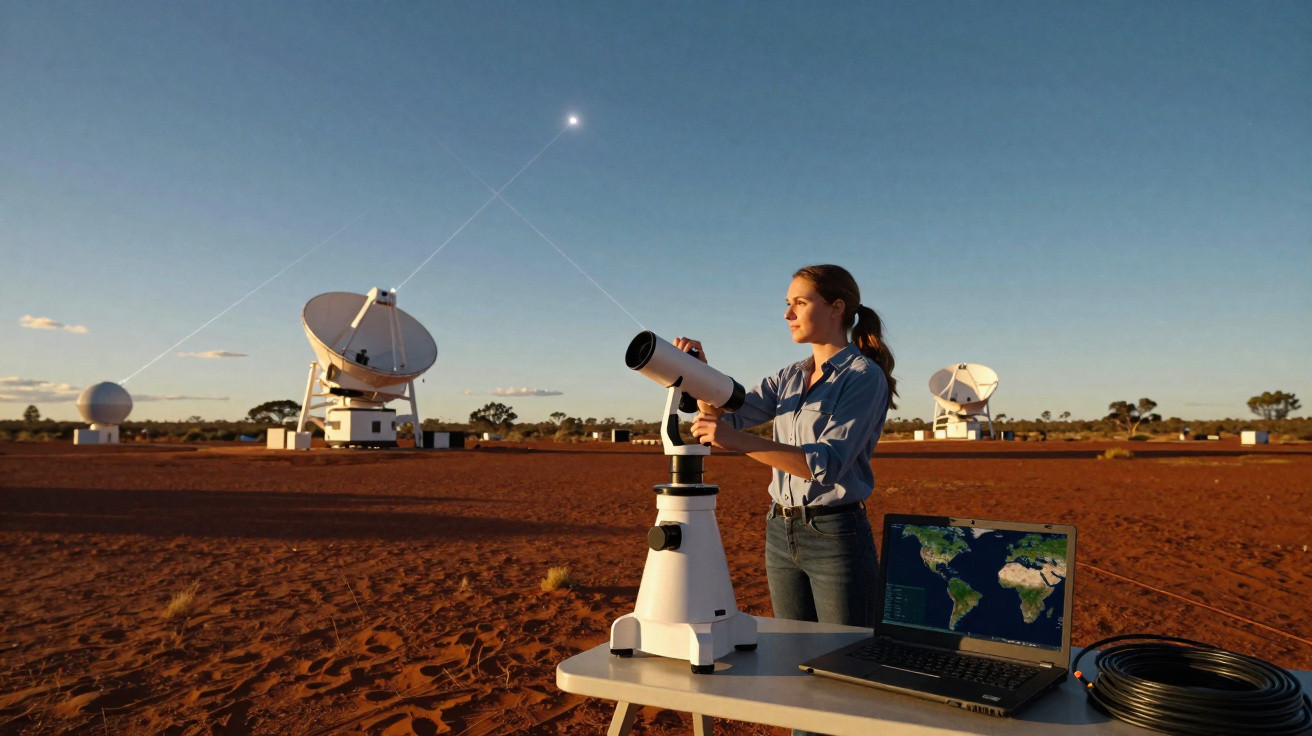
A new laser-powered programme due to begin in Western Australia could dramatically reshape communications around the world.
Researchers report that two optical ground stations in a carefully positioned network have already managed to receive laser transmissions from a German satellite - an achievement that could open the door to boosting space-to-Earth data capacity by 1,000 times.
The TeraNet project in Western Australia
Known as TeraNet, the effort is being led by astrophotonics researcher Sascha Schediwy at the University of Western Australia (WA). The work is supported by the Australian Space Agency’s Moon to Mars Demonstrator Mission.
"The overall aim of the project is to contribute towards Australia's vision for the next generation of space exploration," Schediwy told ScienceAlert.
Why radio links are reaching their limits
Since Sputnik I launched in 1957, satellites have largely relied on radio waves to send information. Because radio signals operate at relatively low frequencies, they impose strict limits on how much data can be transmitted. After close to 70 years of refinement, radio-based systems are increasingly struggling to match today’s vast appetite for data.
"It's been pushed to the absolute extreme, but it's really now reached a bottleneck," said Schediwy.
With thousands of satellites now circling Earth, the volume of information being gathered - and needing to be downloaded - is immense. High-frequency laser links offer a potential way through that problem.
"By switching to infrared laser beams for communications, we get a factor of 100, or 1,000, times greater bandwidth," said Schediwy.
As well as the technical benefits, the team believes a stronger communications system could help the public feel closer to space exploration.
"We can have multiple camera angles and 4K video footage of the next people landing on the Moon," Schediwy said. "That's a really exciting aspect of the technology, I think."
Optical ground stations and the cloud challenge
Conventional radio communications spread across a broad area, which can lead to overlap and interference between signals. By contrast, TeraNet’s short-wavelength optical signals can be tightly directed.
"With optical signals, instead of your beam being maybe 100 kilometres [62 miles] across, it can be 100 metres [328 ft] across. So, you're really targeting an individual user on the ground," said Schediwy.
Given these advantages, it may seem odd that optical satellite communications are not already commonplace. However, laser-based links come with a significant limitation.
Unlike radio waves, these targeted short-wavelength beams are far more vulnerable to disruption. Clouds can break the connection, which makes lasers a less dependable option for satellite downloads.
The team’s proposed fix is straightforward: build several ground stations across WA that all feed into the same network, increasing the odds that at least one site will have clear skies when the satellite passes overhead.
"If it is cloudy in Perth, the satellite can download its data up at Mingenew, 300 kilometres [186 miles] north," said Schediwy.
If cloud blocks both the Perth and Mingenew stations, TeraNet has a back-up plan: an extra ground-station receiver mounted on the rear of a Jeep, which can be driven to whatever coordinates are needed to secure the strongest signal.
From three stations to a wider Australasian network
Should the initial three-station network deliver as hoped, the group is already considering partnerships with organisations on Australia’s east coast and in New Zealand to build an Australasian optical ground station network - and that would be only the first step.
"WA is geographically ideally located to be part of a global communications infrastructure, with an oversight of a large part of the Indian Ocean and a reach into Southeast Asia and the polar region," Schediwy told ScienceAlert.
Once a global optical communications network is in place, it could allow continuous, ultra-fast satellite data downloads. That capability could change how quickly large datasets are shared in time-critical scenarios, including disaster response.
For now it is just three ground stations, but it could mark the start of a new era in space communications.
"This demonstration is the critical first step," says Schediwy.






Comments
No comments yet. Be the first to comment!
Leave a Comment