
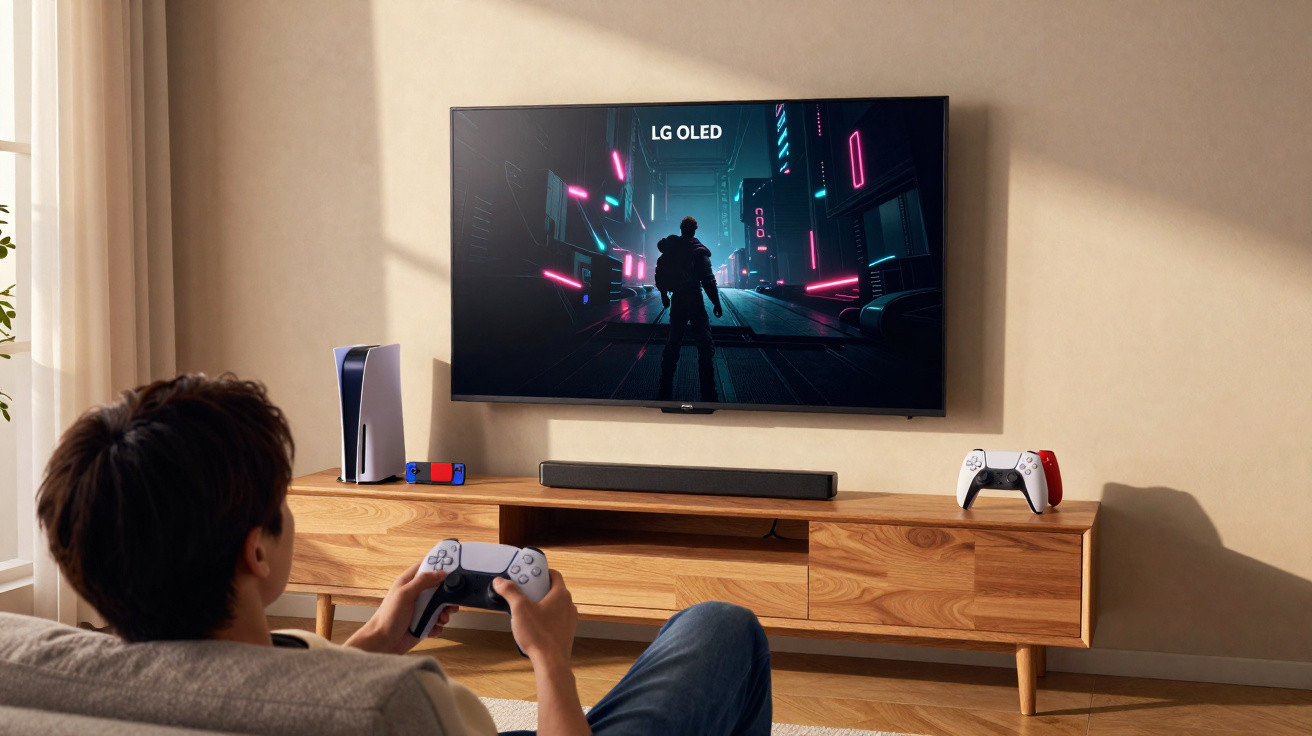
Europe’s early‑year promotions are shaking up the premium TV segment and putting gaming‑ready OLED screens back in the spotlight.
One of the standout deals is the LG OLED55C5, a 55‑inch 4K TV launched in 2025, now showing up with an unusually steep discount in France’s winter sales. With an OLED evo panel, a strong set of gaming features and a 23% price drop, it has become hard to ignore for anyone after a high‑end display for PS5, future consoles such as the Switch 2, or even a PC gamer set‑up.
A TV built for people who take picture quality and gaming seriously
As part of LG’s 2025 OLED range, the LG OLED55C5 targets a very specific crowd: viewers who want cinema‑grade image quality in the living room, but also the responsiveness you’d expect from a gaming monitor. You get a 55‑inch (139 cm) OLED evo 4K panel with a 3840 x 2160 resolution and effectively infinite contrast.
In the winter promotions, the price has dropped from 1,299 € to 999 €, a 23% reduction. For buyers in the UK, that euro figure won’t convert directly to a local retail price once tax, retailer pricing and logistics are taken into account, but it does signal the tier it sits in: this is a premium model that becomes noticeably more attainable as the generation matures.
“The drop to 999 € in France shows a familiar pattern: a latest‑generation OLED TV launches expensive, then becomes a strategic opportunity during the big clearance sales.”
Infinite contrast and HDR for films and series
OLED’s key advantage is still precise light control: every pixel can switch on and off independently. The result is deep blacks (without the “washed‑out grey” you see on many LED TVs) alongside punchy highlights in brighter scenes.
What the OLED evo panel delivers in day‑to‑day use
- True black in dark scenes, which suits horror films and moody productions.
- Highly accurate colours, useful for anyone watching calibrated films or creating content.
- Wide viewing angles, with far less loss of brightness or colour shift.
- A 0.1 ms response time to reduce smearing in fast motion.
HDR support covers HDR10, HLG and Dolby Vision, which currently dominates the libraries of major streaming platforms. The lack of HDR10+ is worth noting, although in practice it matters most to people watching certain physical releases or using a smaller set of services.
AI‑driven picture processing
At the centre of the TV is LG’s α9 AI Processor 4K Gen8. It upscales lower‑resolution sources, works to cut noise, and tweaks contrast and sharpness based on what’s on screen.
“The α9 Gen8 processor tries to understand what’s on the screen - a face, landscape, text - and apply targeted improvements, rather than simply cranking up sharpness.”
Features for PS5, Switch 2 and PC gamer
Where the LG OLED55C5 really separates itself is in its gaming‑focused spec. It includes four full‑bandwidth HDMI 2.1 ports, something that remains uncommon even among expensive sets. In practical terms, you can connect a PS5, a potential Switch 2 with 4K ambitions, an Xbox Series X and a PC gamer rig without constantly swapping cables.
A serious gaming package
| Feature | Benefit for gaming |
|---|---|
| 4x HDMI 2.1 | Connect multiple 4K/120 Hz sources without losing key features |
| Refresh rate up to 144 Hz | Smoother motion, ideal for FPS and competitive games |
| VRR (Variable Refresh Rate) | Cuts tearing and stutter by synchronising the TV with console/PC |
| ALLM (Auto Low Latency Mode) | Automatically switches to low‑latency mode when a game is detected |
| NVIDIA G-Sync / AMD FreeSync Premium | Fewer frame breaks and hiccups on compatible PCs |
| 0.1 ms response time | Minimises trails behind fast‑moving objects |
For the PS5, the mix of 4K/120 Hz, VRR and ALLM covers essentially everything the console offers today. The longer‑term pull is how well it could pair with future hardware such as a Switch 2 that supports 4K and higher frame rates, plus use as a large‑format PC display for modern RTX or Radeon graphics cards.
Game Optimiser, HGIG and cloud gaming
LG includes a “Game Optimiser”, a settings hub that brings together input‑lag controls, shadow detail adjustments, HDR mapping and other tools that help whether you play in a dark room or a bright one.
Support for HGIG (HDR Gaming Interest Group) is designed to prevent HDR images looking washed out or overly dim when a game leans heavily into HDR. The goal is for the console and the TV to align on brightness behaviour.
“HGIG aims to ensure a game’s brightness is shown as the studio intended, without the TV making heavy‑handed compensations.”
webOS 25 also offers direct access to cloud‑gaming services such as Xbox Cloud Gaming. That opens up a compelling use case: playing current‑generation titles without a physical console, provided you have a controller and a strong internet connection. Here, Wi‑Fi 6 matters because it helps reduce network instability - critical for streaming games.
Dolby Atmos sound and modern connectivity
On the audio side, the LG OLED55C5 has a 2.2‑channel system rated at 40 W, with Dolby Atmos support. It won’t replace a dedicated home cinema system, but it can create a larger sense of space than the built‑in speaker size suggests.
If you want to step up the sound, eARC on one of the HDMI ports makes it easier to add a more capable soundbar, including LG models designed to integrate neatly with the TV.
For connectivity, you get Wi‑Fi 6, streaming via AirPlay 2 for iPhone users, and Google Cast for Android - making it straightforward to mirror a phone screen or send videos and presentations to the TV.
Interface, power use and everyday living
webOS 25 keeps LG’s familiar look and feel: large tiles, quick access to Netflix, Prime Video, Disney+ and other widely used apps. The platform is increasingly geared around profiles and recommendations, attempting to suggest content based on viewing history.
On energy use, the OLED55C5 carries a European F rating, pointing to higher consumption than many newer LED TVs. That’s a classic OLED compromise: excellent picture quality, with more watts drawn from the mains.
“Anyone who leaves the TV on for many hours a day needs to consider the impact on the electricity bill, particularly when using brighter picture modes.”
On the other hand, the design is slim - just over 4.5 cm thick without the stand - which helps with wall mounting and lets the screen blend more cleanly into a living‑room layout.
What to know before choosing a gaming OLED
If you’ve never owned an OLED, a couple of points are worth understanding. The first is the risk of image retention under extreme use - the well‑known “burn‑in”. In current generations, LG and other brands use protection algorithms, reduce brightness for static logos, and apply subtle pixel shifting to reduce the likelihood.
Even so, one scenario can still happen: leaving a football game menu or a news channel with a fixed logo on screen for many hours, every day, over years. In those conditions, part of the panel can age differently. It’s uncommon with normal use, but it’s sensible to vary content and keep the TV’s protection features enabled.
Another consideration is peak brightness. OLED TVs have improved greatly, but some mini‑LED models can push higher brightness in very bright rooms - for example, living spaces that get direct sun in the afternoon. If you play and watch in more controlled lighting, OLED’s contrast usually makes up for that difference.
Practical set‑ups for PS5, Switch 2 and the living room
Picture a typical console player’s set‑up in 2025: a PS5 on one HDMI 2.1 input, a possible Switch 2 on another, a PC gamer on a third, and an Atmos soundbar connected via the HDMI port with eARC. The OLED55C5 can handle that arrangement without awkward cable juggling.
In competitive FPS games, the combination of 120/144 Hz, VRR and the 0.1 ms response time brings a tangible benefit: smoother motion, less “ghosting” when you flick the camera quickly, and fewer harsh drops in visual fluidity when frame rates swing from 120 down to 90 or 80 fps.
For anyone focused on home cinema, Dolby Vision can stand out in recent, carefully mastered streaming releases. Paired with OLED’s deep blacks, the result can feel close to what you see in premium cinema auditoriums.






Comments
No comments yet. Be the first to comment!
Leave a Comment