
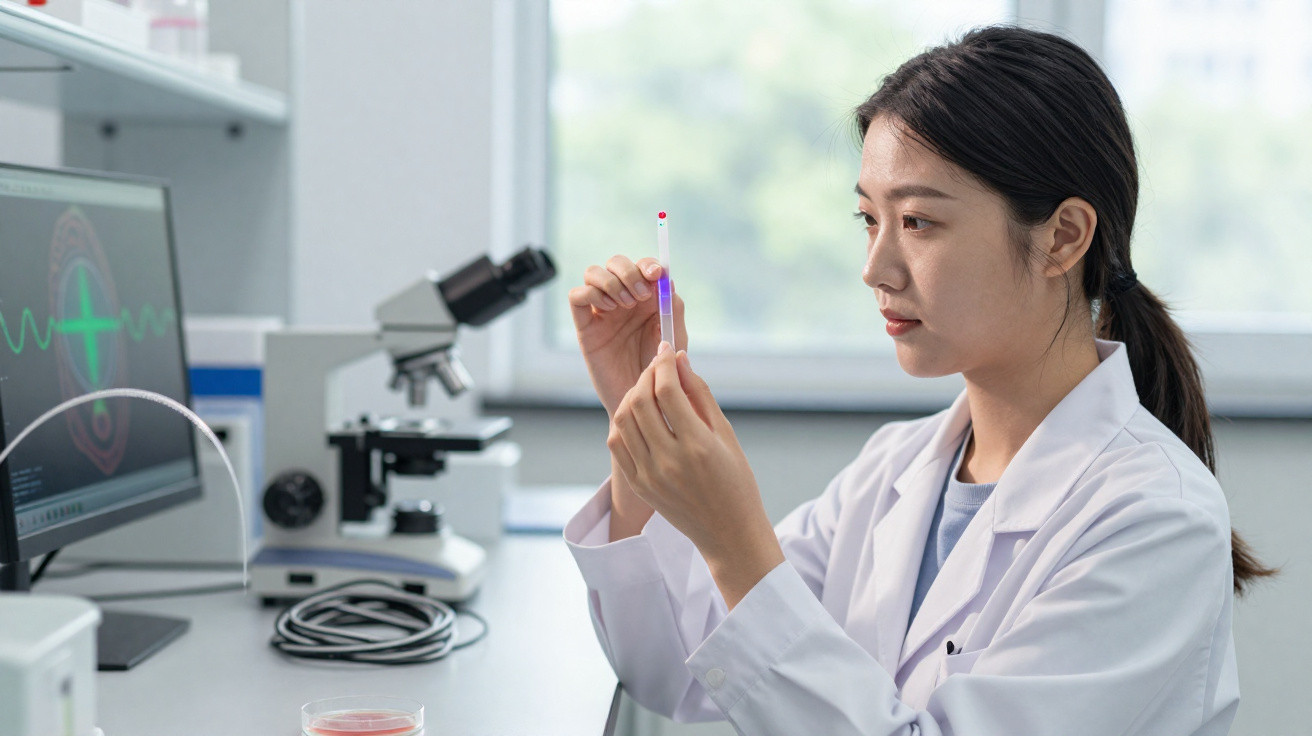
Detecting cancer at an early stage often relies on equipment capable of picking up the slightest internal changes, yet many existing approaches still fail to deliver a sharp, real-time view.
In practice, clinicians are frequently restricted to assessing a single signal at once, which can make it more difficult to tell cancer apart from other illnesses.
Scientists have now produced a sensor that is thinner than a strand of hair, while still being capable of monitoring several signals simultaneously within living tissue.
This miniature device could pave the way for quicker, more accurate cancer detection, alongside a new wave of diagnostic tools that work in real time.
A tiny cancer sensor
The advanced sensor was developed by researchers at Adelaide University and the University of Stuttgart.
Despite its extremely small size, it can take multiple measurements at once. It is able to monitor temperature as well as identify chemical changes occurring inside the body.
To manufacture the sensor, the team used ultrafast 3D micro-printing, a technique that enables highly accurate structures at a microscopic scale. The sensor is printed directly on to the tip of an optical fibre, making it straightforward to position within the body with minimal discomfort.
The study also demonstrates how these micro-printed forms can be carefully engineered to enhance the way signals are collected.
Light signals reveal hidden disease
The sensor detects indicators of disease using light. When certain molecules in the body interact with cancer by-products, they emit light, and the intensity of that light varies with the number of cancer cells present.
“Molecules emit light when they come into contact with a by-product of cancer. The amount of light they emit depends on the concentration of the cancer cells,” said study co-author Professor Shahraam Afshar.
“By inserting the sensors into tissue and measuring the amount of light emitted, we believe we can determine the presence of cancer.”
The research also makes use of specialised materials known as lanthanide-based fluorophores. These compounds glow in different colours, with each colour corresponding to a separate signal-allowing several changes to be monitored at the same time.
Solving a major challenge in diagnosis
A persistent problem for doctors is capturing many signals within the body simultaneously. Most tools currently in use are limited to a single biomarker per measurement.
That limitation can be misleading, because one signal on its own may not clearly identify what is causing a change.
“It’s very difficult to measure or detect different signals coming from a living environment, such as the human body, simultaneously,” said Afshar.
“When you can only measure one biomarker at a time, it’s hard to determine whether the cause of the change is cancer or another issue.
“This is why our method is so revolutionary, as it enables us to provide precise information immediately to medical professionals.”
By collecting several signals together, the new sensor can give clinicians a more complete picture of what is happening inside the body.
Sensor tracks cancer in real time
“This breakthrough could lead to next-generation medical tools that track disease, guide treatment, and monitor the body in real time,” noted Afshar.
Designed to be minimally invasive, the sensor can deliver dependable information while causing very little discomfort. It could help doctors identify disease earlier and follow how it evolves over time.
“The sensors are able to provide reliable and clear information about the presence of disease in a minimally invasive way,” said Afshar. “This opens the pathway for smarter tools in healthcare, environmental monitoring, and wearable technology.”
The same technology may also be adapted for wearable devices that continuously monitor health.
Support for future research
The work was supported by a $1.32 million grant from the Australian Research Council, which will be used to establish a high-precision micro- and nano-printing facility at Adelaide University.
“Having access to the latest laser printing technology will allow us to continue our research and hopefully detect even more biomarkers, such as changes to pH or oxidation-reduction,” said Afshar.
With improved capabilities, researchers will be able to create more sophisticated sensors and evaluate new concepts more quickly.
The future of cancer detection
Next, the team intends to partner with hospitals to adapt and refine the technology for genuine clinical use, helping to turn the sensor into a practical tool for doctors.
“In the future, we would like to collaborate with hospitals to refine the technology, which we believe could be ready for use within the next decade,” said Afshar.
The development highlights how tiny devices can deliver substantial benefits. A sensor as thin as a strand of hair could allow earlier detection of disease, support better treatment decisions, and save lives.






Comments
No comments yet. Be the first to comment!
Leave a Comment