
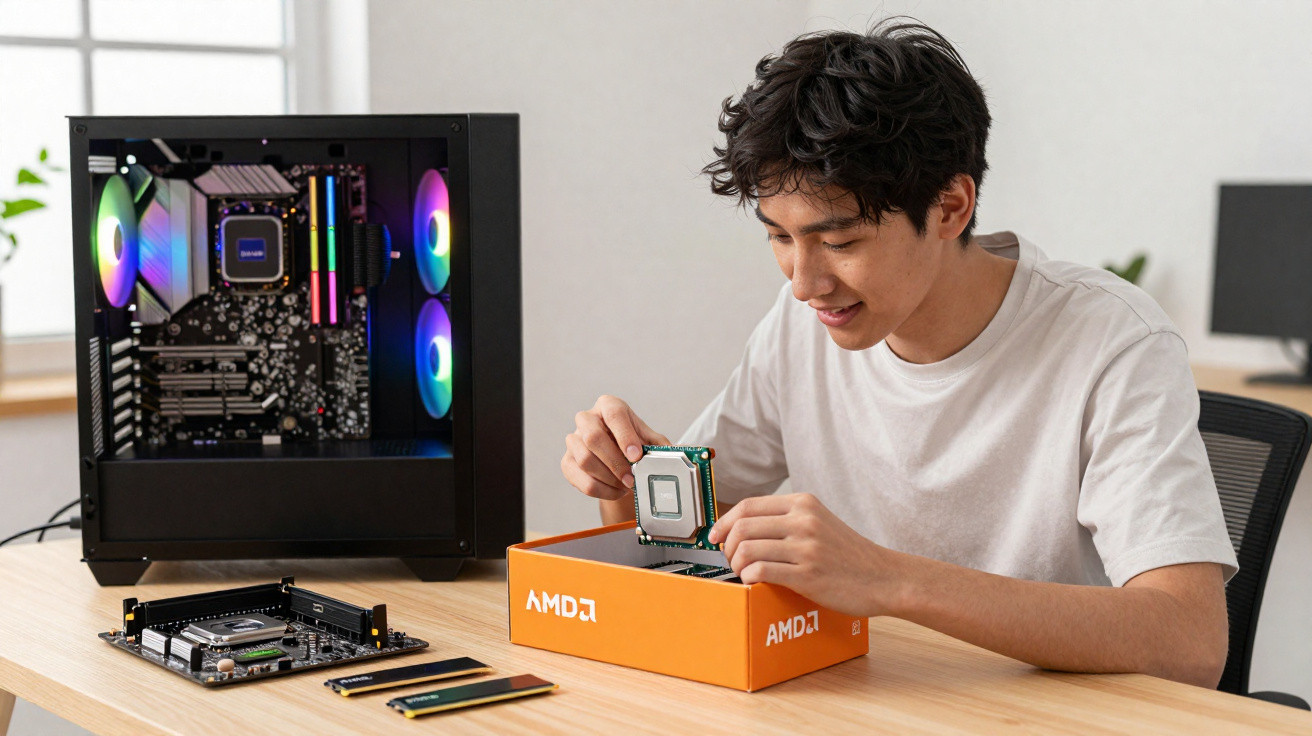
PC component prices have started to soften, and a few previously out-of-reach models are quietly becoming far easier to justify.
One familiar name has reappeared on hardware enthusiasts’ shortlists: the AMD Ryzen 7 7800X3D. This gaming-focused processor is back in the spotlight thanks to a deal that trims roughly 14% off the price, reopening the value-for-money debate for high-performance gaming PCs.
Ryzen 7 7800X3D drops in price and grabs attention again
Typically listed at around €326.42, the Ryzen 7 7800X3D is currently showing up for €279.84 at a major international retailer. That works out at about 14% off-enough to place the chip in a noticeably more competitive position versus other Ryzen 7000 options and Intel’s closest rivals.
"The drop to €279.84 nudges the 7800X3D into the ‘affordable premium’ bracket and makes upgrading feel far more realistic for a lot of players."
If you have already been building a basket and just waiting for the right push on pricing, this reduction could be the prompt to move over to the AM5 platform and DDR5 memory.
What makes the Ryzen 7 7800X3D so strong for gaming
The 7800X3D is an 8-core, 16-thread processor built on Zen 4, manufactured on 5 nm, with a 4.2 GHz base clock and boost speeds up to 5.0 GHz. However, the headline advantage is not simply its clock speeds-it is how those clocks pair with AMD 3D V-Cache technology.
3D V-Cache: the “secret” behind gaming performance
With 3D V-Cache, AMD stacks L3 cache directly on top of the chip, taking total cache to 104 MB. This shortens the path between the CPU and frequently used data, particularly in games that repeatedly request the same information in real time.
"More cache means less time waiting for data to arrive from RAM, which usually translates into higher-and crucially, more consistent-frames per second."
In practice, across many competitive titles and complex open-world games, the 7800X3D often delivers higher FPS than CPUs with similar clocks but less cache. That is where its reputation as a gamers’ favourite comes from.
A modern platform: AM5, DDR5 and PCIe 5.0
The Ryzen 7 7800X3D uses the AM5 socket-AMD’s current platform-which unlocks modern features and leaves room for future upgrades. Key examples include support for DDR5 memory and the PCI Express 5.0 interface.
- DDR5: higher bandwidth, which can help FPS at lower resolutions and accelerate demanding creation workloads;
- PCIe 5.0: keeps your PC ready for next-generation SSDs and graphics cards with more available bandwidth;
- Integrated Radeon graphics: a handy fallback when you do not have a dedicated GPU installed-useful for emergencies or lightweight office use.
Altogether, it is a current, forward-looking base for anyone who would rather not replace their platform again soon.
Specifications at a glance
| Feature | AMD Ryzen 7 7800X3D |
|---|---|
| Architecture | Zen 4 “Raphael”, 5 nm |
| Cores / threads | 8 / 16 |
| Base / boost frequency | 4.2 GHz / up to 5.0 GHz |
| Total cache | 104 MB (with AMD 3D V-Cache) |
| Socket | AM5 |
| Supported memory | DDR5 |
| Interface | PCIe 5.0 |
| TDP | 120 W |
| Integrated graphics | Basic AMD Radeon Graphics |
Who this deal is actually worth it for
The 7800X3D’s target audience is straightforward: gamers chasing top-end in-game performance without paying extra for CPUs that add lots of cores that most games barely use.
"Competitive games at 1080p or 1440p, paired with a powerful GPU, tend to get the very best out of the 7800X3D."
It can also suit creators who stream while playing, edit high-resolution video, or do occasional 3D rendering. Its 8 cores and 16 threads can handle demanding workflows, even if it does not go toe-to-toe with 12- or 16-core models in fully multithreaded tasks.
Typical usage scenarios
- A gaming PC aimed at very high FPS with cards such as the RTX 4070, 4070 Ti, RX 7800 XT or above;
- A live-streaming setup at 1080p or 1440p, with a camera feed, overlays and several apps open at once;
- A hybrid machine for gaming plus editing videos for YouTube or TikTok;
- An upgrade for anyone coming from a Ryzen 3000/5000 CPU who wants a jump to a newer platform.
Watch out for the “hidden” upgrade costs
Before getting carried away by the reduced CPU price, it is worth pricing the full move. If you are coming from AM4, for instance, you cannot reuse your motherboard or DDR4 memory. Switching to the 7800X3D requires:
- An AM5-socket motherboard;
- DDR5 memory modules;
- A compatible, capable cooling solution.
With a 120 W TDP, this chip benefits from a strong air cooler or a decent AIO liquid cooler. Under sustained heavy loads, a weaker cooler can lead to the familiar thermal throttling behaviour, where the CPU drops frequency to keep temperatures under control.
"The promotional CPU price looks great, but the final bill also includes a motherboard, DDR5 RAM and a properly capable cooler."
If you are already on AM5, the picture changes: the swap is usually far simpler, often requiring only the new processor and-depending on the board-possibly a BIOS update.
Why do people talk so much about cache, TDP and PCIe 5.0?
A few terms come up constantly in discussions about the 7800X3D, and they can be confusing if you are not regularly trawling hardware forums.
L3 cache: ultra-fast memory built into the CPU. When it is large-as with the 7800X3D’s 104 MB-more frequently used game data can stay close to the cores instead of being fetched from slower system RAM. That helps keep FPS high even in hectic scenes with lots happening on screen.
TDP (120 W): a guideline for how much heat your cooling solution needs to dissipate under typical conditions. It is not an exact power draw figure, but it is useful for planning. Higher numbers generally mean you need a stronger cooler and a case with good airflow.
PCIe 5.0: the latest generation of the interface that connects your graphics card and SSDs to the motherboard. In many situations today, the difference compared with PCIe 4.0 is small, but PCIe 5.0 provides headroom for future components without bandwidth bottlenecks.
Practical build examples with the Ryzen 7 7800X3D
To make its positioning clearer, it helps to picture two setups.
Scenario 1 – Competitive gaming PC: Ryzen 7 7800X3D, 32 GB of DDR5, RTX 4070 Ti Super, 1 TB PCIe 4.0 NVMe SSD, 1440p 240 Hz monitor. The priority here is extremely high FPS in competitive shooters and MOBAs, while keeping plenty of spare capacity for background multitasking such as Discord, a browser and light streaming.
Scenario 2 – Hybrid gaming + editing workstation: Ryzen 7 7800X3D, 64 GB of DDR5, a GPU such as the RX 7900 XT or RTX 4080, plus NVMe SSDs for video projects and a games library. This combination can handle 4K gaming while also enabling relatively smooth editing of long 4K videos, using both CPU and GPU acceleration.
For anyone thinking about longevity, the mix of Zen 4 architecture, DDR5 support and PCIe 5.0 provides breathing room for several generations of faster GPUs and SSDs. The current discount makes that overall proposition even harder to ignore-particularly at a time when graphics card prices remain high and any saving elsewhere in the build helps balance the budget.






Comments
No comments yet. Be the first to comment!
Leave a Comment