
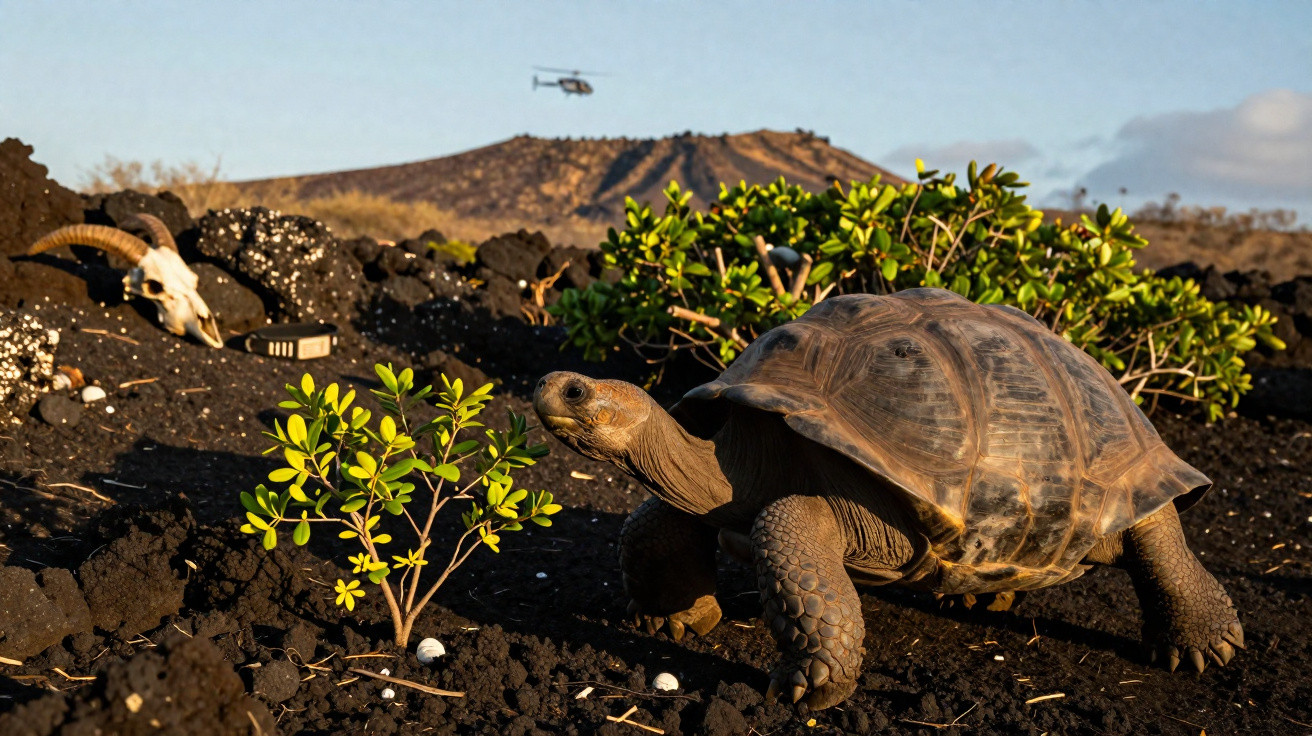
Environmental protection in the Galápagos demanded drastic action to defend the giant tortoises from serious threats. By eradicating invasive animals, conservation teams enabled native vegetation to rebound at an extraordinary pace, restoring the ecological balance that this iconic, vulnerable species depends on.
How did goats threaten the tortoises?
Feral goats are exceptionally hardy, highly social and relentlessly hungry-traits that allowed them to overwhelm island ecosystems. They stripped away the dense forests that help trap mist, which in turn caused an acute shortage of shade and fresh water across the volcanic ground.
That scale of destruction made a comprehensive, hard-edged restoration plan unavoidable in order to confront these introduced mammals. The pioneering programme combined multiple strategies and specialist equipment, focusing on urgent measures such as those set out below.
- Helicopters: Vital for covering rugged terrain that was almost impossible to reach on foot.
- Shooters: Trained aerial marksmen carried out rapid, large-scale removals.
- Maps: Geographic positioning tools guided teams during systematic searches.
- Judas goats: Radio-collared animals that disclosed the hiding places of remaining herds.
- Telemetry: Radio systems used to track these locator animals with precision.
What was Project Isabela?
Known as Project Isabela, the major operation ran from 1997 to 2006 on these remote islands. Total investment reached the striking figure of ten million dollars, aimed at reversing severe environmental degradation.
The campaign was led by the Galápagos National Park together with the Charles Darwin Foundation. Working in partnership, they successfully removed more than 140,000 invasive goats across an area exceeding one million acres (around 405,000 hectares) of protected land.
How did helicopters change the results?
These aircraft dramatically increased the pace of the work given the archipelago’s difficult geography. Hunters operating on the ground faced major physical obstacles, leaving air operations as the only realistic way to cover vast, untouched volcanic landscapes.
Eradication data
Aerial control statistics
During the main project phase that began in 2004, the air teams removed exactly 55,657 animals in just over one year of intensive operations.
By contrast, groups working directly on the ground managed to eliminate only 2,637 individuals over the same monitored period.
Close monitoring showed that the speed of aerial work prevented the remaining harmful animals from rebuilding their numbers. This efficiency delivered key gains and produced targeted scientific reporting, reflected in the figures below.
- Over fifty-five thousand goats removed by air.
- Fewer than three thousand captures carried out by ground teams.
- A sharp reduction in uncontrolled breeding in remote areas.
What role did Judas goats play?
Once the large herds were gone, the few survivors learned to keep away from helicopters. Finding these last scattered animals became extremely slow and complex, requiring innovative biological approaches rooted in the species’ behaviour.
To locate hidden individuals in the bush, scientists exploited goats’ social nature. This ingenious biological tracking tactic relied on advanced technology and produced important findings, organised in detail below.
- Release of more than 700 sterilised animals fitted with radio collars.
- Completion of more than 5,000 aerial telemetry checks.
- Long-lasting hormone implants in females referred to as “Mata Hari”.
How did vegetation respond after eradication?
The complete elimination of invasive mammals led to visible environmental improvements in a very short period. Native shrubs, forest trees and the Opuntia cactus began growing strongly again, providing plentiful food and reshaping landscapes that had been severely degraded.
These giant tortoises actively act as ecosystem engineers through constant grazing. By dispersing native seeds across the terrain, they show why the islands’ complex ecological restoration was an indispensable strategy for conservation and biodiversity.
References: Archipelago-Wide Island Restoration in the Galápagos Islands: Reducing Costs of Invasive Mammal Eradication Programs and Reinvasion Risk | PLOS One






Comments
No comments yet. Be the first to comment!
Leave a Comment