
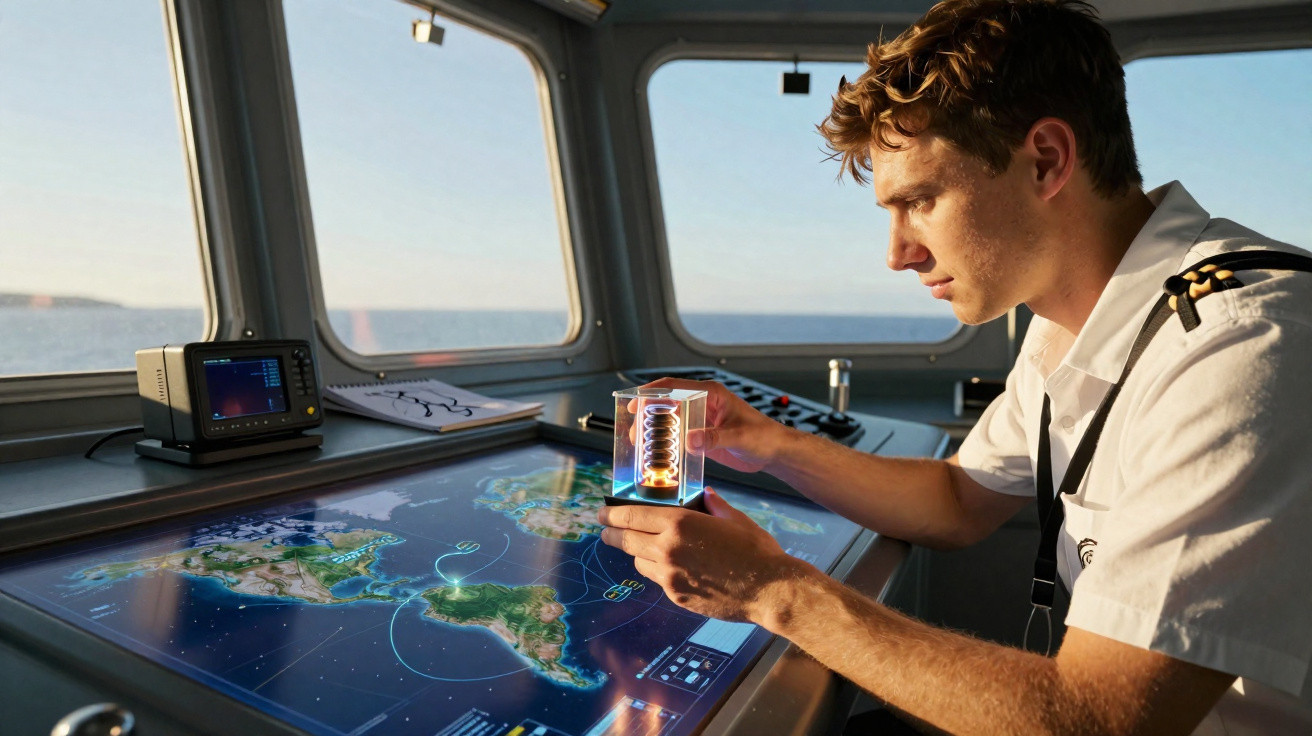
Quantum technology has moved well beyond the laboratory and into day-to-day life. Next, it is poised to change something even more basic: the way we work out where we are and how we get from A to B.
Picture submarines crossing the oceans without ever needing to surface to confirm their position.
Imagine aircraft travelling between continents with rock-solid accuracy, even when external signals are disrupted.
Or consider emergency crews finding their way through smoke-choked buildings and underground tunnels with pinpoint reliability, while autonomous vehicles plot clean, accurate routes through crowded city streets.
These examples can sound like science fiction, yet they could be enabled by a developing concept called quantum navigation.
In time, this technology could alter movement, exploration and connectivity in ways we are only starting to grasp. So what does it involve?
Satellite navigation is at the heart of many things
Global navigation satellite systems such as GPS are woven into modern life. We lean on them for everyday directions, arranging deliveries and adding location tags to photographs. Their importance, however, stretches far beyond convenience.
Satellite timing signals from orbit are used to verify stock market transactions and to help keep the electricity grid in balance. On farms, satellite navigation supports autonomous tractors and assists with mustering cattle.
Blue-light services also depend on satellite navigation to reach incidents quickly, cutting the time taken to get help to people who need it.
Even with these advantages, systems like GPS have clear weaknesses. Their signals can be jammed or otherwise interfered with, whether through warfare, terrorism, or attempts to protect privacy (legitimate or otherwise). Real-time maps such as GPSJAM highlight interference hotspots, including parts of the Middle East, regions around Russia and Ukraine, and Myanmar.
Space conditions are not stable either. The Sun periodically throws out enormous blobs of plasma, producing what we call solar storms. When these eruptions collide with Earth’s magnetic field, they can disturb satellites and GPS reception. Sometimes the disruption is brief, but in more severe events the damage can be substantial.
Losing access to global navigation satellite systems would be far more serious than a minor annoyance - it would unsettle some of our most vital infrastructure.
Some estimates indicate that a GPS loss would cost the United States economy roughly US$1 billion per day (A$1.5 billion), triggering knock-on failures across tightly linked systems.
Quantum navigation to the rescue
There are many places where satellite navigation performs poorly. Signals do not travel well through water, for instance, and they are also ineffective underground.
You may have noticed problems when using Google Maps in dense city centres with tall towers. Skyscrapers can bounce signals around, reducing accuracy, and inside buildings the signal may be weak or vanish entirely.
That is where quantum navigation could eventually provide another option.
Quantum science explores how particles behave at scales smaller than an atom. It brings to light counter-intuitive phenomena such as superposition - where particles can exist in multiple states at once - and entanglement (where particles are linked across space and time in ways that do not fit classical intuition).
These effects are delicate and usually collapse when observed, which is why they are not apparent in everyday experience. Yet that same delicacy can be harnessed to create remarkably precise sensors.
A sensor is any device that notices changes in its surroundings and converts those changes into a measurable or usable signal. Automatic doors that open as we approach and phone displays that react to touch are familiar examples.
Quantum sensors are exceptionally sensitive because quantum particles respond to minute environmental shifts. Where conventional sensors might overlook faint signals, quantum sensors can pick up extremely small variations in properties such as time, gravity and magnetic fields.
This performance comes from the way quantum states readily alter when their environment changes, allowing measurements with far greater precision than has previously been possible.
That level of exactness matters for navigation you can rely on.
Our team is investigating fresh approaches that use quantum sensors to read Earth’s magnetic field for navigation. By exploiting quantum effects in diamonds, we can measure the planet’s magnetic field in real time and match those readings against existing magnetic-field maps, offering a robust alternative to satellite navigation systems such as GPS.
Because magnetic signals cannot be jammed and also function underwater, they could serve as a valuable back-up.
The future of navigation
Navigation systems of the future are likely to incorporate quantum sensors to improve position-finding (using Earth’s magnetic and gravitational fields), sharpen orientation (with quantum gyroscopes), and deliver better timing (through compact atomic clocks and networked timekeeping systems).
Together, these tools could sit alongside - and in certain situations substitute for - traditional satellite-based navigation.
Even so, although the promise of quantum navigation is evident, turning it into something practical remains a major undertaking. Research groups and businesses around the world are trying to mature these technologies, with substantial work taking place across universities, government laboratories and industry.
Both start-ups and established organisations are building prototype quantum accelerometers (instruments that measure movement) and gyroscopes, but most devices are still limited to early trials or niche uses.
Among the main obstacles are shrinking quantum sensors and lowering their power requirements, making them stable outside tightly controlled laboratory environments, and fitting them into today’s navigation systems.
Price is also a significant constraint - current quantum devices are costly and complicated, so widespread use is still some years off.
If these problems can be solved, quantum navigation could influence everyday life in understated but meaningful ways. It will not displace GPS overnight, but it may become a crucial part of the infrastructure that keeps the world in motion.
Allison Kealy, Director, Innovative Planet Institute, Swinburne University of Technology
This article is republished from The Conversation under a Creative Commons licence. Read the original article.






Comments
No comments yet. Be the first to comment!
Leave a Comment