
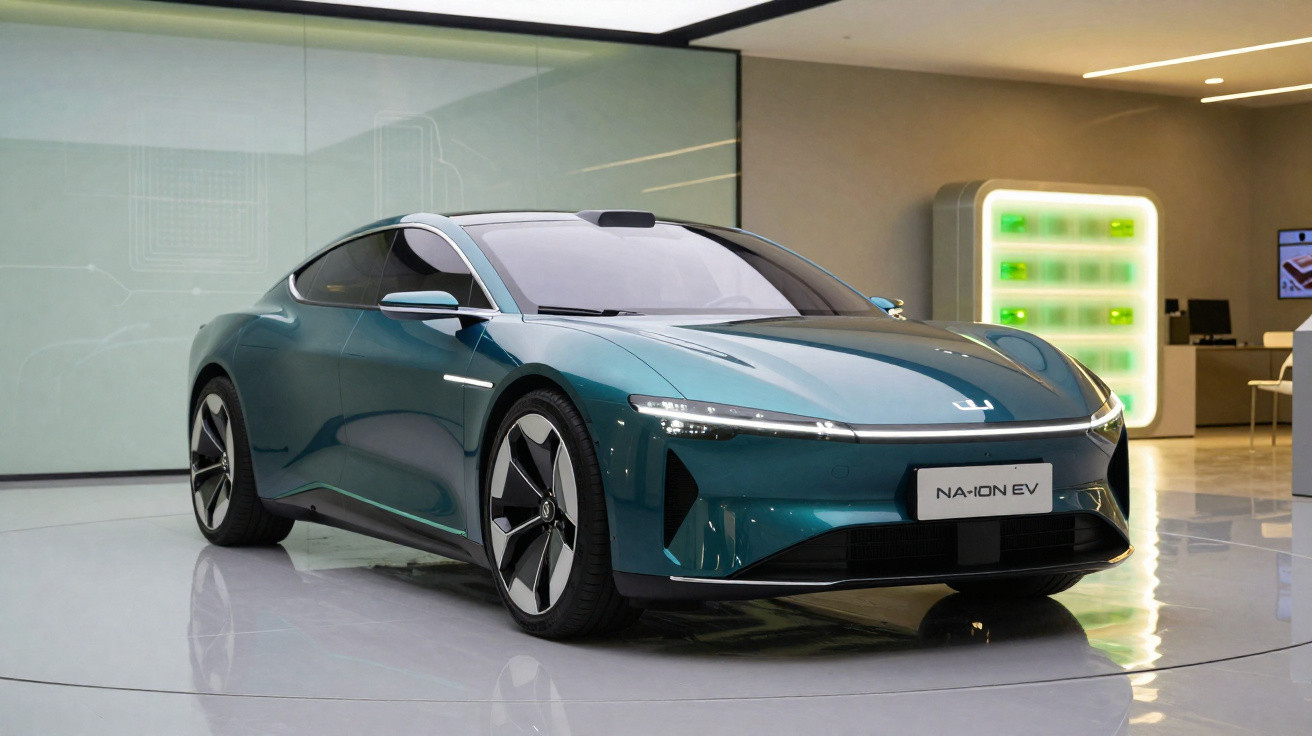
Rising battery costs have been one of the toughest obstacles in recent years as the car industry shifts from combustion engines to electric vehicles.
Battery prices have not fallen at the pace predicted a few years ago - the cost per kWh even increased in 2022 - so finding workable alternatives has become essential.
Cost pressure behind LFP and NMC battery choices
One option that has steadily gained prominence is the LFP (lithium iron phosphate) battery, which is around 20% cheaper than NMC (nickel, manganese, cobalt). Both are lithium-ion technologies; the price gap largely comes down to the materials used.
An even more affordable route is emerging: sodium-ion batteries. These stand out because they do not use lithium, and since sodium is the sixth most common element on the planet, they can be 10–20% cheaper than LFP. If production scales up, they could become cheaper still.
Why sodium-ion batteries are not yet common in electric cars
If sodium-ion batteries can be that much less expensive, why are they not widely fitted to electric cars? The key issue is energy density: it is lower than LFP, which in turn is lower than NMC.
Northvolt sodium-ion battery reaches 160 Wh/kg
Northvolt, the Swedish company and one of Europe’s largest battery manufacturers, now says it has developed a new sodium-ion battery with an energy density of 160 Wh/kg. That figure is a benchmark for the category and on a par with today’s LFP batteries.
“(…) I am very pleased to be able to say that we have developed a technology that will (…) accelerate the energy transition. (…) this type of battery technology is crucial to achieving global sustainability goals, making electrification more economical, sustainable and accessible worldwide.”
Peter Carlsson, CEO and co-founder of Northvolt
What Northvolt’s sodium-ion progress means for Europe
Northvolt is not alone in the race for sodium-ion batteries: Chinese giants CATL and BYD are also pursuing the technology. BYD, for instance, announced just a few days ago that it will build its first sodium-ion battery factory with an annual capacity of 30 GWh.
Even so, Northvolt’s development is positive news for Europe. Sodium-ion batteries - especially with local production - could help reduce Europe’s growing dependence on China for the supply of batteries used in European electric cars.
Advantages and disadvantages
Sodium batteries work in exactly the same way as any other battery: there is a cathode and an anode, and sodium ions (rather than lithium ions) move between them to generate electricity.
Compared with NMC and LFP, these batteries are safer, cheaper and more sustainable, and they can be made using abundant, regional minerals (iron and sodium). On the downside, sodium is heavier than lithium; combined with the generally lower energy density, this could make electric vehicles heavier than they already are.
“Our sodium-ion technology delivers the performance needed to enable longer-duration energy storage than alternative battery chemistries at a lower cost, thereby opening up new pathways for the deployment of renewable power generation.”
Peter Carlsson, CEO and co-founder of Northvolt
Where sodium-ion batteries fit first: electricity storage
Because costs are lower and these batteries tolerate high temperatures well, Northvolt plans to take the technology beyond Europe - including to Africa, the Middle East and India - using it primarily for electricity storage.
Will this sodium battery make its way into cars? They can already be used in some types of vehicles, but probably not in mainstream electric cars yet. Northvolt says the next generation of this technology, which promises higher energy density, will be better suited to automobiles.
Although it is already one of Europe’s largest battery manufacturers, Northvolt was only founded in 2016 in Stockholm, Sweden. It supplies (lithium-ion) batteries to BMW, Scania, Volvo Cars and the Volkswagen Group.



Comments
No comments yet. Be the first to comment!
Leave a Comment