
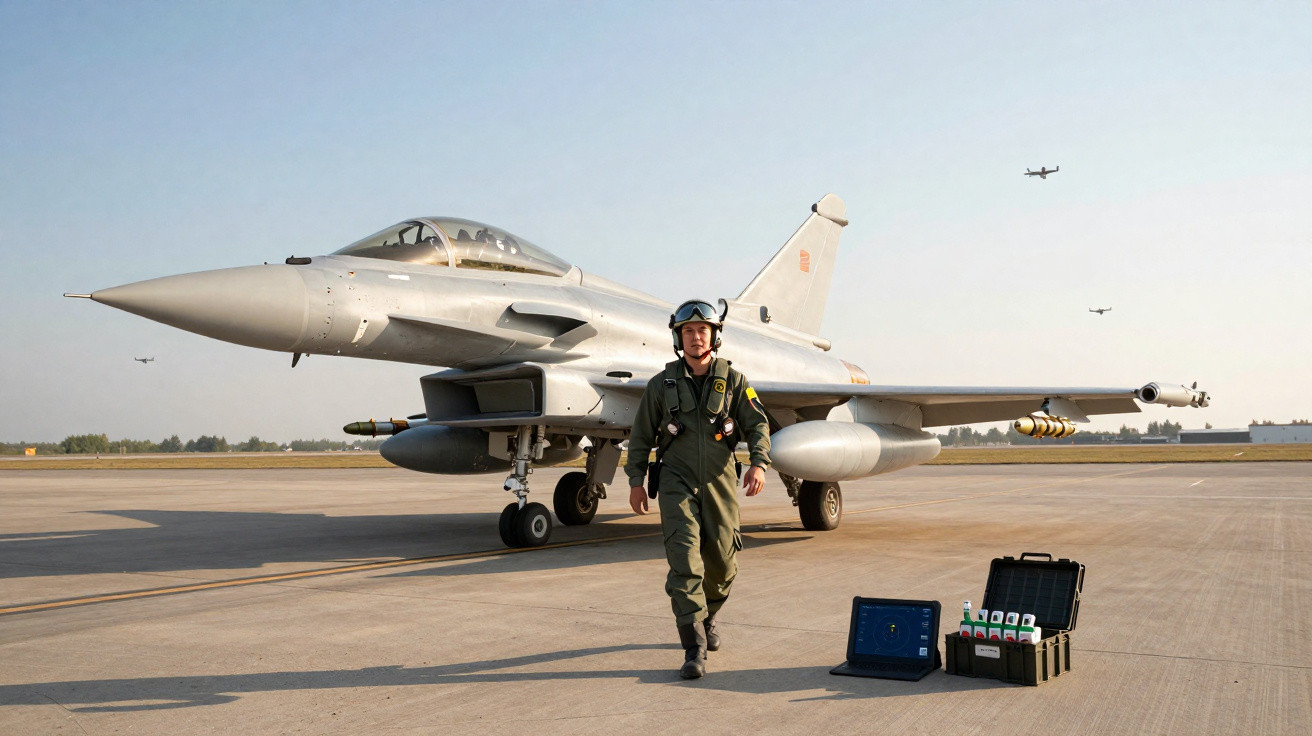
The addition of “low-cost” guided weapons to British Eurofighters marks another step in how the Royal Air Force (RAF) is adapting to the growing drone threat. By integrating the Advanced Precision Kill Weapon System (APKWS), Typhoon fighters now gain an extra, more affordable way to engage both air and ground targets compared with conventional air-to-air missiles.
APKWS upgrades unguided Hydra 70 rockets into precision-guided munitions by fitting a laser guidance kit. This gives pilots a more accurate means of striking targets while making better use of available stores. In doing so, the RAF aims to broaden its operational choices against emerging threats without relying solely on more complex and costly missiles.
A response to the rising drone threat
Recent operations have highlighted the challenge posed by low-cost unmanned aerial vehicles. In response, armed forces are looking for options that can support sustained operations without substantially increasing the expense associated with using high-end munitions.
Within that context, APKWS allows Typhoon crews to intercept certain targets at a fraction of the price of a traditional air-to-air missile. Its lower-yield warhead also helps to reduce the likelihood of collateral damage, which is particularly important in complex operating environments. The laser guidance system deploys control fins after launch and homes in on an illuminated target, enabling accurate strikes in both air-to-surface and air-to-air tasks.
From trials to operational capability: APKWS on RAF Typhoon
APKWS integration was delivered through close work between the UK Ministry of Defence, the RAF, and domestic firms BAE Systems and QinetiQ. The programme progressed on an accelerated timeline, driven by the need to field effective tools against low-cost airborne threats.
Assessment activity included trials conducted by Typhoon aircraft from the 41st Test and Evaluation Squadron. During these events, the fighters achieved successful engagements against ground targets as well as aerial threats. The testing also validated the system’s ability to defeat drones through specific fuze-system adjustments, allowing airborne targets to be destroyed at a considerably lower cost than traditional approaches.
The cost–benefit equation in modern warfare
The UK’s move fits a broader pattern seen across several recent conflicts. Systems such as Iranian-designed Shahed drones have shown that relatively inexpensive platforms can have outsized effects against infrastructure and military objectives, forcing armed forces to rethink the relationship between the interceptor’s price and the value of the threat being countered.
Set against missiles such as the AIM-9 Sidewinder, ASRAAM, or AIM-120 AMRAAM, APKWS provides a more economical alternative for dealing with certain categories of targets. Experience gathered in the Middle East and during the war in Ukraine has underlined the need for “low-cost” guided weapons-capability that now expands the combat options available to the RAF’s British Eurofighter Typhoons in an environment where drones play an increasingly prominent role.





Comments
No comments yet. Be the first to comment!
Leave a Comment