
About 30 years ago, downloading a single song could tie up the telephone line for hours - and any incoming call might drop the connection entirely. Today, 5G networks carry high‑resolution video, gaming and real‑time meetings, illustrating how the internet has shifted from a slow, fixed experience to an almost invisible part of everyday life.
How did dial-up internet work?
Widespread in the 1990s, dial‑up relied on a modem to convert digital data into signals sent over the phone network. Connecting came with its familiar screeching tones and meant you could not use the telephone at the same time. Even the most capable models, in ideal conditions, reached only 56 kbps.
At that speed, pictures would load line by line on the screen, and files of just a few megabytes required long waits. Even with these constraints, dial‑up introduced millions of people to what felt like groundbreaking tools: email, chat rooms, search engines and web pages reachable from anywhere in the world.
What changed with the arrival of broadband?
As ADSL, cable and fibre‑optic technologies spread, there was no longer a need to dial an internet provider every time you wanted to go online. Connections became “always on” and gained the capacity to move far larger amounts of data, paving the way for social networks, streaming services, cloud storage and remote work.
This shift also reshaped life at home. Computers, televisions, mobiles, games consoles and smart devices began sharing the same network. Instead of being something used only at specific moments, connectivity became essential infrastructure for studying, working, shopping, keeping in touch and consuming entertainment.
Why does 5G represent a new stage?
5G was designed to deliver higher speeds, lower latency and the ability to connect many devices at once. According to the International Telecommunication Union, the technology already reached 55% of the world’s population in 2025 and accounted for more than one third of mobile broadband subscriptions.
This step forward enables activities that depend on fast responses and reliable links:
- High‑resolution video streaming;
- Online gaming with less response time;
- Video calls for meetings and lessons;
- Home and business automation;
- Connectivity for sensors, machines and vehicles.
In real‑world use, performance varies with the frequency band in use, distance to the mast, physical obstacles, congestion and the equipment itself. That is why seeing the 5G icon on a phone or router does not automatically mean you will get the headline top speed. What you experience depends on the infrastructure available at your address and the network conditions at the time.
Watch the video shared by the TecMundo YouTube channel telling the full story of the internet, from dial‑up through to fibre optic.
Can 5G replace cable-based internet?
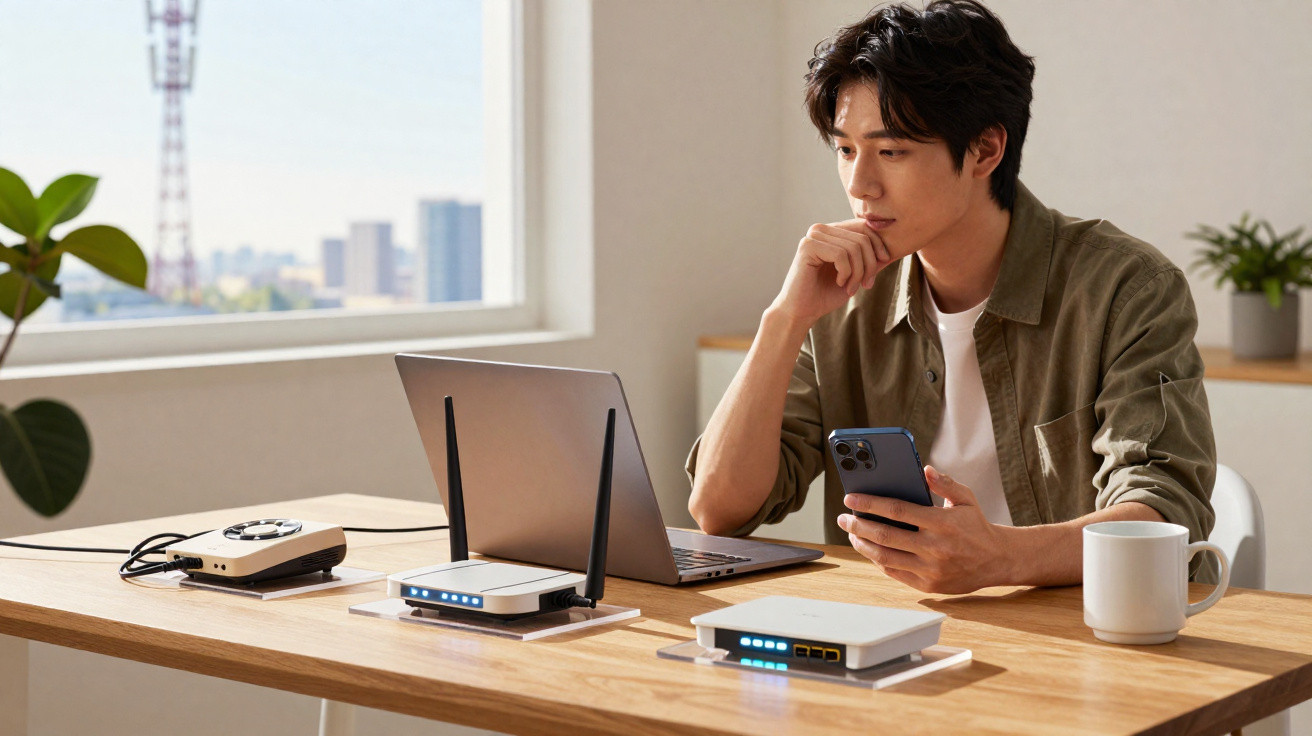
Fixed Wireless Access, known as FWA, brings a 4G or 5G signal to a router installed in the home, without needing fibre or cable run directly into the property. Ericsson recorded 185 million of these connections at the end of 2025 and forecasts 350 million by 2031, with 5G playing a major role.
This option can be particularly helpful for rented properties, holiday homes and areas where installing cables is expensive or slow. Fibre still tends to deliver more predictable performance for heavy use, but 5G is gaining ground thanks to straightforward installation, mobility, and the option to serve as either the main connection or a back‑up.
How to choose a future-proof connection
Before taking out a home mobile internet plan, it is important to check the coverage map, confirm any data limits and consider how many devices will be online. Router placement matters too, as windows and higher positions can improve signal. Hardware that supports modern Wi‑Fi standards will also distribute the connection more effectively around the home.
The journey from the noisy modem to 5G shows how each leap created behaviours that once seemed impossible. Now, the next change is already reaching inside people’s homes. Compare coverage, stability, data allowance and price before you decide, because choosing the right connection today can shape how your home works, learns and communicates in the years ahead.



Comments
No comments yet. Be the first to comment!
Leave a Comment