
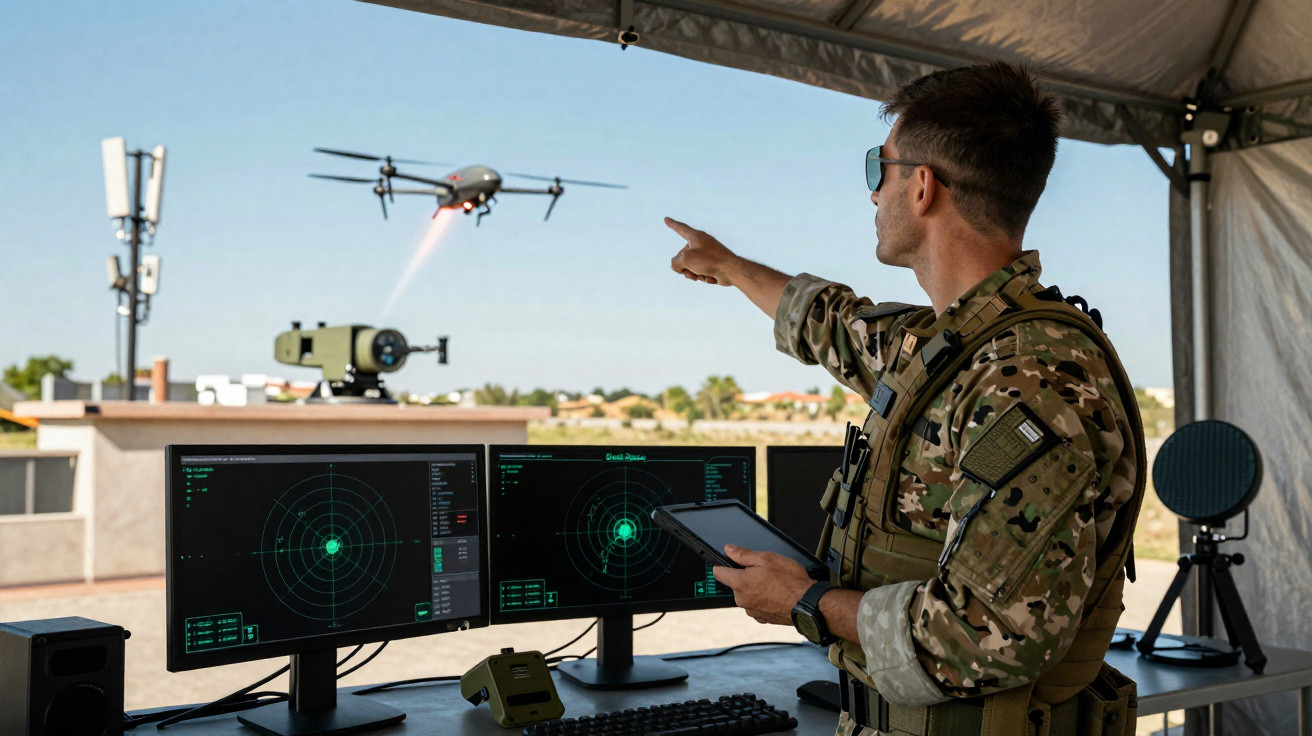
Integrated, multi-layer air defence in contested environments
The steady development of integrated, layered air-defence systems continues unabated. Unlike earlier generations, these capabilities can no longer be designed as standalone platforms; they must be networked and coordinated within a wider ecosystem that can respond efficiently and effectively to aerial threats operating at the tactical, operational and strategic levels of the battlefield, especially in contested operational environments.
Drawing on that trend, Turkey’s ASELSAN is driving a major effort with its Steel Dome air-defence system. Company representatives told Zona Militar during a visit to its systems-integration facilities in Ankara that Steel Dome is conceived as a multi-domain, multi-layer, multi-sensor and multi-effector solution, incorporating artificial-intelligence technologies to counter threats ranging from drones to aircraft and ballistic missiles, among others.
Operational lessons from the Syria conflict gave both ASELSAN and the Turkish Armed Forces an early indication of the impact drones and other uncrewed systems would have on the battlefield. That effect later appeared in full scale during the Nagorno-Karabakh conflict between Armenia and Azerbaijan, and then with stark clarity in the Russo-Ukrainian war.
As ASELSAN has noted, air-defence systems that work in isolation-without fast, reliable communications with command-and-control centres, and with limited ability to detect, process, classify and defeat threats-become easy targets when confronted by aerial vehicles of all kinds.
This is far from a minor issue. From an efficiency perspective, the fact that an air-defence system costing millions-and even hundreds or thousands of millions-of dollars can be destroyed by one or more drones worth only a few thousand dollars clearly illustrates how the battlefield has changed, and how armed forces must adapt, evolve and respond if they are not to be knocked out.
The same point matters because it directly affects the cost-and-sustainability equation. Today, militaries are pursuing capabilities that are not only effective, but also economically efficient-available in large numbers, at any time and in any place-supported by sizeable stockpiles and by production capacity that can sustain supply to deployed units during operations.
Based on its own experience feeding into the development and assessment of its defence systems, ASELSAN stated that one of the most important conclusions is the need to choose the most economical and most appropriate effector for each threat. Doing so demands detection, tracking, processing, analysis, classification and neutralisation capabilities that operate within ever shorter time windows.
Steel Dome by ASELSAN and the role of AI
A further takeaway-applied directly to Steel Dome’s development-is the requirement for high processing capacity built on the adoption of artificial-intelligence techniques, process automation and operator decision-support tools. These are intended to speed up human decision-making, drawing on a continuous flow of data and on redundancy in real-time information feeds from multiple sources.
DRONEDEF in Steel Dome: first and last layer of defence
During the visit to ASELSAN facilities in and around Ankara, Zona Militar obtained an initial look at what constitutes both the first and the last defensive layer of the overall system. This layer is designed to neutralise aerial threats such as FPV drones, loitering munitions, drone swarms and low-cost aircraft.
Within this first Steel Dome layer, ASELSAN brings together a broad set of soft-kill means-microwave systems, directed-energy solutions and electronic jamming-alongside more traditional hard-kill options based on short- and very-short-range anti-aircraft systems, including various KORKUT variants and other smaller-calibre systems.
As part of the tour, we saw several soft-kill solutions up close and also watched a capability demonstration at the company’s Technological Test Centre in Gölbaşı, where these systems were displayed.
Soft-kill systems demonstrated: İHTAR, GÖKBERK and EJDERHA
Among the systems highlighted-and supplementing the static display-we observed the İHTAR counter-drone system operating. With a range greater than 25 kilometres, it offers a dual function to detect, identify and neutralise UAVs and their swarms, using a combination of AESA sensors and electro-optical systems for television tracking or thermal imaging of threats.
In the directed-energy segment-commonly referred to as laser systems-the presence of GÖKBERK stood out. It appeared both as a mobile version mounted on a 4×4 lorry carrying a 5 kW laser, providing short- and very-short-range neutralisation capability at distances between 150 metres and 2 kilometres, and as a higher-power version designated GÖKBERK 10, fitted with a 10 kW laser.
Rounding out these soft-kill solutions was EJDERHA, based on an electromagnetic-wave emitter designed to destroy drones’ electronic systems and integrated circuits, thereby neutralising them both individually and in swarm configurations.
Hard-kill systems on show: GÖKALP, MİĞFER and KORKUT
Turning to the hard-kill options displayed, GÖKALP was a notable presence. It uses a hit-to-kill method through the deployment and launch of a physical effector to defeat drones at distances starting from 1,000 metres in the Class 1 version, and up to 7,000 metres for the Class 2 and 3 versions, offering a low-cost solution that complements the systems above.
It is also worth noting that DRONEDEF includes solutions based on cannons and other compact weapons, such as MİĞFER. Its primary role is to protect air-defence systems themselves, which-like the assets they are guarding-may be targeted by drones or other threats.
This system is built around lightweight 12 mm weaponry and complements heavier, more powerful anti-aircraft solutions such as the already well-known 25 mm and 35 mm KORKUT. It is designed to be easily installed and integrated on fixed weapon stations or on armoured and utility vehicles, as required.
Conclusions The first hands-on exposure to DRONEDEF provided another indication of the level of sophistication reached by Turkey’s defence industry in general, and by ASELSAN in particular. The company shows a clear awareness of how rapidly threats are evolving, and of the need for continual adaptation.
To that end, ASELSAN has been making significant investments not only in infrastructure-through the expansion of its Ankara facilities-but also in the ongoing training of its workforce and in adopting artificial-intelligence technologies so it can respond efficiently and effectively to customer requirements shaped by operational experience.
For that reason, while DRONEDEF is presented as the first defensive layer, in our assessment it also stands as both the first and the last line of defence within the Steel Dome air-defence system.
As seen in the Russo-Ukrainian war, drones are no longer launched from hundreds of kilometres away from their targets, but from ever shorter distances-and even from within the territory of the belligerents themselves. One need only recall Operation Spider Web driven by the Armed Forces of Ukraine, which moved camouflaged civilian lorries into Russia; their trailers carried FPV drone launch systems that struck bases of the Russian Aerospace Forces, with particular emphasis on strategic aviation aircraft.
These precedents set the tone: systems such as ASELSAN’s DRONEDEF are necessary for operating in contested environments that can be penetrated by multiple means-from the lorries used in Operation Spider Web to special-operations forces deploying uncrewed capabilities to strike and put critical air-defence systems out of action, as seen in Israeli attacks against Iranian anti-aircraft systems months ago.
Finally, in the case of ASELSAN and Turkey, it should not be overlooked that the country is surrounded by active conflicts or potentially volatile situations that could require the Turkish Armed Forces to be employed. Looking north of the Anatolian peninsula, the Russo-Ukrainian conflict continues with no end in sight; to the east lie long-standing tensions with Armenia, which recently fought an armed conflict with Azerbaijan-a country with which Turkey has deep geographical, historical, cultural and linguistic ties. To the south-east, and beyond the fall of Bashar al-Assad’s regime, Syria remains a focal point; while to the west the complex relationship between Greece and Turkey persists, with particular emphasis on the Cyprus issue. Nor should the conflict involving the United States, Israel and Iran be omitted, along with any situations that might arise from it and affect Turkey despite it not sharing borders with the latter two states.



Comments
No comments yet. Be the first to comment!
Leave a Comment