
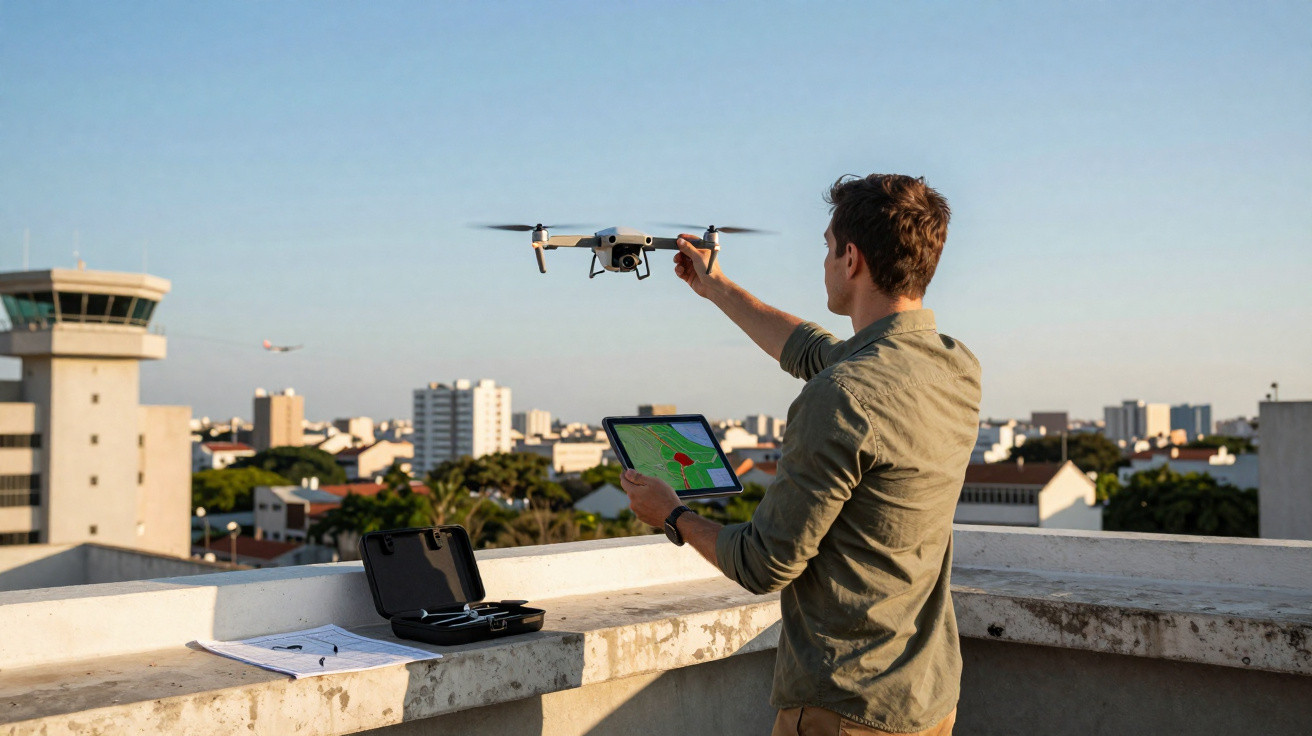
The updated edition of Aeronautics Command Instruction (ICA) 100-40 came into force on 1 July. Issued by the Department of Airspace Control (DECEA), it sets out the procedures and responsibilities for safe access to Brazilian Airspace by Unmanned Aircraft.
Updated ICA 100-40 from DECEA consolidates the rules
In this revision, the requirements for unmanned aircraft to access the airspace have been brought together in a single document. In doing so, ICA 100-40 replaces the separate manuals that previously dealt individually with special operations and the recreational use of model aircraft.
Key change: drones under 250 grams now also need to request access
A major change concerns aircraft with a Maximum Take-off Weight (MTOW) below 250 grams. Until now, drones in this category were exempt from requesting access to the airspace; under the new rule, that exemption is removed.
According to the Head of DECEA’s Unmanned Aircraft Planning Subdivision, Major Aviator Rodrigo Gonzalez Martins de Magalhães, the update means that every user will be able to check airspace restrictions before take-off.
“The rules for recreational flights have not changed: operations remain limited to 60 metres in height, keeping the drone within the pilot’s visual range and away from restricted areas, heliports and airports. However, because flight requests were waived for drones below 250 grams, many operations took place outside these conditions without the operator’s knowledge, since the only way for the user to know they are inside a restricted area is by using the request system. In this way, the Air Force, through DECEA, is extending the use of the tool to all users, enabling everyone to operate safely”, he explained.
Why the measure matters: more reports involving drones and aircraft
The change also reflects the rise in reported occurrences involving drones and manned aircraft. While Brazil has not recorded accidents of this type, reports of incidents and sightings have increased markedly in recent years. In 2024, 35 occurrences were recorded; in 2025, the figure rose to 57-an 83% increase.
More efficient processes, UTM Zone criteria and the new “Suitable Area”
ICA 100-40 also introduces adjustments intended to streamline processes. One of these is a shorter minimum lead time for requesting operations that depend on segregated airspace published through Aeronautical Information Service (AIS) products, reduced from 12 to eight calendar days.
The regulation also defines new criteria for operations in a UTM Zone, setting a limit of up to one hour per flight and maximum operational areas of 15 km² for VLOS (Visual Line of Sight) flights and 30 km² for BVLOS (Beyond Visual Line of Sight) operations.
Another development is the creation of the concept of a “Suitable Area”, understood as an airspace volume with defined dimensions. DECEA’s Regional Bodies will be responsible for establishing these areas, following a prior assessment of the operational impact of the intended activity.
SARPAS authorisations and a new app
Authorisations will continue to be issued via DECEA’s SARPAS system. From this month, users will also have access to an app designed to make it easier to use the platform.
For recreational operations conducted below 60 metres, keeping the drone within the operator’s visual line of sight and outside restricted areas, authorisation will be granted automatically within up to 30 minutes. More complex operations will be assessed by air traffic control bodies and may take up to eight days.
The new regulation was formally established by DECEA Order No. 2094/DNOR8 of 18 March 2026, published in the Aeronautics Command Bulletin (BCA) No. 58 of 30 March 2026.
To view the full text of the new ICA 100-40, click here.
Information from DECEA




Comments
No comments yet. Be the first to comment!
Leave a Comment