
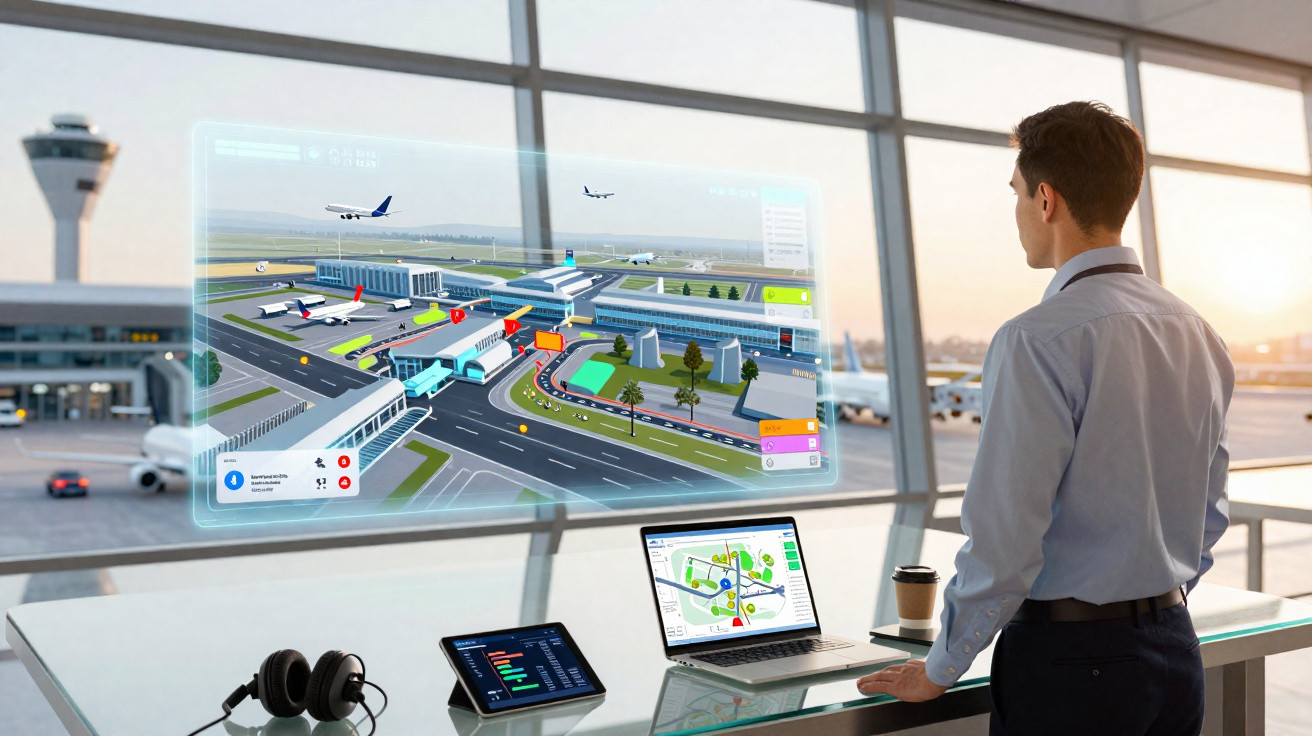
What Digital Twin technology is
Digital Twin technology creates a faithful, living virtual replica of a physical asset, infrastructure, system, or process. It is continuously refreshed using real-time sensor feeds, AI (Artificial Intelligence) and ML (Machine Learning) so that the model mirrors the real world’s current condition and behaviour.
Because it supports “What If” simulations, airport operators can trial scenarios and safely fine-tune performance before any change is deployed on site.
Why airports need a Digital Twin
In effect, airports operate like compact, self-contained cities, running under relentless operational pressure 24 hours a day, 7 days a week. Coordinating millions of passengers each year alongside thousands of interconnected systems creates conditions where a single component fault can trigger costly, reactive disruption.
Traditionally, critical infrastructure assets - from underground structures to the scheduling and management of aircraft movements on the ground - have been overseen by fragmented teams working with isolated datasets.
The key barrier to more efficient airport management has been the missing link between asset registers and their true, spatial, real-world components. Conventional computer-aided facilities management systems store technical attribute tables, but lack real-time geographic context.
By building a spatially accurate and dynamic digital replica of the physical environment, operators can bring together:
- Building Information Models (BIM) to define precise 3D geometry.
- Asset Management databases to track live maintenance records.
- Live IoT (Internet of Things) sensor streams to monitor asset conditions instantly.
This visual, integrated view fundamentally changes how airport teams interpret anomalies and helps them anticipate system-wide failures before passengers ever feel the impact.
Digital Twins for airport operations: core use cases
Airport Digital Twins have become a pivotal technology for running highly complex, fast-moving hub operations. They can be deployed across several critical functions, including:
1. Passenger flow and queue management
Real-time monitoring: By blending occupancy data, flow sensors and live flight information, Digital Twins can identify emerging bottlenecks (for example, at security screening or immigration) minutes before they become obvious on the terminal floor.
Resource optimisation: Airports can model passenger surges to dynamically redeploy security staff or trigger the opening of overflow lanes.
2. Airside operations monitoring
Turnaround optimisation: Digital Twins track aircraft positions, stand availability and Ground Service Equipment (GSE) within a single, shared environment. This makes it possible to measure and improve aircraft turnaround times, reducing expensive delays.
Runway and taxiway management: They monitor airside space utilisation, simulating movements to prevent conflicts and maintain safety.
3. Predictive maintenance
Equipment monitoring: The approach pulls together sensor data from baggage handling systems (BHS), escalators and passenger boarding bridges to track health and performance.
Predictive analytics: Rather than responding after equipment breaks down, the digital model spots anomalies and wear, enabling maintenance teams to schedule repairs during quieter periods.
4. Baggage handling optimisation
Operators can visualise how baggage handling systems behave and test routing ideas inside a 3D model to improve performance without disrupting or putting operations at risk.
5. Emergency response
Scenario testing: Digital Twins allow safety teams to rehearse disaster scenarios, security incidents and evacuations, improving emergency responses without stopping operations.
6. Infrastructure project (Capex) management
Before construction begins on a terminal expansion or new airside infrastructure, Engineering and Operations teams can see how the project will unfold and understand how multiple build phases overlap. This makes it easier to identify likely impacts on day-to-day operations and to launch a joint mitigation plan to remove or reduce those impacts.
The strategic roadmap for airport infrastructure: resource planning and long-term simulation
Beyond immediate, day-to-day operations, Digital Twin technology can also provide executive boards with a continuous, reliable historical record of infrastructure asset performance. When a particular asset type repeatedly underperforms under real loads, the Digital Twin flags the issue. That, in turn, feeds directly into Engineering specifications for future design-and-build contracts.
Operators can export known real-time datasets to run complex “What If” scenarios. This lets them test the operational impact of runway closures, major changes to aircraft ground routing, or terminal construction before altering anything in the real world. Ultimately, this shifts the Digital Twin from a facilities tool into an operational control centre for analysis, risk mitigation and planning.
Case study – Vancouver International Airport (YVR): the smart aerodrome
While facilities platforms often focus on monitoring performance inside buildings, Vancouver International Airport (YVR) has extended Digital Twin technology to the aerodrome itself. YVR’s intelligent 3D aerodrome model combines data from separate platforms to dramatically improve real-time situational awareness. Capabilities developed within YVR’s operational framework include:
1. AI stand-occupancy tracking: Acting like a visual “metal detector”, the platform trains existing CCTV cameras to recognise whether an aircraft is present. This automatically resolves data mismatches when aircraft are towed without official notification.
2. Flight trajectory analysis: Using AI/ML polynomial regression models to analyse historical approach trajectories, the system detects real-time altitude or speed anomalies. This proactively alerts Control Tower teams to unexpected behaviours, such as potential rejected take-offs or missed approaches.
3. CCTV-based passenger flow management: Analysis of metadata covering passenger dwell times, line crossings (specific locations) and object counts. This sets automatic thresholds that trigger queue alerts, removing the need for manual visual observation of the terminal and speeding up decision-making.
Case study – Denver International Airport (DEN): calculating the probability of failure
At Denver International Airport in the United States, which operates a vast aerodrome covering 135 km², the Digital Twin deployment is strongly focused on risk mitigation and facilities preservation indices. Facilities directors balance system-wide impact against the localised age profile of assets.
Failure probability is calculated using multiple inputs, including asset age, maintenance history and facility condition assessments over five years.
For instance, an escalator serving a critical, high-traffic security screening channel is automatically assigned a far higher failure rating than an identical asset located in a lower-traffic area.
By calculating failure probability via a real-time data pipeline - combining historical maintenance records from the Computerised Maintenance Management System (CMMS), original asset age and comprehensive facility condition assessments carried out every five years - Maintenance teams avoid reactive fixes and move towards a more rigorous preventive schedule.
When this criterion is embedded into a unified Digital Twin, DEN automates asset tracking and synchronises maintenance records directly onto a clear spatial layout. This approach improves resource allocation, reduces operational disruption and supports smoother passenger journeys by delivering a better experience.
Modern airports are no longer merely a physical junction of runway and concrete. They are a living, pulsating data ecosystem. As facilities grow and passenger volumes reach new record levels, fragmented legacy management systems cannot keep pace with the demand for flawless execution, exactly when it is required. Digital Twin technology closes that gap by turning chaotic, isolated data silos into a single, unified operational control centre.
By adopting available platforms and building bespoke solutions - as seen in Denver - forward-looking hubs are unlocking even greater strategic value:
1. From reactive to predictive: Airports can spot and anticipate critical asset failures - such as escalators or baggage conveyors - before they disrupt operations, shifting maintenance from costly, high-impact emergency response to an organised preventive timetable.
2. Optimised resource allocation: Seeing infrastructure workflows in real time and historically enables leadership to prioritise capital investment and replacement cycles based on real risk and real utilisation, rather than vague estimates.
3. Improved passenger experiences: Real-time CCTV analytics, passenger heat mapping and streamlined tracking remove terminal bottlenecks, keeping passengers satisfied and moving in a steady flow, while protecting airport profitability.
4. Advanced scenario simulation: Aviation operators can test future construction designs, weather impacts on operations, or aerodrome irregularities inside a safe virtual environment before applying them in the real world.
In this way, Digital Twins function as the central nervous system of modern airport operations and infrastructure. By harmonising complex systems into one clear, intuitive 3D view, the technology enables faster, smarter decisions, reduces costly operational surprises and delivers the smooth journeys today’s passengers expect.
Airports that embrace this digital evolution now are the ones most likely to pull ahead of competitors tomorrow.



Comments
No comments yet. Be the first to comment!
Leave a Comment