
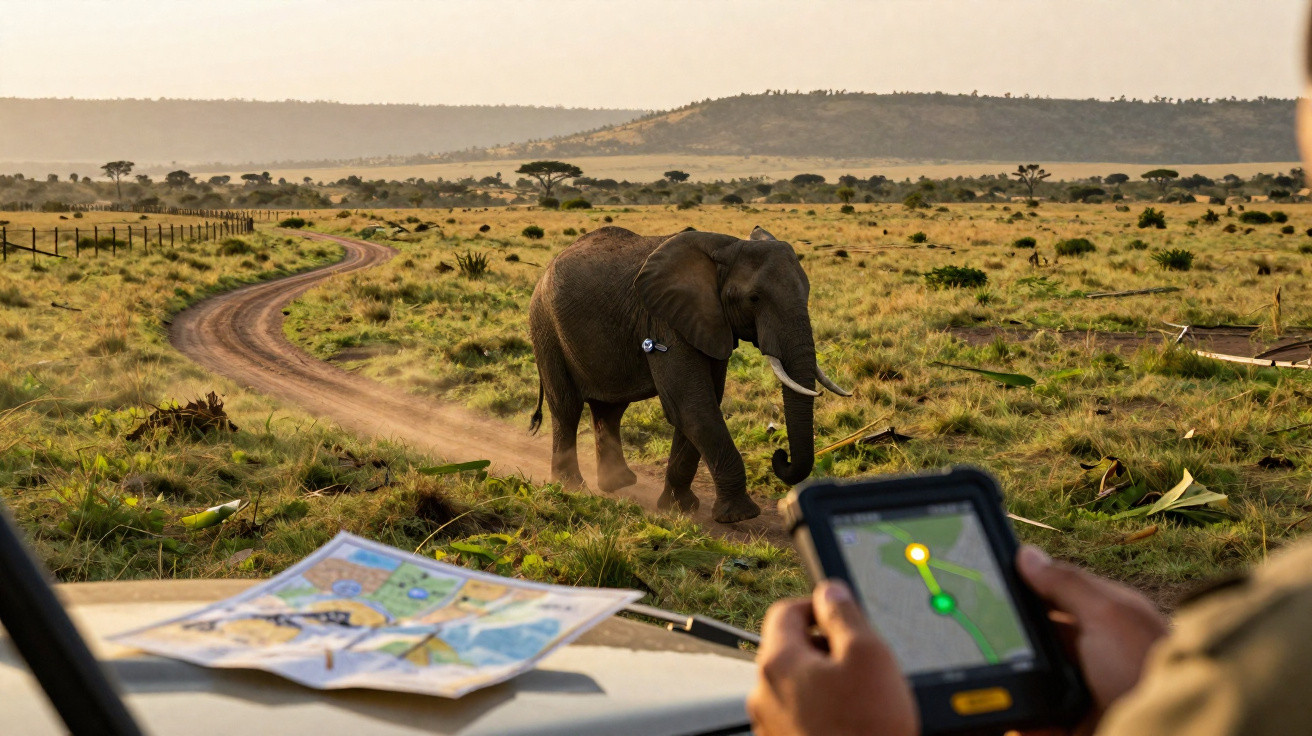
Tracking wild animals has uncovered an impressive achievement in African fauna. A young elephant covered thousands of kilometres, crossing political borders in four countries and showing how ancient migration routes remain embedded in the biological memory of these large species.
How did the tracking of elephant Z16 begin in Zambia?
In June 2023, researchers fitted a monitoring device to a young male known as Z16. The procedure took place in the northern part of Sioma Ngwezi National Park, in Zambia, marking the start of an in-depth study of animal movement.
Led by the research team, the project relied on advanced technology to follow the animal’s movements. The collar-mounted unit recorded precise location data, allowing this mammal’s travel to be mapped over months of continuous spatial observation.
A GPS-tracked wolf also surprised researchers when it reached a lake in Switzerland. During its satellite-monitored crossing, the predator chose to swim through the lake’s icy waters… Read more.
Which countries and parks did the elephant travel through on its journey?
Across two years, GPS tracking logged an extraordinary journey of nearly 12,000 kilometres. The route linked areas of Zambia, Namibia, Botswana and Zimbabwe, underlining the species’ remarkable capacity for long-distance movement.
Over the course of this journey, the elephant passed through six key conservation units that are crucial to regional biodiversity. Among the places visited were Mudumu, Okavango, Makgadikgadi and Hwange, highlighting the importance of keeping ecosystems fully connected.
Below is a video from the Google channel on YouTube that explores the points discussed in this topic in more depth:
How do elephants use ancestral migration corridors?
The information collected confirmed that the animal followed old routes used by previous generations. Its repeated use of the Sobbe corridor indicated that these animals carry an inherited mental mapping that is essential for crossing vast stretches of wilderness.
Even when faced with modern physical barriers and artificial political borders, native populations continue to move along their traditional paths. This strikingly accurate navigation shows how the collective memory of the species can persist despite intense human interference in Africa’s natural habitat.
Migration Highlights
Connected Corridors - Main observations from elephant Z16’s movement:
- 1
Coverage of nearly 12,000 kilometres in two years of continuous monitoring; - 2
Passage through six national parks in four countries in the region; - 3
Use of ancestral corridors such as Sobbe to move freely.
What challenges threaten migration routes in Africa?
The fast expansion of human infrastructure is becoming an increasing obstacle for local fauna. Building roads and containment fencing breaks up the landscape, making it far harder for these animals to travel freely between protected natural reserves.
Despite the strict limits created by human development, ecological corridors remain vital. The broad connectivity promoted by the KAZA initiative aims to safeguard these pathways, supporting the long-term survival of wild populations.
Key factors affecting the movement of these populations include:
- Barriers caused by fences and roads in transition zones;
- Fragmentation of natural habitats along state borders;
- The strategic importance of protecting cross-border corridors.
Why is cross-border conservation essential?
Linking national parks is central to maintaining biodiversity across the ecosystem. Free movement supports genetic variation and helps sustain the environmental balance needed for the region’s sustainable development.
The valuable findings from the tracking effort reinforce the urgent need to protect these natural routes. Stronger international policies help ensure that these giants can continue their historic journey in harmony with the wider environment.






Comments
No comments yet. Be the first to comment!
Leave a Comment