
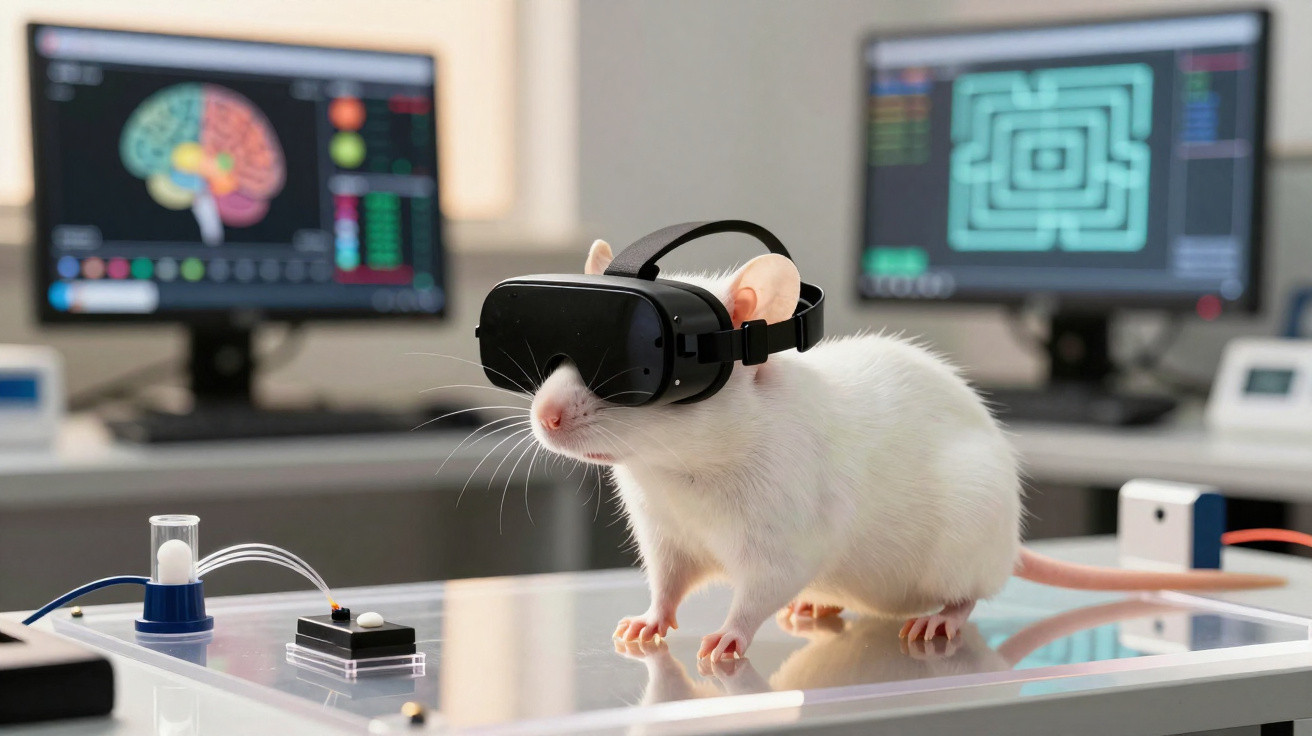
Researchers at Cornell University have developed miniature virtual reality headsets for mice. The system, called MouseGoggles, isn’t meant as a tiny break from lab life; it’s designed to give scientists a clearer window into animal behaviour and brain function.
MouseGoggles at Cornell University: how the mini virtual reality headsets work
The idea of a mouse wearing a VR headset is charming, but the setup isn’t as free-moving as the face-mounted goggles people use. Instead, MouseGoggles are supported by a scaffold and use two smartwatch-sized displays positioned behind a pair of Fresnel lenses. The system also includes technology to monitor eye movements and measure changes in pupil dilation.
Using this arrangement, mice rapidly learned to move through a virtual world by running on a spherical treadmill. The visuals also seemed to feel more convincing than before: viewed through MouseGoggles, the animals responded much more strongly to reward and fear cues than when similar virtual environments were shown on large 360-degree projector screens.
This isn’t simply a novelty. By making VR experiences more lifelike for mice, researchers can track brain activity linked to spatial navigation and memory with greater precision.
If you’ve ever put on a VR headset yourself, you’ll recognise how much more immersive it can be than watching on a large display. The new Cornell study suggests mice experience that difference too.
Earlier efforts to test mice in virtual environments typically placed them at the centre of circular screen setups, with imagery projected around the walls. Although the animals did learn to navigate while running on a spherical treadmill, what they saw was reportedly less persuasive.
Fear responses: the ‘looming stimulus’ test
To compare systems, the team evaluated mice using MouseGoggles and more traditional, screen-based VR with a ‘looming stimulus’.
In this test, a dark blob rapidly grew in the animals’ field of view to mimic an approaching predator. The mice didn’t just jump and arch their backs; they also reduced their walking speed, shifted their gaze, and their pupils dilated.
"When we tried this kind of a test in the typical VR setup with big screens, the mice did not react at all," says neuroscientist Matthew Isaacson, lead author of the study.
"But almost every single mouse, the first time they see it with the goggles, they jump. They have a huge startle reaction. They really did seem to think they were getting attacked by a looming predator."
Rewards, spatial learning, and what comes next
In more positive experiments for the animals, the researchers trained mice on a looped, linear VR track. The mice received liquid rewards when they licked at a particular spot. By the fourth or fifth day, the reward was withheld - yet the mice continued licking at the same location as if expecting a treat, and they reduced their ‘exploratory licking’ outside the reward areas.
Together, these outcomes suggested the MouseGoggles configuration can still support spatial learning in mice.
The longer-term aim is not improved VR gaming for rodents. More faithful simulations let scientists examine neurological responses across a broader set of scenarios than would otherwise be practical in the laboratory. As the looming-stimulus results indicate, projection-based VR simply doesn’t seem credible enough to mice.
"The more immersive we can make that behavioral task, the more naturalistic of a brain function we're going to be studying," says biomedical engineer Chris Schaffer.
The MouseGoggles design is also cheaper, and it makes it possible to add capabilities such as eye tracking.
According to the team, the next stages include creating wearable versions for other animals, and even bringing additional senses into the virtual experience.
"I think five-sense virtual reality for mice is a direction to go for experiments, where we're trying to understand these really complicated behaviors, where mice are integrating sensory information, comparing the opportunity with internal motivational states, like the need for rest and food, and then making decisions about how to behave," says Schaffer.
The research was published in the journal Nature Methods.





Comments
No comments yet. Be the first to comment!
Leave a Comment