
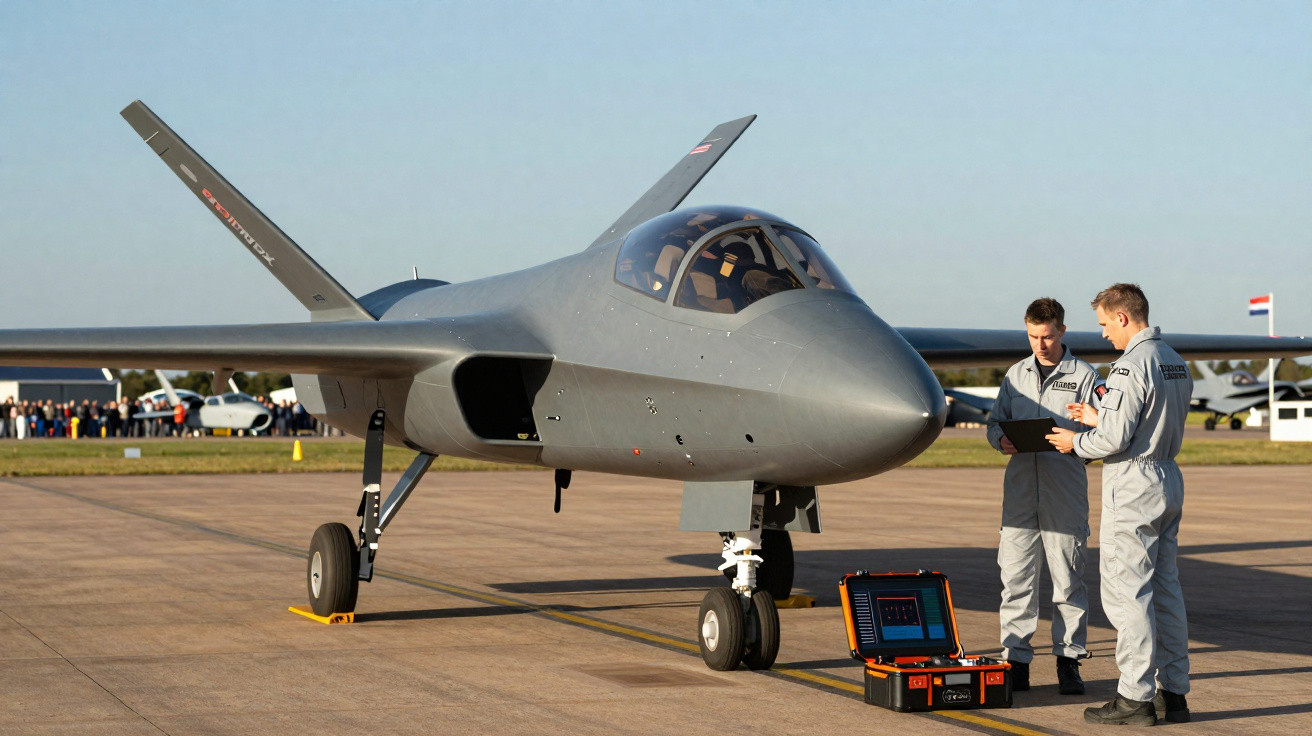
At the Farnborough International Airshow, BAE Systems unveiled Brontanax, the United Kingdom’s first autonomous Collaborative Combat Aircraft (CCA). The announcement was made in the presence of the UK’s new Secretary of State for Defence, Wes Streeting.
Brontanax CCA and collaborative combat roles
Like other collaborative combat platforms, the aircraft has been designed to operate alongside crewed jets, expanding combat capacity by providing electronic warfare capabilities and carrying out precision strikes against both air and ground targets.
Development by BAE Systems FalconWorks in Warton, Lancashire
The programme has been delivered by BAE Systems’ in-house FalconWorks team, which has involved more than 500 staff so far. Work took place at the company’s research and innovation centre in Warton, Lancashire, and was funded entirely by BAE itself, with investment exceeding £400 million (approximately US$ 530 million).
Control options, modular design, and future upgrades
Roughly similar in size to the Hawk advanced jet trainer currently in service with the Royal Air Force (RAF), Brontanax will be controllable either by nearby pilots flying Eurofighter Typhoon fighters or remotely from the ground.
BAE Systems also emphasised that the new collaborative fighter features an open architecture and a modular design, enabling continual upgrades to keep pace with the rapid evolution of military technology, including the United Kingdom’s future generation of fighters.
Brontanax’s public debut comes only days after the UK government reaffirmed its commitment to the collaborative aircraft concept.
The latest Defence Investment Plan allocates £300 million (US$ 400 million) to develop these “loyal” platforms under the Storm Fighter programme.


Comments
No comments yet. Be the first to comment!
Leave a Comment