
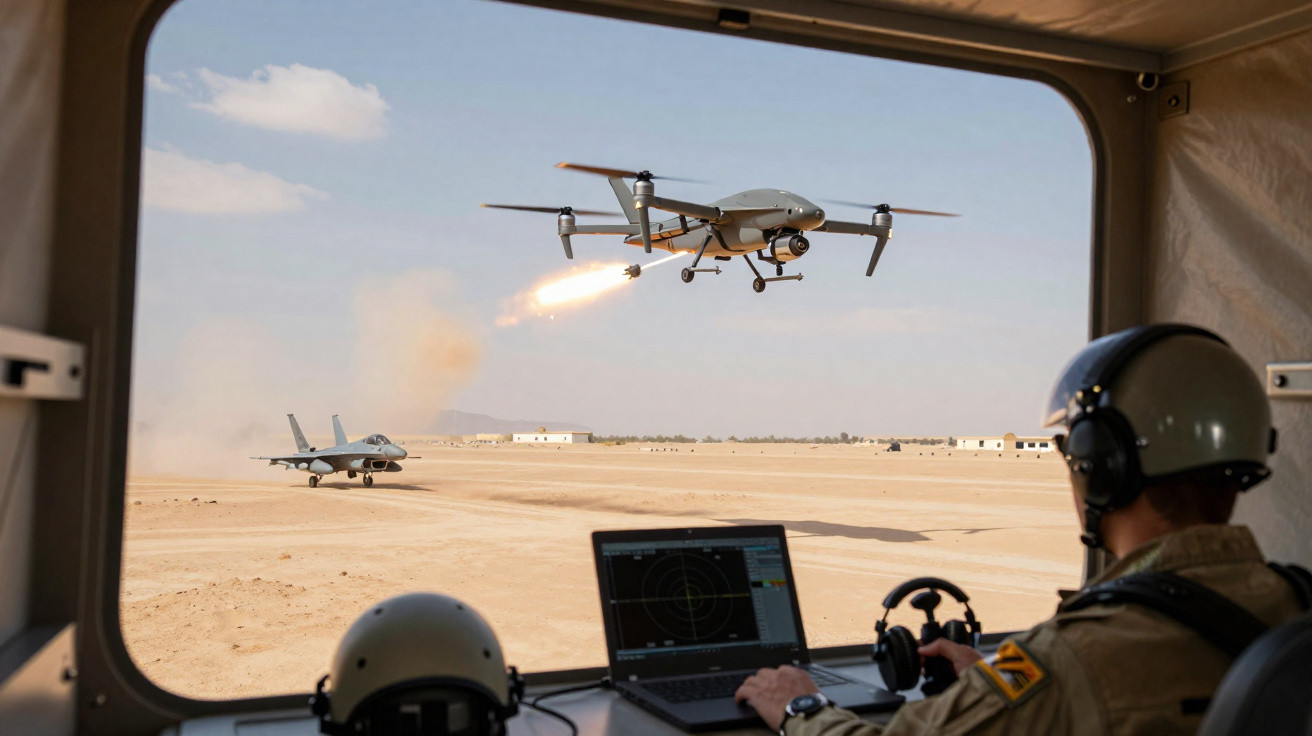
The United States Air Force (USAF) Collaborative Combat Aircraft (CCA) programme has reached another landmark after the YFQ-44A drone, built by Anduril Industries, successfully carried out its first air-to-air missile launch with an AIM-120 AMRAAM. The trial took place from Edwards Air Force Base in California’s Mojave Desert and marks the first time the platform has employed a weapon in a combat-representative scenario, underlining its future role alongside crewed fighters.
How the YFQ-44A executed the BVR engagement
In details released by the USAF and Anduril, the YFQ-44A completed a full Beyond Visual Range (BVR) engagement against a simulated target. During the test, the autonomous Lattice system was fed target data and, once a human operator granted permission, it launched an AIM-120 AMRAAM-confirming the entire employment chain, from detection through to weapon release.
The USAF Chief of Staff, General Kenneth S. Wilsbach, described the event as “an important step” towards bringing collaborative combat aircraft into operational service. Anduril, for its part, stressed that the achievement was not merely firing a missile, but proving end-to-end integration between sensors, autonomous software, data links and weapons systems within a complete operational architecture.
Designed to operate alongside crewed fighters
Produced by Anduril Industries, the YFQ-44A sits within the first tranche of the USAF’s Collaborative Combat Aircraft (CCA) programme. These aircraft are intended to work in concert with crewed platforms such as the F-35 Lightning II and the future F-47, taking on air superiority, strike, electronic warfare, reconnaissance and decoy tasks-while remaining under the oversight of a human pilot.
US officials have again emphasised that, despite the system’s high level of autonomy, the authority to employ weapons will remain solely with a human operator, who retains mission control throughout the sortie. The AMRAAM shot also represents the culmination of a test campaign that began earlier this year with inert weapons carriage trials, substantially raising the maturity level of a programme that envisions fielding around 1,000 collaborative combat aircraft over the coming decades.
Development continues to gather pace
This successful firing adds to a string of milestones recorded over recent months. After completing its first flight in November 2025, the YFQ-44A moved into low-rate initial production at the start of 2026. In June, the United States Air Force also awarded fresh contracts intended to speed development across the different CCA aircraft families.
At the same time, the programme’s other contender-the General Atomics YFQ-42A-is also expected to conduct its first weapons release before year-end, reinforcing a new phase in the evolution of these platforms, which are set to accompany the USAF’s next generation of fighters.



Comments
No comments yet. Be the first to comment!
Leave a Comment