
Most of the planet’s digital memory is stored on media that simply isn’t made to endure. Hard drives and magnetic tape can degrade within a matter of years, which forces organisations to keep copying files just to stop them vanishing.
As the volume of global data continues to balloon, that weakness becomes harder to ignore, placing growing strain on systems that were never intended for long-term preservation.
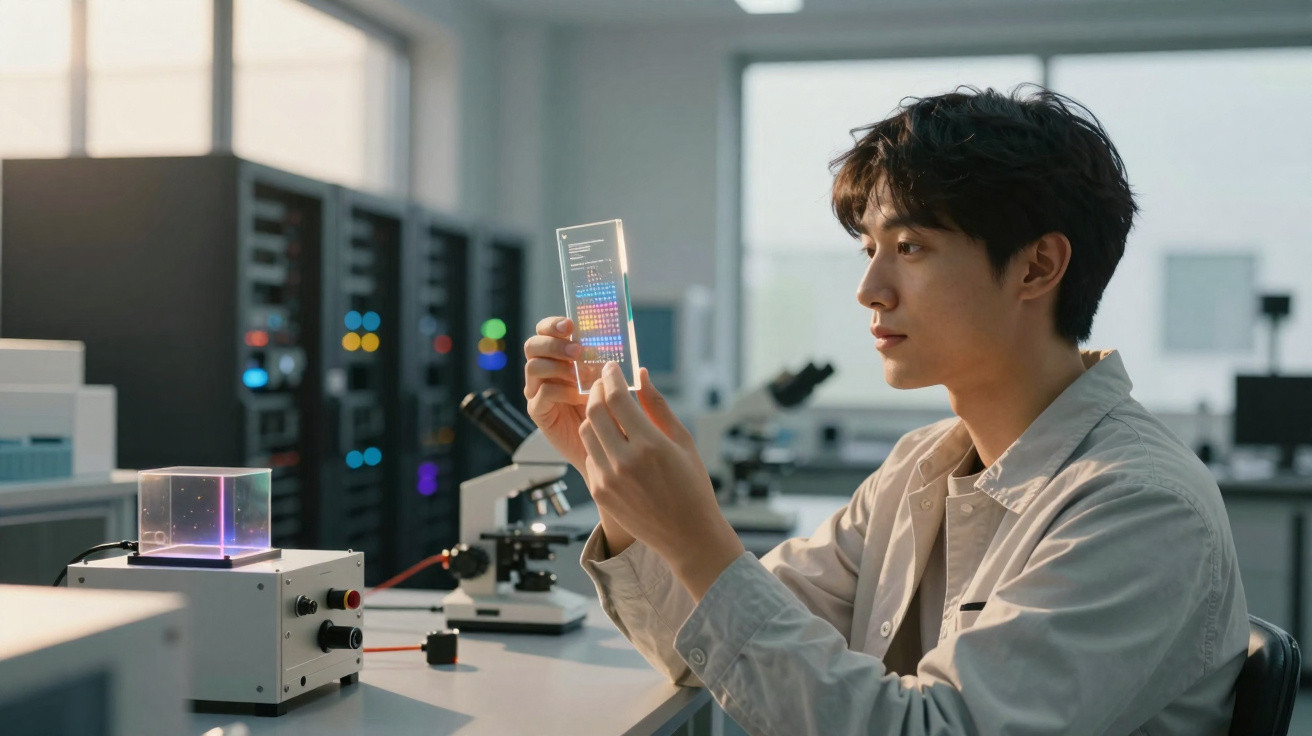
Researchers are now putting a different concept to the test: archiving information inside glass.
In one recent demonstration, a thin sheet of borosilicate glass stored nearly two terabytes of data and delivered it back without errors - hinting at a future where digital records could outlast today’s storage technologies by a wide margin.
Inside the data storage glass
Within a plate only 0.08 inches (about 2.0 mm) thick, 258 data layers were stacked into a highly compact record, held in a slab roughly 4.7 inches (about 11.9 cm) across.
Using that multi-layered “platter”, a Microsoft Research team outlined a system that can write, read and decode the data automatically.
The significance was not just the amount stored in the glass, but that the very same piece kept the information in a state the team could retrieve cleanly.
That shifts the central question from whether glass can store information at all to why archives need a medium that is designed to last.
Digital storage keeps failing
Modern digital storage has a persistent, understated flaw: it doesn’t endure. Data volumes are climbing quickly - roughly doubling every few years - while the hardware used to hold it can fail much sooner.
As a result, institutions end up migrating files repeatedly simply to keep them alive, consuming time, energy and equipment even when the data is not being accessed.
Glass points to a different model. After the information is written, it can remain intact without power or continual upkeep.
For long-term archives, that change matters more than headline capacity. Over decades, what counts most is how little maintenance the system demands.
Writing data with light on glass
Rather than burning or etching the surface, the method relies on minute bursts of light to create tiny internal changes within the glass.
Each pulse slightly modifies the way the material bends light, leaving a microscopic marker that encodes data.
Those pulses - femtosecond lasers - operate at extraordinary speed, lasting only a fraction of a trillionth of a second, and they place marks one by one.
Because the information is embedded inside the glass rather than sitting on the surface, it is far less exposed to scratches or everyday wear.
Reading data from glass
Retrieval is as vital as storage. To read the archive, researchers pass light through the glass and record the resulting patterns using a microscope camera.
Each minute marker - a voxel - represents a unit of data in three dimensions. When the voxels are packed tightly, their signals can blur slightly.
Software then analyses the patterns, rebuilds the original data and fixes minor errors as it goes. This stage is essential, because even the highest-density archive is useless if it cannot be read back reliably.
Glass stores data for 10,000 years
Durability is one of the strongest arguments for glass storage. The material can tolerate scratches, boiling water and high heat without erasing the data held within.
As one researcher put it, the archive can survive “benign neglect,” meaning it does not require careful, ongoing maintenance to remain usable.
Tests indicate the information could persist for more than 10,000 years at room temperature, although real-world threats such as stress and corrosion still matter. Even so, the long-term outcome will depend on how the glass is stored, handled and protected over time.
Why simple glass storage works
Compared with earlier high-density arrangements, Microsoft’s design uses borosilicate glass - the heat-resistant material found in laboratory flasks - and a generally less complex optical setup.
Long before this iteration, Peter Kazansky at the University of Southampton demonstrated that laser-written structures in glass could store data at even higher densities.
“\“If you want to send messages to the future, there is nothing better than storing them in glass,\”” he said.
That comment reflects Microsoft’s compromise: lower absolute density than the best fused silica (an extremely pure form of glass), but a more straightforward route towards practical use.
Speed could hold it back
Even a highly resilient archive will struggle if it is impractically slow. Data writing has to be usable in the real world, not merely achievable.
At present, the system writes by using multiple laser beams in parallel, reaching around 66 megabits per second.
That remains slower than conventional tape, but the approach could be accelerated by adding more beams and increasing parallel processing.
Ultimately, speed influences durability in practice, because organisations are less likely to adopt a platform that takes too long to write.
From lab to real data
This is not confined to controlled demonstrations. The project has already been used to store real material, including the film Superman and long-term music archives.
So far, these trials show the technique can handle real-world data, not just carefully prepared samples. Even so, Microsoft has not announced plans to commercialise the system.
For the moment, glass storage sits between breakthrough and product: technically compelling, but still awaiting a clear route into everyday deployment.
The next big data challenge
From here, the key issue is less whether glass storage works and more how cheaply it can be scaled.
More powerful lasers, a higher number of parallel beams and improved optics could raise throughput, while alternative glass types might improve density and efficiency.
Any operational deployment will also require robotics, redundancy and stable handling so the media can move safely between writing and reading.
That is the real change being signalled. What Microsoft has built is not a consumer backup drive, but a long-life archival medium intended to push decay, maintenance and data loss far further into the future.
Glass has already passed a major scientific milestone - but archival systems only become meaningful when institutions can afford them, run them reliably and trust them for the long term.
Even if it never becomes a commercial product, the implication is straightforward: digital memory does not have to fade on magnetic disks or deteriorate on tape. With the right approach, it can endure in glass.




Comments
No comments yet. Be the first to comment!
Leave a Comment