
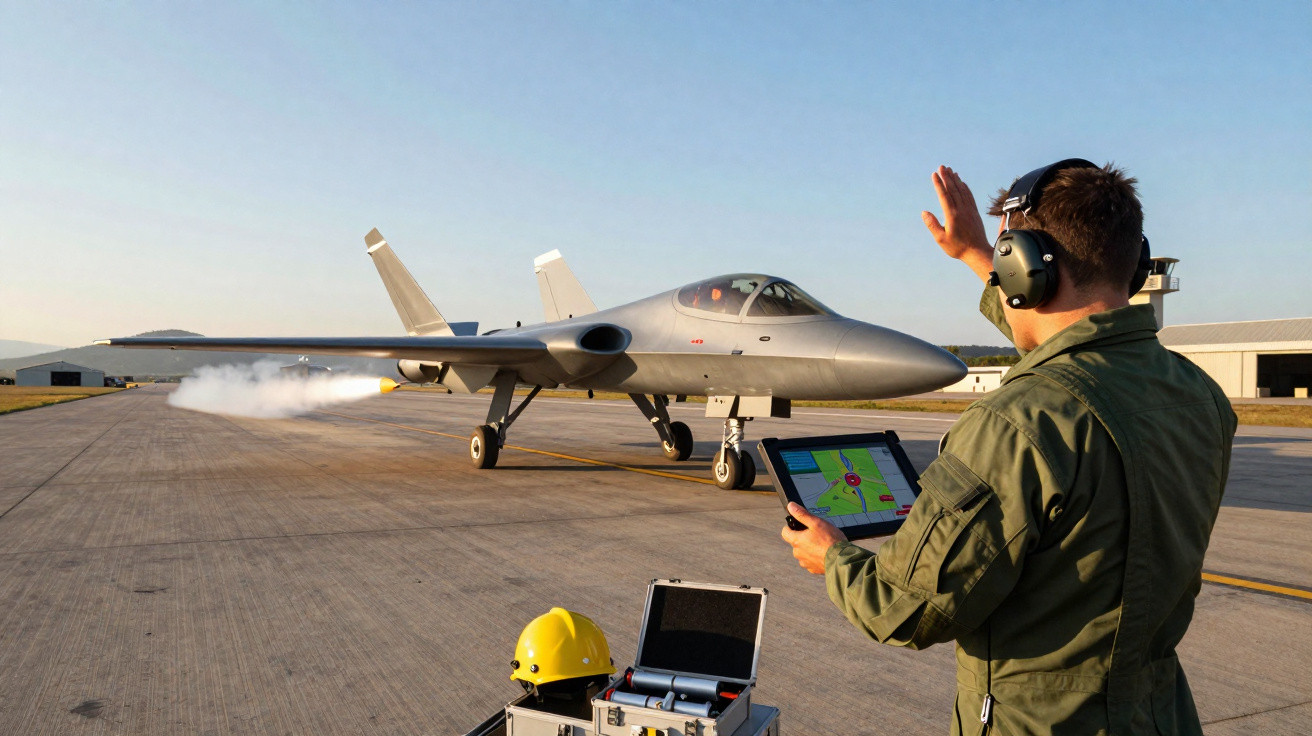
Successful JET230 ballistic missile firing
In a series of short posts on their official social media channels, Turkish companies Baykar and Roketsan announced that live firings have been carried out with the new JET230 ballistic missiles. The tests mark a significant step towards bringing the weapon into service on the advanced Kizilelma combat drones.
According to both firms, the trials were fully successful: the fired round struck its maritime target at roughly 120 km, with the Merzifon Air Base serving as the test venue.
Commenting on the milestone, Roketsan stated: “(Ed.: The missile) continues to be the firepower of our national platforms, and we continue working with the same determination and faith for a secure future for our country.” Baykar’s president, Selcuk Bayraktar, also sent a message to those involved in the test effort, congratulating them on what he described as the achievement of an important milestone.
Kizilelma JET230 trials: flight timeline and integration
Local media reports add further detail on how the event unfolded. The Kizilelma combat drone with tail number S2 initially departed Baykar’s Flight Training and Test Centre (in Tekirdag Province) on 8 July. After arriving at Merzifon Air Base, the aircraft was readied for the launch.
Only on 11 July did the unmanned system take off again, this time carrying two JET230 ballistic missiles. The aim was to engage a simulated target and, in doing so, assess the missile’s integration with the platform, as well as its accuracy and range.
JET230 design expectations and potential users
Regarding the JET230’s design, Turkish analysts have pointed out that it could offer a maximum range of around 200 km. If confirmed, that would be a notable improvement over the 150 km associated with Roketsan’s UAV-230 model, which was developed for launch from drones.
In addition, based on the chosen name for the new weapon, some reporting has raised the possibility that the company intends to position it not only as another tool for unmanned systems, but also for combat aircraft operated by the Turkish Air Force.
Wider weapons integration on the Kizilelma platform
From a Kizilelma-focused standpoint, it is also worth noting that Baykar has made a range of advances in recent months to integrate different Turkish-made weapons. This fits within a broader policy direction aimed at increasing Armed Forces autonomy by developing local industrial capabilities.
In that context, Kizilelma has already carried out tests with the Gökdoğan air-to-air missile, as well as guided munitions such as the TEBER-82 and TOLUN, among others.
In the case of the Gökdoğan missile trials, Kizilelma achieved a further milestone by demonstrating its suitability for interception missions and for shooting down aerial targets at beyond-visual-range distances, even when facing high-speed airborne threats. On that occasion, the drone was accompanied by no fewer than five F-16C/D fighter aircraft, which supported the trials and closely monitored the platform’s performance.
Finally, linked to the above, Kizilelma has also recently completed test flights alongside M-346 aircraft operated by Leonardo and the Italian Air Force, intended to confirm its ability to integrate into a formation of crewed platforms. As we previously reported, the event required prior development of so-called “smart fleet autonomy algorithms” and laboratory procedures in which both companies worked jointly. Various simulations were also conducted ahead of the real manoeuvres to prevent any kind of issue.





Comments
No comments yet. Be the first to comment!
Leave a Comment