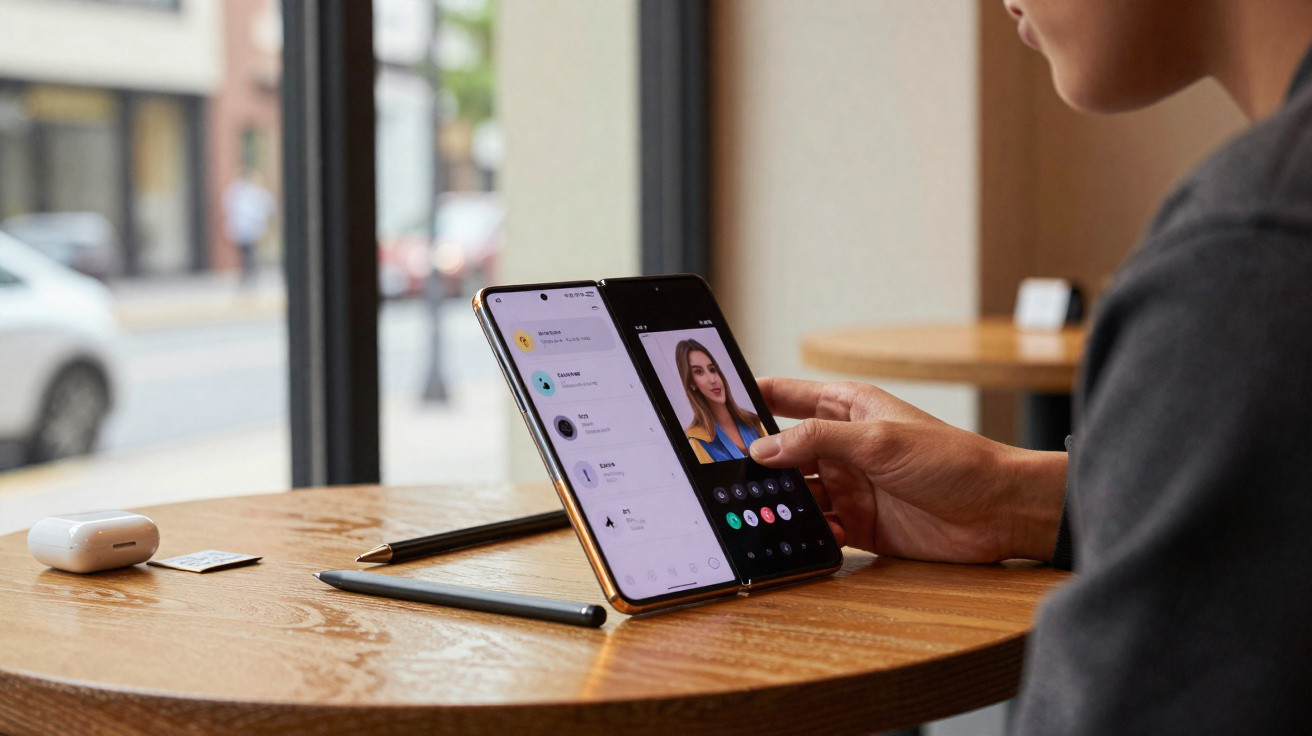
This new, more versatile form factor could well establish itself as the foldable standard of tomorrow. One major barrier remains: at this price, the entry ticket is still too expensive for what it delivers.
Were you waiting for the iPhone Fold to introduce the foldable smartphone that would bring this technology into the mainstream? Samsung has, as it so often does, beaten its American rival to the punch.
On 22 July, the market leader unveiled its latest foldable smartphone range. Having released two models a year since the first Z Flip, apart from last year’s Z Flip7 FE, Samsung has added a third device this year. The Galaxy Z Fold8 - not the Z Fold7’s successor - is the first smartphone sold in Europe in a passport-style format, which is also the form factor expected for the first foldable iPhone. The Z Fold8 Ultra, which does succeed the Z Fold7, and the Z Flip8 are modest updates to the previous generation.
Naturally, ahead of their 7 August release, all attention is on the Z Fold8. I brought a unit back from Samsung’s conference and used it for a week. Here is my verdict.
Samsung Galaxy Z Fold 8 256GB: best prices
Base price: €1,999
| Retailer | Discount | Price | Link |
|---|---|---|---|
| Amazon | -21% | €1,585 | View offer |
| FNAC | €1,999 | View offer | |
| Darty | €1,999 | View offer | |
| Samsung | €1,999 | View offer | |
| Rueducommerce | €1,999 | View offer |
View more offers
Why the Galaxy Z Fold8?
Before getting into the review itself, it is worth clarifying Samsung’s new naming system for its Korean foldables. The Z Fold8 does not replace the Z Fold7; that responsibility falls to the Z Fold8 Ultra. Why? Samsung says it has incorporated the bulk of the Galaxy S26 Ultra’s technologies so that its most expensive model is also its most powerful. The manufacturer also argues that this makes the foldable line-up as coherent as the Galaxy S range. It is not immediately obvious, but let us accept it.
The Galaxy Z Fold 8 range therefore breaks down as follows:
- The clamshell Z Flip8 is the least expensive and most mainstream model. It is aimed at consumers who enjoy social media and content creation.
- The Z Fold8 Ultra is the range’s most powerful book-style device. It retains the Z Fold7’s format, while its specification has been refreshed, particularly for photography.
- The Galaxy Z Fold8 sits between those two models. Closed, it resembles a small passport-style smartphone, ideal for quick everyday tasks. Opened up, like the Ultra, it becomes a device for entertainment and productivity. There are two important differences, though: it is smaller and lighter, and its camera system is less comprehensive, as I will explain later.
That covers the introductions.
What I liked about the Galaxy Z Fold8
Its passport-style form factor
The Galaxy Z Fold8 brings together the strengths of both worlds. From the Z Flip, it takes a compact design that handles quick everyday jobs. Social media, messaging and emails: the Z Fold8 lets you do more than a closed Z Flip while retaining compact dimensions of 123.9 x 81.9 x 9.7 mm and a featherweight 201 g.
This approach won me over. I particularly enjoyed typing messages on this display, for instance. I would nevertheless recommend using Gboard rather than Samsung’s pre-installed keyboard, since the latter takes up half the screen. Making calls is more pleasant too, as is browsing an audio streaming service, whose interface fits the 4:3 format perfectly.
From the Z Fold, it inherits versatility. When unfolded, the Z Fold8 reveals a 7.6-inch, 16:10 display made for entertainment. It also remains just as capable at multitasking. In landscape orientation, the larger viewing area is ideal for films, series and favourite games. Some titles, such as Call of Duty Mobile, even expand across the entire display. It is a genuine delight.
Used in portrait, the Z Fold8 becomes an e-reader or a compact tablet that makes web browsing and social media much more comfortable. On Instagram and TikTok, slim black bars appear at either side. Developers have not yet optimised their platforms for this distinctive format. Yet there is little doubt that Apple’s arrival will persuade them to put in the extra work required to remove this small flaw. Until then, I thoroughly enjoyed viewing Reels, TikToks and YouTube videos on this decidedly surprising phone.
Reading books on this screen is a constant pleasure. That is especially true for manga and comic-book fans, as these formats are perfectly suited to the display.
Finally, although it is a little smaller than the Z Fold8 Ultra’s, the Z Fold8’s internal screen is spacious enough to make it a formidable productivity machine. I regret the lack of stylus support, as it would have made an excellent note-taking tool, but the Z Fold8 includes features that deliver a superb multitasking experience. I could, for example, run up to three apps on a single screen and even add a floating window. I could also edit photos and assemble short videos without tearing my hair out. A real treat.
All of this requires high-end hardware. Performance is there too, thanks to the inclusion of the Snapdragon 8 Gen 5 chip, Qualcomm’s latest gem. Although throttling can occasionally be aggressive, with performance drops of up to 60%, the Z Fold8 always met my demands. Certain jobs, including video editing, do make it run a little warm, but never to a particularly disruptive extent.
As you will have gathered, I have greatly enjoyed using this little foldable, which slips easily into a pocket. Beside it, my iPhone 17 Pro Max and OPPO Find X9 Pro feel almost huge, despite offering a far less enjoyable entertainment and productivity experience.
Displays without a crease in sight
If there is one area in which Samsung could not afford to disappoint, it is the screen. After several generations of foldables, the Korean company finally seems to have found the right formula. The Z Fold8 introduces a new generation of Flex Titanium panel alongside an entirely new hinge. Together, these refinements make the crease almost imperceptible, both to the eye and under the finger. You now have to inspect it twice, from a very particular angle, to spot it. Since I had the product for only one week, I will not comment on how the crease might develop over time. I will return to that in my several-month review.
The 7.6-inch internal AMOLED panel has a 120 Hz refresh rate, while the external 5.5-inch display also runs at 120 Hz. Both panels reach 2,600 nits of standard brightness, or 3,000 nits at peak, allowing comfortable reading in direct sunlight. That might seem normal for a conventional smartphone, but foldable displays are usually highly reflective. Here, Samsung has done exemplary work with an anti-reflective coating on the internal screen. A year after the Z Fold7, there appeared to be very little room for improvement. Samsung has nevertheless found a way to do better.
You will therefore not be surprised to learn that I loved watching films, series and YouTube videos on this generous, exceptionally high-quality panel. Indeed, if rumours are to be believed, the future iPhone Fold will also use panels made by Samsung Display.
Polished software
Samsung’s experience with foldable smartphones is equally apparent in its software. OneUI 9 has matured further, managing continuity between the outer and inner displays with disarming smoothness.
Galaxy AI features are available on both displays, including live translation during calls, note summaries and generative photo editing. None is genuinely new compared with the rest of the Galaxy S26 range, but their integration into the foldable format, especially through multi-window use, is excellent.
The icing on the cake is the inclusion of Samsung DeX. This mode turns the phone into a miniature computer when it is connected to any monitor via USB-C, HDMI or wirelessly. Once connected, a desktop interface appears on the display; pair a Bluetooth keyboard and mouse with the phone, and you have a computer more than capable of handling most productivity needs. Using DeX, I was able to edit photos, write part of this review and edit videos.
Samsung’s years of experience have resulted in the most complete software currently available on a foldable smartphone. OneUI 9 on the Galaxy Z Fold8 can serve as a smartphone, tablet, e-reader, games console and PC all at once. I am keen to see how Apple responds with its foldable iPhone.
Samsung Galaxy Z Fold 8 256GB: best prices
Base price: €1,999
| Retailer | Discount | Price | Link |
|---|---|---|---|
| Amazon | -21% | €1,585 | View offer |
| FNAC | €1,999 | View offer | |
| Darty | €1,999 | View offer | |
| Samsung | €1,999 | View offer | |
| Rueducommerce | €1,999 | View offer |
View more offers
What I liked less about the Galaxy Z Fold8
Disappointing battery life
Anyone who follows technology news knows that foldable smartphones pose engineering challenges when it comes to fitting components in, particularly batteries. Unfortunately, the Galaxy Z Fold8 does not perform miracles. Samsung has at least finally adopted silicon-carbon technology to fit a 4,800 mAh battery into this tiny chassis. Out of caution, however, the Korean company has not gone as far as its Chinese rivals, using silicon-carbon in a smaller proportion.
In practical terms, during a typical day involving social media, a few episodes of a series, web browsing, a little photo editing, video editing and a 30-minute gaming session, I needed to recharge the phone early in the evening. That is not alarming for moderate use, but when the 7.6-inch internal screen is running at 120 Hz with high brightness, battery life falls away much faster than on a conventional smartphone. Battery life is therefore fairly disappointing.
A convincing charging experience might have been some consolation. That is not really the case, despite 45 W wired charging, up from 25 W last year. In the name of durability, Samsung has altered the charging process so that both built-in batteries fill simultaneously. The result is slower charging. On average, I waited 1 hour 30 minutes for the Z Fold8 to recover a full charge. A shame.
A highly frustrating camera
On the photography side, the concerns I raised during my initial hands-on are confirmed after a week of testing. The Z Fold8 makes do with two 50-megapixel sensors paired with a wide-angle and an ultra-wide-angle lens. Samsung has therefore omitted a telephoto lens from a €2,000 smartphone. The company says it lacks the space for a telephoto module. I might have forgiven it, perhaps, if it had chosen a 200-megapixel main sensor to compensate, as it has on the Ultra version. Instead, I see a strategy designed to push buyers further up the range. Choosing a 50-megapixel sensor can only be explained by a desire to protect margins.
The outcome is that zooming beyond 2x digital zoom is impossible without losing image quality, which quickly becomes limiting for street photography or travel photography - an irony for a passport-style phone. In low light, the ProVisual Engine processing system does its utmost to reduce digital noise, but the results remain well below the standards expected of a smartphone at this price, even a foldable one.
In reality, the Galaxy Z Fold8 only lives up to its positioning when lighting conditions are ideal: outdoors in daylight. That is not especially impressive given that smartphones costing five times less can achieve the same.
Samsung partly makes up for this through a few effective features, but above all through its video expertise. A new dynamic reframing feature can turn a horizontally filmed wide shot into vertical social-media content while tracking the chosen subject. It is exceptionally easy to use and proves interesting, even though image quality deteriorates in low light.
I had hoped Samsung would be more generous with photography. It is not, and I found the experience very frustrating. If, like me, photography matters to you, look instead to the far more complete Galaxy Z Fold8 Ultra. If you are content with everyday photos and videos, the Z Fold8 will do the job very well.
A stratospheric price
The Galaxy Z Fold8 costs €1,999 in its 256GB version, €2,199 with 512GB and €2,399 for the 1TB model. It is therefore €700 more expensive than the Z Flip8, which starts at €1,299, and only €200 cheaper than the Z Fold8 Ultra, which is better equipped for photography and battery capacity.
This pricing is unquestionably the Galaxy Z Fold8’s biggest weakness. Worse still, Samsung has missed an opportunity to truly unsettle Apple, whose first foldable smartphone is expected to cost around €2,500.
Samsung partly attributes the price to the sharp rise in memory-component costs over recent months. Fair enough. Yet at this price, the Z Fold8 is not compelling enough to finally bring a market mainstream that it entered seven years ago without ever taking off.
The good news is that the Z Fold8 can be found at a very attractive price from launch. With trade-in offers and pre-order bonuses, some retailers list it at around €1,300. At that price, if you can afford it, I warmly recommend it.
Galaxy Z Fold8 Ultra: the true Fold7 successor
The Z Fold8 Ultra is the genuine successor to the Z Fold7. It targets a very different audience, one more focused on productivity and willing to give up some compactness.
Its display is therefore larger at 8 inches, it has a triple-camera system partly inherited from the S26 Ultra, including a 200-megapixel module, and a bigger 5,000 mAh battery. In return, it is slightly heavier at 215 g, but above all bulkier and €200 more expensive.
If your priorities are work, multitasking or photography, the Ultra remains the range’s most rational choice. Provided you can afford it.
Samsung Galaxy Z Fold 8 Ultra 256GB: best prices
Base price: €2,199
| Retailer | Discount | Price | Link |
|---|---|---|---|
| Amazon | -19% | €1,785 | View offer |
| Cdiscount | -10% | €1,986 | View offer |
| FNAC | €2,199 | View offer | |
| Darty | €2,199 | View offer | |
| Samsung | €2,199 | View offer | |
| Rueducommerce | €2,199 | View offer |
View more offers
Who is the Galaxy Z Fold8 for?
This week of testing has helped me define the typical Galaxy Z Fold8 user more clearly. First and foremost, it is the ideal companion for people who consume a great deal of content every day: social media, series, video games, manga and comic books. For all these activities, its 16:10 screen is unquestionably its finest asset.
It is above all a strong option for anyone wanting a compact smartphone for daily messages, calls and quick browsing that can transform into a productivity and entertainment machine. Of every foldable model currently available, the passport-style format is unquestionably my favourite.
On the other hand, you should look elsewhere if photography plays a major role in your use, or if your budget is below €1,500, which is already a very comfortable sum. Take care too if battery life is one of your buying criteria, as the Z Fold8 is very average in this respect and charging remains slow.
Samsung Galaxy Z Fold 8 256GB: best prices
Base price: €1,999
| Retailer | Discount | Price | Link |
|---|---|---|---|
| Amazon | -21% | €1,585 | View offer |
| FNAC | €1,999 | View offer | |
| Darty | €1,999 | View offer | |
| Samsung | €1,999 | View offer | |
| Rueducommerce | €1,999 | View offer |
View more offers
My verdict on the Galaxy Z Fold8: a promising start
Does the passport-style format have a future? After a week with the Galaxy Z Fold8, I am convinced it has everything required to finally make foldables mainstream. Samsung has struck the right balance between compactness and comfort in use. With the iPhone Fold about to adopt the same proportions, this format could become the new foldable smartphone standard over the coming years.
Samsung could still have done better, however. The underpowered camera module deserves a more ambitious second generation. Battery life must also keep pace with a device designed around entertainment. Lastly, the Korean company has completely misjudged the price, the greatest obstacle to widespread uptake of this foldable format.
The Z Fold8 is not yet the perfect foldable smartphone. But it outlines the direction the market should take in the months and years ahead. It remains to be seen whether Apple can match it, or even surpass it, with its iPhone Fold expected by the end of this year or at the beginning of next year.
Why are we not scoring the Galaxy Z Fold8?
Given the excitement surrounding the Galaxy Z Fold8, Samsung was unable to lend it to us for more than one week. As we had to return it to the brand so it could be shared with our fellow journalists, which is entirely normal, we could neither carry out laboratory testing nor use the phone long enough to award a final score. We will add this score when we have the chance to test the phone for at least one month, later this year.


Comments
No comments yet. Be the first to comment!
Leave a Comment