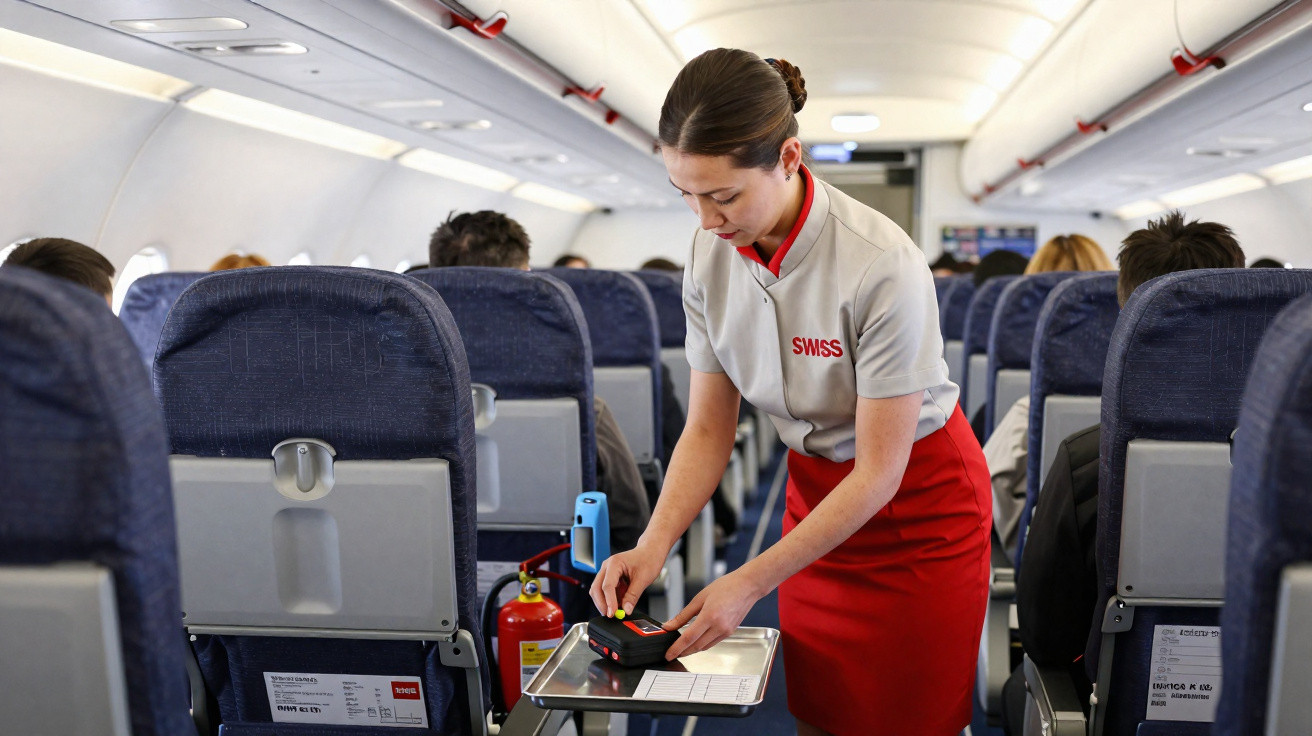
SWISS has this week released the findings of its investigation into the incident on flight LX16, operated between Zurich, Switzerland, and New York, United States, by an Airbus A330-300. The airline confirmed that the smoke seen on board came from a headphone charging case that became trapped in an aircraft seat.
The incident took place last Monday (27), when the Airbus crew diverted the flight to Bangor International Airport in the US state of Maine after smoke appeared in the cabin. The aircraft landed safely.
SWISS investigation into smoke on flight LX16
After passengers disembarked, SWISS sent a technical team to the airport to examine the aircraft. The airline said its investigation established that the case had slipped into the internal structure of a seat, where it became jammed. The resulting damage caused it to heat up and release smoke.
According to the company, it was an ordinary case which not only stores Bluetooth wireless headphones but also charges them through an integrated battery, in a similar way to a power bank.
SWISS stressed that many electronic devices use lithium batteries, which may overheat and, in more serious circumstances, start a fire if damaged or faulty. It therefore reiterated the existing rules governing the carriage and use of such equipment during flights.
Power bank and electronic device rules on SWISS flights
Since the start of this year, power banks have been prohibited from use on the airline's flights. Passengers are consequently not allowed to use them to charge electronic devices or recharge the power banks themselves during the journey.
Despite the restriction on use, each passenger may still carry up to two power banks in hand luggage or on their person. The devices must remain with the passenger, in the seat pocket or in a bag stowed beneath the seat in front. They are prohibited in checked baggage and in the overhead cabin lockers. The same requirements apply to electronic cigarettes.
The airline also said that its pre-departure safety video instructs passengers to alert the crew immediately if an electronic device becomes hot, gives off smoke, is damaged or falls beneath a seat.
SWISS stated that, while the LX16 incident involved only a small charging case, higher-capacity batteries, including those in conventional power banks, can pose considerably greater risks if damaged or malfunctioning. The company said it would continue its awareness campaigns on the issue and reiterated that safety also relies on passengers following the rules.
Crew response and clarification over the LX16 incident
The airline praised the actions of the LX16 crew, saying the pilots correctly followed the procedures for situations involving smoke of an unknown origin. In such cases, the protocol requires an immediate diversion to the nearest suitable airport, a preventive action taken to safeguard safety.
Cabin crew were also recognised by the company. SWISS said they receive specific training to deal with fires, smoke and devices powered by lithium batteries. Every aircraft in the airline's fleet also carries special fire-resistant bags, known as Lithium Safe Bags, which are used to isolate equipment that overheats or swells.
Finally, SWISS clarified that incorrect reports are still circulating claiming that a fire occurred in the cockpit of flight LX16. The airline said this never happened, reiterating that there was only smoke in the passenger cabin, visible solely in the forward section of Business Class. According to the company, the United States Federal Aviation Administration (FAA) shortly afterwards corrected an initial report that had mistakenly referred to a cockpit fire.












Comments
No comments yet. Be the first to comment!
Leave a Comment