Engineering motion at very small scales is becoming more difficult at the same time as medicine, electronics and robotics increasingly require devices that flex rather than fracture.
Researchers have demonstrated that rotation need not rely on rigid components: it can instead be produced by a soft, flowing material. This could reshape what engineers can create in settings where rigidity is a drawback.
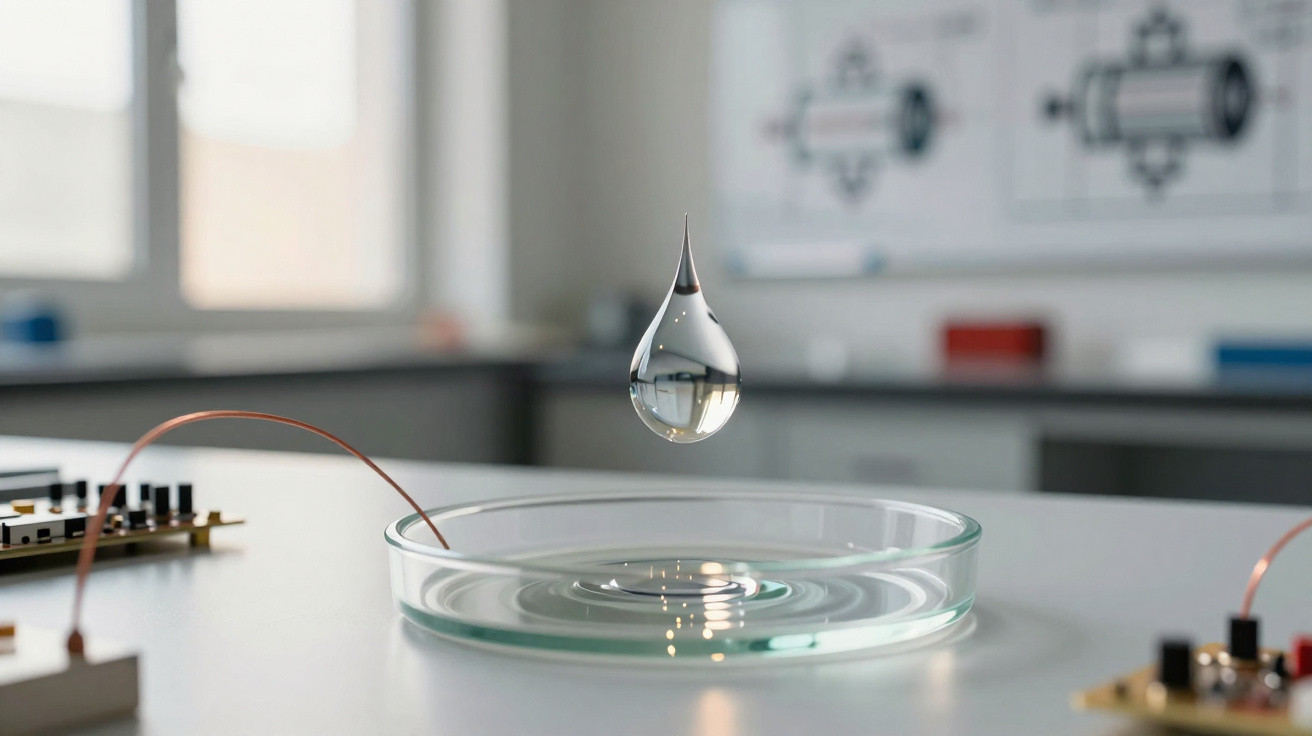
Their research focuses on a newly developed motor that creates spin from a minute liquid-metal droplet, rather than solid gears, coils or shafts.
A liquid metal motor
Engineers created a device that continues to operate while its principal moving component remains entirely liquid.
The work emerged at the University of New South Wales (UNSW) in Sydney, where engineers sought a form of rotation that could withstand bending.
Dr Priyank V. Kumar, a senior lecturer at UNSW, studies devices that move as electrical signals alter a liquid surface.
This approach framed rotation as a fluid-dynamics challenge, rather than a mechanical system dependent solely on stiff components.
How the droplet spins
The droplet motor rotated a copper paddle through a sustained circulation within the liquid metal.
The metal was enclosed by a salt solution, while electrodes supplied voltage that arranged the internal flow in one direction.
This circulating metal turned the paddle and achieved 320 revolutions per minute in the team’s UNSW laboratory experiments.
The arrangement remained compact because the droplet generated its own torque, eliminating the need for a separate shaft, gear train or magnet.
Chemistry behind the spin
Inside the device, the researchers used an alloy of gallium and indium, two metals that remain liquid at room temperature.
An alkaline solution removed the droplet’s oxide layer, keeping the metal surface responsive.
Applying voltage redistributed charged ions across the droplet surface, producing Marangoni flow: liquid movement caused by differences in surface tension.
That difference in surface tension generated internal vortices, which passed force to the paddle instead of displacing the entire droplet.
Pulses replace steady voltage
The motor was powered by timed electrical pulses, with the team turning voltage on and off at defined intervals to intensify the flow.
Compared with continuous operation, the current demand fell by roughly half, meaning less energy was lost as heat.
The researchers found that rotation occurred only within a particular applied-voltage range, creating practical limits for the control electronics.
Future versions will need stable pulses, as signal noise could disturb the circulation and gradually reduce rotational speed.
Spin without stiffness
Soft robots can bend and compress, but they still require dependable rotation for implements, valves and small wheels.
A recent review identified liquid metal actuators-components that convert energy into motion-as particularly valuable at small scales.
Within a soft structure, the droplet motor could continue rotating while the surrounding material stretches or twists.
However, that benefit relies on careful enclosure, as the motor still requires electrodes and containment for the liquid.
Motion inside tiny devices
Flexible electronics can use fluid channels for cooling or sensing, while microfluidics-the movement of very small liquid volumes through narrow channels-can control flow.
A spinning paddle could mix or pump fluids without large bearings, an advantage where space is limited and surfaces are fragile.
Liquid metals have already demonstrated motion control through ion gradients in droplets, connecting chemistry and movement without gears.
The new droplet motor applies that principle to rotation, although engineers must still maintain stable chemistry around it.
Materials and safety limits
The apparatus used sodium hydroxide, a caustic alkali that can burn tissue and cause serious injury.
Devices intended for direct handling would require sealed chambers to stop leaks and shield nearby materials.
Gallium alloys may wet and corrode certain metals, so compatible components must be selected for prolonged operation.
These limitations suggest that initial uses may remain in controlled laboratory equipment before reaching consumer products.
Medical promise meets reality
Medical implants require biocompatibility and safe long-term performance inside the body, and the present chemistry would not be suitable for tissue.
Engineers might enclose the droplet in a sealed capsule, keeping the corrosive solution separate from the body.
Supplying power is another consideration: wires restrict where a device can be placed, while batteries increase its bulk.
Even with effective packaging, regulators will require extensive testing to demonstrate steady speed, controllable direction and safe failure modes.
What engineers test next
Dependable control will depend on repeatable manufacturing, because minor differences in paddle geometry or surface condition can change performance.
Earlier liquid metal robots employed voltage to generate robotic movement, demonstrating that liquids can already deliver practical motion.
A public report highlighted that flowing metal can rotate a paddle while allowing designers to avoid conventional gears in compact devices.
“It proves that simple, flowing metals can drive rotation and opens the door to an entirely new class of motors,” said Kumar.
Rethinking how motors work
Overall, the research demonstrated that rotation can arise from a liquid’s internal flow rather than only from rigid assemblies.
The next stage is to develop sealed, controllable versions that function safely in real-world devices, including medical systems.

















Comments
No comments yet. Be the first to comment!
Leave a Comment