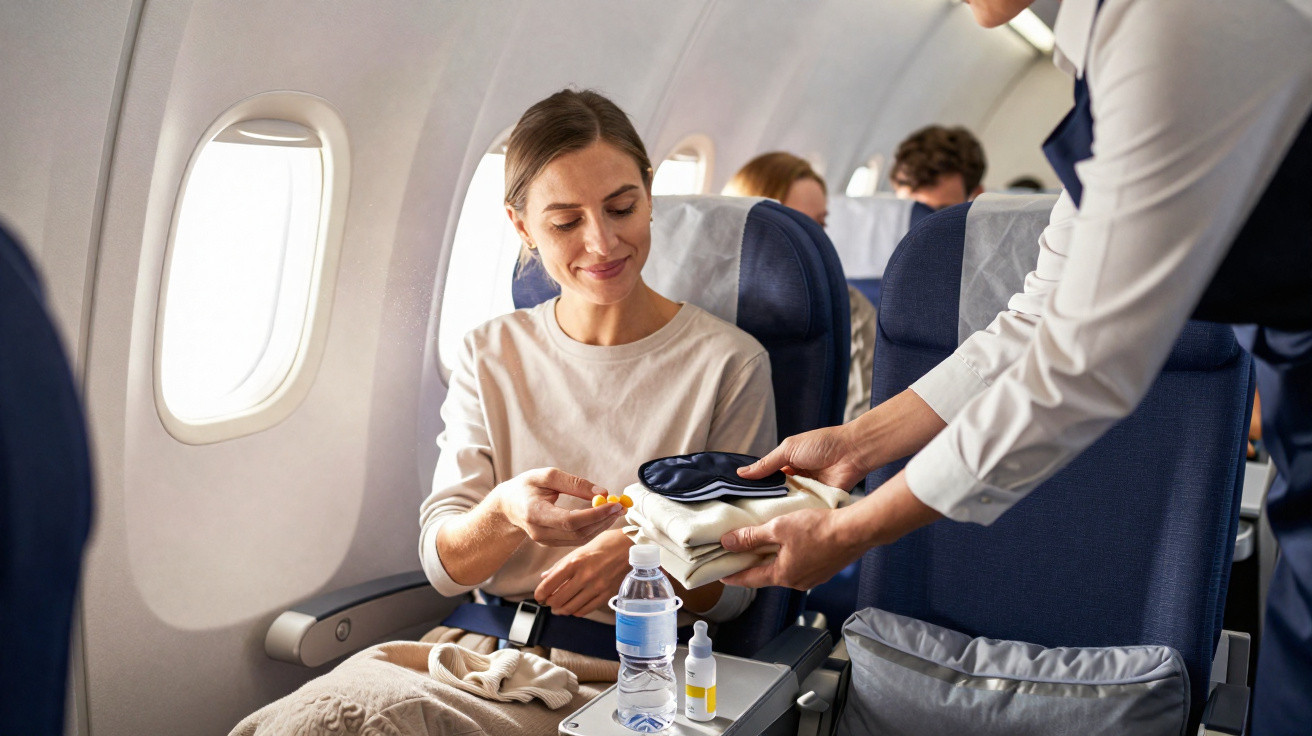
Comfort still comes with a useful trick.
You do not need to buy a premium ticket to be more comfortable in the air. Make a well-timed, sensible request and the cabin can feel far more accommodating.
Why free items matter at 35,000 feet
Aircraft cabins typically have humidity levels of around 10–20%. This quickly dries out your eyes, throat and skin. During cruise, noise commonly sits at roughly 70–80 dB, placing strain on your concentration and mood. Light spills from screens and galleys, while a confined seat can leave your muscles unsettled and your breathing shallow. A few small items can address these discomforts at no cost.
Most airlines carry quiet helpers you rarely see. Ask, and many appear: earplugs, eye masks, blankets, pillows, basic headphones, water, and even a seat belt extender.
The seven freebies worth asking for
- Earplugs
- Eye mask
- Blanket
- Pillow
- Basic headphones
- Seat belt extender
- Water, including cup refills
They tackle the main sources of discomfort: sound, light, cold, posture, fit and dehydration. As a result, you may fall asleep sooner, read for longer and arrive feeling clearer.
When and how to ask without awkwardness
Timing that earns a yes
Hold off until the aircraft has reached cruising altitude. By then, the cabin is calmer, trolley service may have paused and the crew are more likely to have a spare moment. If the aisle is clear, walk to the galley. Unless it is urgent, avoid using the call button while service is under way.
Words that work
Keep your request short and precise. For example: “Hello, could I please have earplugs and an eye mask?” A smile is more effective than you might expect. Where possible, greet the crew in the airline’s language; it shows consideration.
Moves that backfire
- Asking for “everything you have.” Start by choosing two things.
- Making requests during hot-drink service, when the aisle is congested.
- Insisting on a full bottle while the trolleys are busy. Request cups regularly instead, as refills are simpler.
Ask early, ask clearly, and keep it light. Stocks are limited, but polite precision unlocks them.
What each item actually does for your body
| Item | Problem solved | Pro tip |
|---|---|---|
| Earplugs | Reduces engine hum and passenger chatter | Combine them with quiet, soft music for more consistent sleep |
| Eye mask | Shields you from cabin glare and light from screens | Request a mask with a wide band to limit light leaking in at the sides |
| Blanket | Keeps your legs and core warm in a cool cabin | Place it over your knees, as temperatures are lower near the floor |
| Pillow | Gives support to your neck or lower back | Position it at your lumbar area to help your shoulders loosen |
| Basic headphones | Lets you use seatback audio and watch safety videos | Request a two-prong adaptor if the socket requires one |
| Seat belt extender | Relieves tightness and can make breathing easier | Ask discreetly while boarding or shortly after take-off |
| Water (by the cup) | Helps counter dry air and tiredness | Take frequent small sips; try for a cup about every hour |
Hydration that actually works in the air
Drink little and often rather than consuming lots at once. Regular small cups are kinder to your throat and can support more settled sleep. If it is available, add a squeeze of lemon. Avoid strong alcohol before attempting a nap, since it dehydrates you and disrupts sleep. Should you take an empty bottle through security, many crews can refill it between services when possible.
Seat belt extender: quick facts
When your seat belt presses into your abdomen, request an FAA- or EASA-approved extender. A crew member can attach it within seconds. Do not bring or use a personal extender on board, as regulations require airline-approved equipment. It is designed to provide both safety and comfort, keeping the buckle reachable and the belt comfortably fitted.
Smart add-ons many crews still have
On long-haul services, galleys frequently hold a few basic amenity items. You may be able to request:
- A toothbrush and miniature toothpaste, useful before arrival
- Refreshing wipes or, where offered, a warm towel
- Hot water for your own tea bags
- An additional cup for electrolyte powder you have packed
Availability differs between airlines and routes. Even when kits have run out, a pleasant request may produce an alternative, such as a warm cup and a napkin.
Sleep strategy you can use tonight
Create a brief routine: put on your mask, insert earplugs, lay the blanket across your knees, place the pillow behind your lower back, keep the belt visible over the blanket, drink some water, and switch your phone to airplane mode with a soft timer set. Then close your eyes for ten breaths. Your nervous system reacts to this familiar order. At altitude, small routines are more effective than relying on willpower.
Etiquette that keeps the cabin calm
- Clear space for the trolley by stepping into your row as crew pass.
- Hand back items you will not use, allowing other passengers to benefit.
- If you notice a name badge, thank the crew member by name. It is well received.
Cabin comfort isn’t luxury. It’s a few small asks, timed well, shared fairly.
Extra angles frequent flyers swear by
Pair free items with gentle movement. When permitted, stand near the galley for a minute, circle your ankles and flex your calves. This promotes circulation and can reduce the heavy-legged sensation after arrival. At a window seat, set an unobtrusive hourly reminder to drink some water and adjust your position.
A back-up plan is useful if supplies are limited. Keep a slim eye mask and foam earplugs in a jacket pocket, then rely on the crew for everything else: a blanket, pillow, water and headphones. This leaves you in charge of the essentials without adding bulk. For daytime flights under four hours, prioritise noise, light and water. For overnight sectors, add warmth and lumbar support. The toolkit changes with the flight, but the aim remains the same: a calmer body.







Comments
No comments yet. Be the first to comment!
Leave a Comment