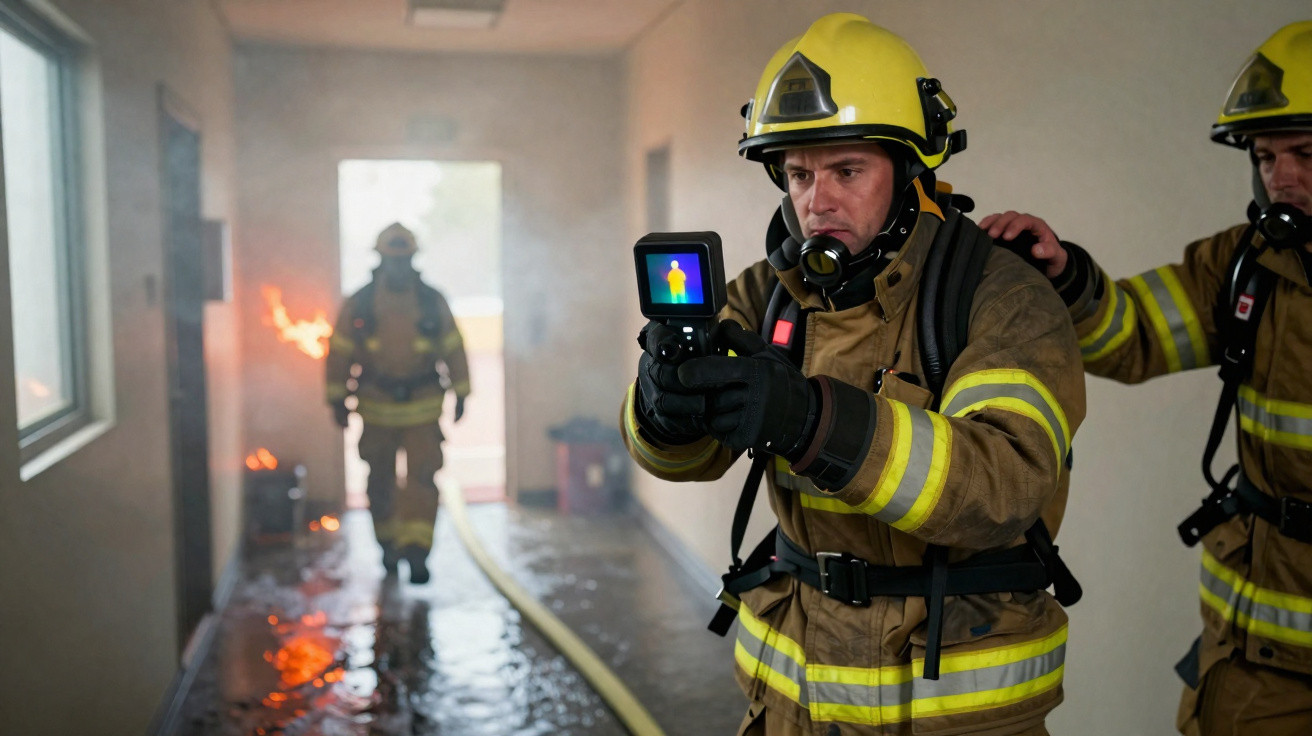
A fire service thermal imaging camera can do more than help locate missing occupants during a building fire. It can also protect the health and save the lives of breathing apparatus crews deployed for internal firefighting.
In the past, purchase costs were often a barrier. In recent years, however, manufacturers have introduced increasingly affordable models. Here, we outline the key technical considerations, testing requirements and buying criteria for a fire service thermal imaging camera used by an attack crew.
What are the benefits of thermal imaging cameras?
Many specialists believe every crew conducting internal firefighting should carry a fire service thermal imaging camera. It enables the attack crew to retain visual orientation even in smoke and darkness. With a thermal imaging camera, they can identify obstacles and hazards, including staircases. The crew can also:
- move more quickly;
- use the equipment while searching for people;
- pinpoint a fire; and
- exit rapidly and safely.
Thermal imaging cameras are also an important safety tool for emergency personnel:
- they reduce the risk of trips and falls;
- they help prevent crews from passing dangerously close to the fire;
- structural elements remain visible even through smoke – for instance, steel beams that are deforming;
- safety crews can locate injured colleagues more quickly in an emergency.
How does a thermal imaging camera work?
Ordinary light visible to the human eye does not travel well through smoke. Invisible, longer-wave infrared radiation (thermal radiation), by contrast, can pass through smoke far more effectively. Every object with a temperature above absolute zero – approximately -273 degrees Celsius (0 degrees Kelvin) – emits this infrared radiation. Thermal imaging cameras make use of this characteristic by converting infrared radiation into electronic signals that can be displayed for the human eye.
Put simply, thermal imaging cameras contain a lens, a sensor (detector), electronics and a display. The lens is generally made from germanium, which, unlike ordinary glass, allows IR radiation to pass through completely.
Fire service thermal imaging cameras are usually fitted with uncooled semiconductor sensors (microbolometers) made from amorphous silicon (a-Si) or vanadium oxide (VOx). Their resistance changes according to the infrared radiation received. The electronics analyse these electrical signals and convert them into a thermal image (thermography), shown on the display in black and white or colour.
A thermal imaging camera can reveal seats of fire through dense smoke, identify people requiring rescue, and check the fill levels of containers and tanks. These cameras also provide vision in complete darkness.
Fire service expertise: thermal imaging camera
What is a thermal imaging camera? Fire services use thermal imaging cameras for a wide range of tasks.
Thermal imaging cameras do have limitations, however. Thermography cannot see through solid objects. A fire service thermal imaging camera cannot show what is behind an overturned cupboard. Users should also be aware that glass and other particularly smooth surfaces can reflect thermal radiation. For example, when a thermal imaging camera is aimed at a window pane, the thermal image shows the user rather than a person thought to be in distress behind the glass. A similar effect can occur on other shiny surfaces.
When did the first thermal imaging cameras for fire services reach the market?
Thermal imaging cameras (TICs) were developed for military use around 1960. In the early 1980s, the US company eev (now e2v) launched the first handheld model for fire services. Initially, TICs were used for firefighting on ships.
Thermal imaging cameras became more widely used by European fire services after Interschutz 1994. The product range grew increasingly diverse towards the end of the 1990s. More recently, many manufacturers have focused on developing compact models that offer good value for money. This is intended to allow fire services to purchase more units and equip as many internal firefighting crews as possible.
Is there a fire service thermal imaging camera standard?
Germany has no standard for thermal imaging cameras. Consequently, there is no clear definition of the equipment a thermal imaging camera for fire services must have, or the performance it must deliver in areas such as temperature display, image quality and robustness. Many manufacturers therefore follow the US NFPA 1801 framework, “Standard on Thermal Imagers for the Fire Service”, in its version updated in 2013.
As certification to this standard involves costs, NFPA thermal imaging cameras cost more than non-certified models. For attack crews, many functions are unnecessary, which can make low-budget models the better option.
Which fire service thermal imaging camera features matter?
When choosing a thermal imaging camera for attack crews, fire services should pay particular attention to the following points:
- Sensor resolution: According to specialists, the camera should have a resolution of at least 160 x 120 pixels to produce an image that can be assessed properly.
- Thermal sensitivity: This indicates the smallest temperature difference the camera can detect. It is less important for direct temperature measurement than for dynamic image rendering. The lower the value, the lower the risk of image noise.
- Frame rate: This describes how often the display and sensor communicate. A higher rate produces smoother motion. Some specialists say at least 30 Hertz is required for internal firefighting. Others consider 9 Hertz entirely sufficient for an attack crew camera.
- Display (colour modes): A black-and-white thermal image – where lighter areas are hotter – can be interpreted quickly, while temperature-dependent colourisation above defined threshold temperatures can highlight heated areas.
- Direct temperature measurement (DTM): A measurement using a crosshair or square measuring area with a numerical display. It does not provide exact readings like a thermometer, but it does offer guidance.
- Dynamic rendering: This is the ability to display objects at different temperatures without hot areas overwhelming colder ones. It depends on sensor resolution, display size, sensitivity range and image processing, as well as the user’s subjective perception. It can therefore only be assessed through practical testing.
- Self-calibration time: Thermal imaging cameras must self-calibrate at regular intervals, briefly freezing the image. The shorter this time, the better. This can be evaluated in practical tests.
- Start-up time: Faster is better. Although there is usually some time between arrival and use of the camera, seconds matter when changing a battery.
- Drop test: A fire service thermal imaging camera should withstand a fall from a height of 2 metres onto a concrete floor.
- Ingress protection rating: This indicates how well the camera is sealed. A fire service thermal imaging camera should be certified to IP 67 (dust-tight, fully protected against contact and protected against water ingress during temporary immersion).
- Instruction, training and camera handling: Users must receive proper training as a fundamental requirement. Alongside equipment familiarisation, this should cover basic operational tactics.
- Service: Even where a low-budget thermal imaging camera cannot be compared with a high-end model, service support should work smoothly. This includes an easily accessible service centre, rapid turnaround times and the provision of replacement units while repairs are being carried out.
In a video, FLIR compares frame rates of 9 and 30 Hertz.
YouTube video consent
We need your consent to load the YouTube Video service.
We use a third-party service to embed video content which may collect data about your activity. Please review the details and accept the service to watch this video.
This content cannot be loaded because it is not permitted by trackers disclosed to the visitor. The website owner must configure the site with its consent management platform to add this content to the list of technologies used.
- More information
- Accept
Powered by Usercentrics Consent Management Platform
5 tips for buying a thermal imaging camera
- Establish in advance which options are available for funding, grants and sponsorship.
- Draw up a requirements specification: which functions are necessary for the intended operational use? Which would be desirable but can be omitted?
- Remember that cameras with simple controls are generally advantageous under stress.
- Seek advice from specialists and fire services that already have experience with comparable thermal imaging cameras.
- Create a shortlist, then carry out a test under real conditions in fire simulation or heat-acclimatisation facilities before buying.







Comments
No comments yet. Be the first to comment!
Leave a Comment