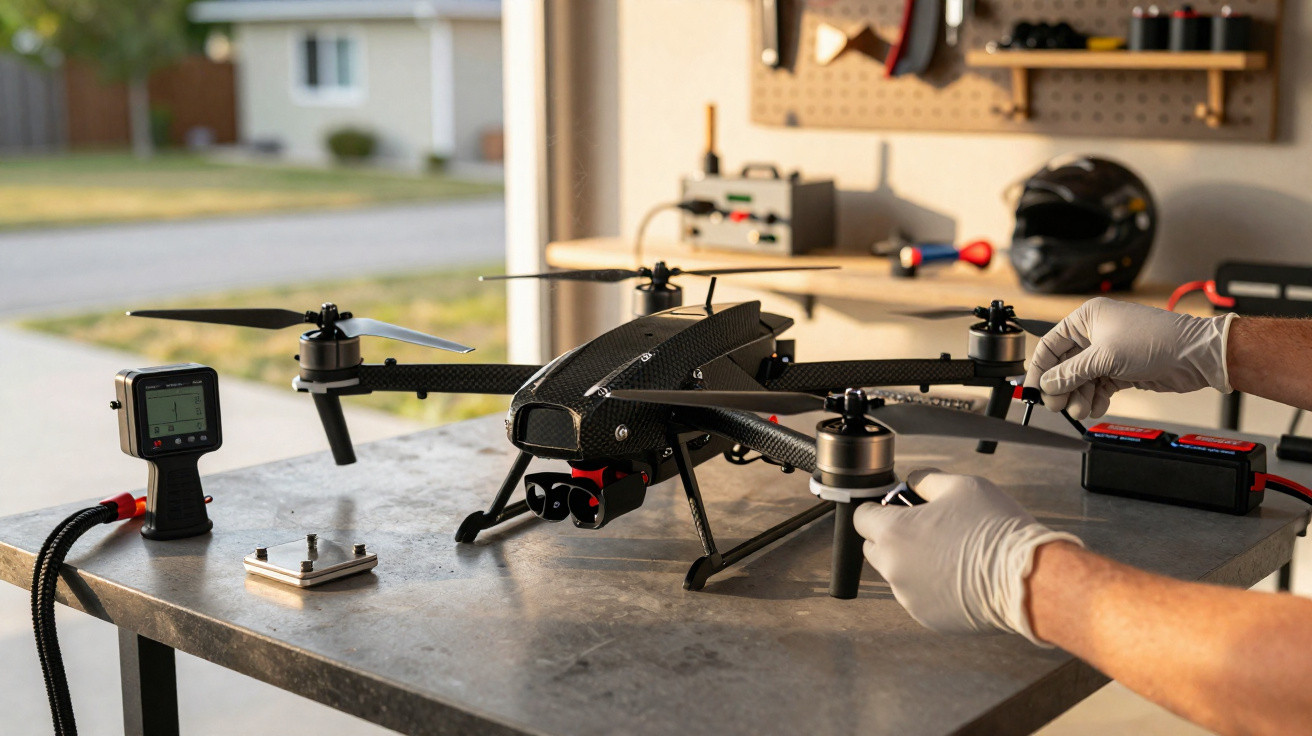
A flight lasting just seconds has nevertheless set online forums alight and left engineers surprised: a drone built by hand on a garage workbench seems to have come close to 700 km/h, surpassing speeds more commonly linked with commercial record-attempt projects.
A garage project that outran the pros
The aircraft, named Blackbird, was created by Australian maker Benjamin Biggs, who is not employed as an aerospace engineer. A self-taught enthusiast, he used evenings and weekends to design, print, solder and test a machine built around one straightforward challenge: just how fast can a quadcopter fly?
Biggs is said to have spent approximately €3,000 on components, broadly equivalent to the cost of a top-end consumer drone. There was no company funding, university laboratory or defence spending behind the project.
Built for the cost of a premium shop-bought drone, Blackbird has posted speeds usually associated with military-grade hardware.
The record attempt was conducted in the Australian bush, a secluded and thinly populated setting with long clear stretches of airspace and less concern over noise or unexpected bystanders. Video and flight telemetry have rapidly circulated through the Drone Pro Hub YouTube channel, now a prominent destination for hobbyist high-performance builds.
How close to 700 km/h did it really get?
On its test flight, Blackbird recorded a top speed of 690.0 km/h, based on its onboard instrumentation and saved telemetry. That result alone would put it among the quickest multicopters ever to have flown.
Rather than depend on one spectacular burst of speed, Biggs completed a timed run across a set distance of 100 metres. Its speed was worked out from the elapsed time, then corroborated using the drone’s own sensors.
- Average speed over 100 m: ≈ 661 km/h
- Pass against the wind: ≈ 635 km/h
- Pass with the wind: ≈ 690 km/h
The spread between the with-wind and against-wind passes gives the run more credibility than a single one-way dash.
This method of averaging reflects the approach used for many speed records, where at least two passes in opposing directions are generally needed to offset the effect of wind. On these figures, Blackbird would narrowly exceed the former reference point: the Peregreen V4, constructed and flown by Luke Maximo Bell, which took a Guinness World Records title in December at a speed around 3 km/h slower.
Why Guinness has not validated the record
For all the strength of the recorded data, Blackbird’s result is absent from official record listings. Guinness World Records demands either an accredited observer at the event or rigorous certification covering the timing equipment and the test conditions.
Biggs was unable to arrange for an independent specialist to attend before the attempt. While the isolated location made the test safer and easier in regulatory terms, it also complicated the practical arrangements. In the absence of a qualified witness, the achievement is still “unofficial” - compelling for enthusiasts, but not formally acknowledged in any record table.
On paper, Blackbird is faster than the reigning champion, yet bureaucracy and geography keep it off the official podium.
Inside the Blackbird: how a backyard quadcopter hits jet speeds
A powertrain built for brutal acceleration
Blackbird uses four AAX 2826 Competition motors, designed to provide substantial power and brief, forceful thrust bursts rather than relaxed long-duration flying. Power comes from two batteries, set up to supply the voltage and current necessary for hard acceleration during an extremely short window.
It is fundamentally a sprint vehicle, more akin to a dragster than a touring car. Endurance has been traded away for outright punch.
Weight shaving down to the last gram
Biggs also redesigned the way electrical power is routed through the frame. Rather than fit conventional plug-and-play connectors and external cable looms, he passed the motor cables through the arms themselves and soldered them directly onto the electronic speed controllers.
By removing intermediate connectors, the builder cut weight and shrank the arms, slicing aerodynamic drag along with excess grams.
As well as cutting mass, this solution reduces frontal area, a major consideration beyond 600 km/h. Narrow arms displace less air, and even modest drag reductions at such speeds can add several kilometres per hour.
The finished craft is a stripped-back, almost skeletal quadcopter: no cosmetic extras and barely any enclosure, with only the structure required to keep its motors, batteries and control electronics together through a punishing sprint.
How far can drones really go in terms of speed?
Blackbird’s attempt poses a wider question: what is the upper limit of multicopter performance? Conventional aircraft, using wings and streamlined fuselages, benefit from decades of aerodynamic development. Quadcopters, however, are naturally drag-heavy, with four propeller discs, several arms, exposed hardware and continuously varying thrust vectors.
They also bring certain benefits. Their small scale reduces structural loads, while current brushless motors can reach remarkable rotational speeds in short intervals. High-density lithium batteries allow a notable amount of power to be packed into a compact unit.
As materials, battery chemistry and control software improve, experts anticipate steady advances:
- Improved propeller designs tailored to transonic tip speeds
- Better motor and ESC cooling for longer full-throttle operation
- More resilient but lighter composite arms and frames
- More precise flight controllers able to cope with severe vibration
Even so, drones such as Blackbird operate at the boundary of practicality. Their flights last seconds rather than minutes, and their operating margins are extremely narrow: a gust of wind, system fault or minor construction defect could lead to a catastrophic crash.
Why hobbyist records matter to the industry
To major aerospace businesses, a one-off project from a garage may appear little more than a novelty. However, projects of this kind frequently provide a proving ground for concepts that are later developed and incorporated into commercial aircraft platforms.
Independent builders tend to move fast, take risks and share mistakes openly, creating a pool of real-world data that big manufacturers quietly watch.
Weight-saving cable arrangements, forceful motor-and-battery combinations, unconventional arm shapes and inventive cooling systems regularly appear in DIY builds years before reaching commercial drones. Industry engineers follow the same discussion boards and view the same test footage as enthusiasts.
For regulators and safety authorities, flights such as Blackbird’s also demonstrate that readily available components can now produce capabilities previously associated with classified programmes. This prompts new questions over airspace separation, speed restrictions and the definition of a “model aircraft” in 2026.
Understanding the numbers: from km/h to real-world risk
Speeds near 700 km/h can feel abstract, so a straightforward comparison is useful. Travelling at 660 km/h, a drone covers roughly 183 metres every second. With a delay of only 0.2 seconds from a pilot or autopilot, it has already travelled the equivalent of two football pitches.
At these speeds, a control lag, GPS error or mechanical issue leaves virtually no opportunity to respond. This danger explains why attempts are generally made in remote locations, well away from roads, properties and people, and why certain countries assess extreme-speed drones with the same level of scrutiny as small experimental aircraft.
Hobbyists considering similar speed runs are better served by gradual testing, using shorter routes, restrained power settings and comprehensive failsafe measures. A crash at even 200–300 km/h can penetrate car panels or building facades, making robust insurance and compliance with local aviation requirements far more than an administrative formality.
What this means for ordinary drone pilots
Most drone pilots will never operate a machine comparable to Blackbird, yet its underlying technology could filter down in practical forms. Lighter wiring approaches and more intelligent component placement may improve the battery life of camera drones. Propeller improvements created for racing may help aerial photography platforms become quieter and more efficient.
There is a cultural dimension as well. A garage-made quadcopter approaching the speed of a small jet shows younger enthusiasts that aerospace is not beyond their reach. With savings, persistence and online community access, they can experiment, refine designs and, on occasion, establish benchmarks that push the wider sector onwards.
As further extreme builds appear, debate is likely to intensify over the boundary between benign experimentation and machines that effectively function as unregistered missiles. At present, Blackbird occupies that uncertain territory: an exceptional technical accomplishment that remains unofficial on paper, but is clearly documented in the data logs from a small black blur racing across the Australian bush.













Comments
No comments yet. Be the first to comment!
Leave a Comment