
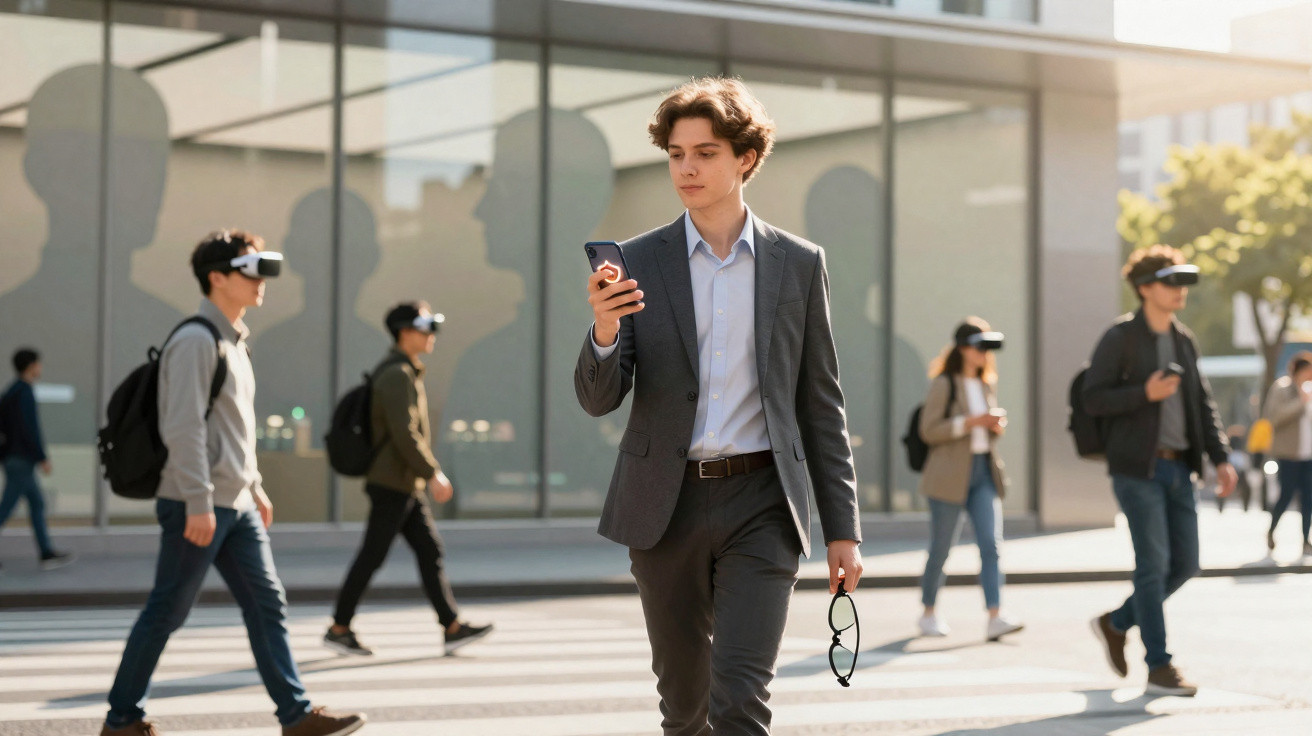
Rather than some polished new headset, the evidence came from what we already know intimately: phones held aloft, alerts chiming and thumbs scrolling relentlessly. Onstage, a prominent venture capitalist brightly announced, “The smartphone era is over,” while slides showing AR glasses and brain-computer interfaces appeared behind him.
A teenager in the front row continued recording the entire presentation… using a slightly cracked iPhone. Two seats along, a company manager anxiously opened Teams on a Samsung, apparently worried everything would unravel within 30 seconds. In the corridor, a PR representative unsuccessfully hunted for a 5G signal to upload an Instagram video.
Everyone at the event was discussing what comes after the smartphone. In reality, nobody was functioning without one.
While Musk, Gates and Zuckerberg promise disruption, Cook focuses on habit
Elon Musk enjoys projecting clear, direct paths into the future: Neuralink, xAI and a robot that may eventually bring you coffee. Bill Gates speaks more quietly about AI agents arranging flights and condensing your life into summaries. Mark Zuckerberg uploads videos in which he puts on a headset and strolls through virtual sitting rooms as though it were already an ordinary Tuesday next week.
Tim Cook, by comparison, still walks onstage holding an iPhone. He speaks about Vision Pro and wearable devices, certainly, yet his attention always returns to the small rectangle resting beside millions of pillows each night. As others declare the smartphone finished, he discreetly improves its camera, introduces satellite functions and makes iOS a little harder to leave.
This is not sentimentality. It is a wager on human behaviour: the automatic movement of our fingers towards the same pocket, and the peculiar reassurance provided by a screen we understand better than our own kitchen drawers. While technology visionaries sketch dramatic futures, Cook is studying something considerably less glamorous: your routines.
The difference between those visions becomes clear in real use. Musk pictures a future in which you “talk” to AI directly through your brain, with no device needed at all. Gates envisages an AI assistant moving between your laptop, television and smart home, making the specific hardware matter less. Zuckerberg advocates a world in which your main “device” is a headset, alongside controllers fastened to your hands.
Apple, meanwhile, continues to position the iPhone as mission control. Your watch, AirPods, headset, in-car system and even house keys all lead back to that single device. This is deliberate: an ecosystem strategy based on the assumption that people will not readily abandon the central hub. In a spreadsheet, it may appear cautious. During the morning commute, it appears practical.
During a train journey from Paris to Lyon last month, nearly every passenger in my carriage was holding a smartphone. One person had smart glasses on. No one was wearing a headset. Whenever the train entered a tunnel, people instinctively raised their phones, as if lifting them might improve reception. An old reflex meeting new technology. This is the inconvenience that Musk, Gates and Zuckerberg often minimise.
The practical logic is unforgiving: technological revolutions seldom arrive as tidy breaks. We do not swap one device for another overnight; instead, we add layers. Desktop to laptop. Laptop to phone. Phone to watch. Voice assistants, earbuds and even VR headsets end up circling the object we already use 200 times a day. Acknowledging that may not sound visionary onstage, but it succeeds in your pocket.
Apple’s chief executive seems less concerned with declaring the smartphone over than with allowing it to gradually recede into the background. Consider how Face ID made unlocking almost imperceptible, or how the watch silently assumed responsibility for notifications and fitness tracking without any grand manifesto. This is how disruption tends to arrive in everyday life: gradually, rather than as a press-release headline.
The “non-end” of the smartphone: what Apple is actually doing
Behind the marketing sheen, Apple’s genuine manoeuvre is understated. The company is not attempting to destroy the smartphone. Instead, it wants the device to merge so seamlessly with daily life that the boundary between phone and world is barely visible. The iPhone becomes less of a gadget and more of a remote control for reality.
That explains why so many Apple launches initially look incremental. A modestly improved camera. A brighter display. More battery life. People mock them on Twitter, before joining the queue at the Apple Store. The appeal is not found in the specifications sheet, but in the cumulative impact of a device that becomes more embedded in your habits every year.
At a practical level, Apple is placing bets in several directions. Vision Pro attracts attention, though it sells in very small volumes. AirPods and Apple Watch are major products, but they still rely on the iPhone for set-up and most tasks. Services, from iCloud to Apple Music and TV+, are tied to your Apple ID, which generally began with buying an iPhone. The “end of the smartphone” would mean the end of Apple’s gravitational centre, and Cook is not prepared to risk that.
On a wet Sunday afternoon, somebody you know probably did a quietly, unmistakably 2024 task. They backed up old photographs, transferred WhatsApp conversations to a new phone and spent two hours signing back into every application. Life carried on through a screen 0.2 inches larger than the previous one. No brain implant. No mixed-reality revolution. Just a better selfie camera for the same social networks.
We talk endlessly about disruption, but most customers act like gradualists. They do not seek to “end” the smartphone; they want one that is marginally less irritating. Less delay in games. A torch that activates more quickly. A battery that lasts until bedtime without the anxiety caused by that red indicator. The technology gods imagine leaps; the rest of us upgrade step by step.
Abandoning the smartphone sounds exciting from a stage. In your hand, it frequently sounds inconvenient: unfamiliar interfaces, different gestures and fresh learning curves. Apple’s stance is almost contrarian here: rather than making people alter what they do, make technology feel increasingly invisible as they do it. The danger is clear-Apple could be excessively careful and miss a major shift. Its wager is that friction beats futurism in everyday life.
How this struggle will shape your next five years with technology
If you are trying to make sense of these sweeping declarations, the wisest response may be surprisingly modest. Think of the “end of the smartphone” debate as a timeline rather than a precipice. You do not need to decide between having a phone and having no phone; you can gradually change the work your phone does for you.
Begin with small adjustments, shifting one habit at a time. Your watch might handle notifications, so your phone no longer demands attention every three minutes. Your laptop may become the principal AI hub, while your phone remains the device for capturing photographs, recording voice notes and carrying out quick searches. Small changes in roles can feel more revolutionary than purchasing an entirely new category of gadget.
Apple is already steering you in that direction. Fitness rings sit on your wrist. AirPods switch smoothly from iPhone to Mac. Continuity features allow you to copy on one device and paste on another with apparent magic. The smartphone does not disappear; it becomes less of a loud protagonist and more of a quiet co-ordinator backstage.
There is also a psychological dimension that we rarely acknowledge. On a stressful day, your phone acts as a security blanket: messages, banking app, tickets and maps in one slab. On a lonely evening, it provides light, noise and company. On a tedious commute, it becomes a casino of content. On a vulnerable morning, it is also the device that informs you that you have already spent 1h42 on Instagram this week.
At a human level, this is why the claim that we will simply move beyond phones sounds slightly naïve. Our attachment is not only to their usefulness, but to the emotional habits they create. On a difficult day, knowing your phone is in your pocket resembles knowing your keys are on the table: life feels at least partly under control.
Let us be honest: nobody genuinely maintains perfect digital hygiene every day-the careful screen-time limits, the ideal notification detox and the virtuous separation from devices. You promise not to sleep beside your phone, then wake up with it under the pillow. The companies understand this. Musk exploits it through perpetual drama on X. Zuckerberg uses endless Reels. Cook relies on making the same device feel a little safer and calmer each year.
“We don’t think about replacing the iPhone,” Tim Cook told an interviewer not long ago. “We think about how it can fade into the background while still being essential.”
Read slowly, that sentence functions as a roadmap: for Apple, for your routines and for the coming decade of “post-phone” technology hype. The ending is not an explosion; it is a gradual fading.
There is a straightforward way to follow this shift without becoming lost in it:
- Pay attention to what you truly use each day, rather than what impresses you during keynotes.
- Upgrade when a device demonstrably removes friction, not merely because it represents “the future”.
- Keep in mind that habits typically outlast predictions, including the noisiest ones.
| Key point | Details | Why it matters to readers |
|---|---|---|
| Smartphone as “hub”, not “end product” | Rather than replacing the iPhone outright, Apple is making it a control centre for Watch, AirPods, Vision Pro, HomeKit and even car dashboards. | This suggests that your phone is more likely to change role quietly than vanish, allowing you to plan upgrades instead of worrying about a sudden technological reset. |
| Big visions vs. real-world habits | Musk, Gates and Zuckerberg outline futures involving implants, AI agents and headsets, but most people still use a phone as their main screen for 4–5 hours daily. | Recognising this divide helps you filter hype and concentrate on tools that actually suit your daily life, rather than pursuing every new category. |
| Incremental change beats clean breaks | Functions such as Face ID, eSIM, satellite SOS and seamless earbuds seemed minor at launch, yet collectively made phones both more essential and less intrusive. | This clarifies why your next major shift is likely to come from a “boring” update that eliminates friction, rather than from a dramatic new device requiring an entirely new routine. |
Where that leaves us, phone in hand
At a café terrace in Lisbon last week, I saw a brief scene that captured the whole argument. A man in his twenties was teaching his mother to pay with her phone rather than her card. She paused, laughed nervously and then tapped the terminal. It beeped, the payment succeeded and, for a moment, she looked at the display as though it were magic.
We speak of ending smartphones while continuing to discover fresh uses for them: paying, unlocking doors, translating and recording a sunset that memory alone would blur by tomorrow. The more the device becomes part of life’s flow, the less we notice that we are already living in a kind of “post-phone” world-a world where the phone is not the star but the glue.
At a deeper level, the debate returns a question to us rather than to Silicon Valley: what do we genuinely want from our technology? Fewer screens, or better screens? Less time on devices, or more meaningful time with them? Apple’s restrained resistance to the “end of the smartphone” narrative reminds us that a keynote will not provide the answer.
It will emerge from small, unglamorous decisions: which alerts you retain, whether you permit your watch to remind you to stand and whether your next upgrade truly releases your attention or merely transfers it to a differently shaped screen. On a good day, technology feels like an expanded horizon. On a bad day, it feels like a smaller room.
At dusk on a street corner, when the sky reaches that particular shade of blue and you instinctively raise your phone to capture it, the future of devices becomes remarkably simple. Whatever follows the smartphone must be as available, as close and as personal as that reflex. Until then, the “end” may look like this: the same rectangle, less conspicuous, carrying more of your life than you would ever admit aloud.
FAQ
Are Elon Musk, Bill Gates and Mark Zuckerberg really predicting the end of the smartphone? They do not all use those precise words, but their public visions point in that direction. Musk discusses brain-computer links that bypass devices, Gates describes AI assistants moving across screens, and Zuckerberg presents mixed-reality headsets as a primary interface. The shared idea is that the phone should no longer be the centre of your digital life.
How is Apple’s approach different from the others? Apple favours continuity over rupture. Rather than announcing that the phone is obsolete, it is gradually assigning tasks to the Watch, AirPods, Macs and now Vision Pro, while retaining the iPhone as the anchor for set-up, security and identity. Its message is less “throw away your phone” and more “let your phone quietly run things from the background.”
Does this mean smartphones will still be around in 10 years? Almost certainly in some form. Their shape, size and interface could change-more glasses, more voice interaction and perhaps lighter devices-but the concept of a personal hub that is always with you is deeply established. A gradual blending of phone functions into other objects you already use is more likely than disappearance.
Should I wait for the “next big thing” instead of buying a new phone now? Waiting can be sensible if your existing phone works well and you are interested in upcoming categories. However, replacing it remains a practical choice if you are coping with weak battery life, absent security updates or continual crashes. The key question is not “Is this the future?” but “Will this make my everyday life less painful right now?”
How can I prepare for a world where the smartphone matters less? You do not need to make dramatic changes. Start by spreading your digital life: use a password manager that works across all your devices, store important files in the cloud and test functions such as watch payments or laptop-to-phone hand-off. Then, should new interfaces arrive-glasses, smarter earbuds or better assistants-you will be ready to adapt without drama.

Comments
No comments yet. Be the first to comment!
Leave a Comment