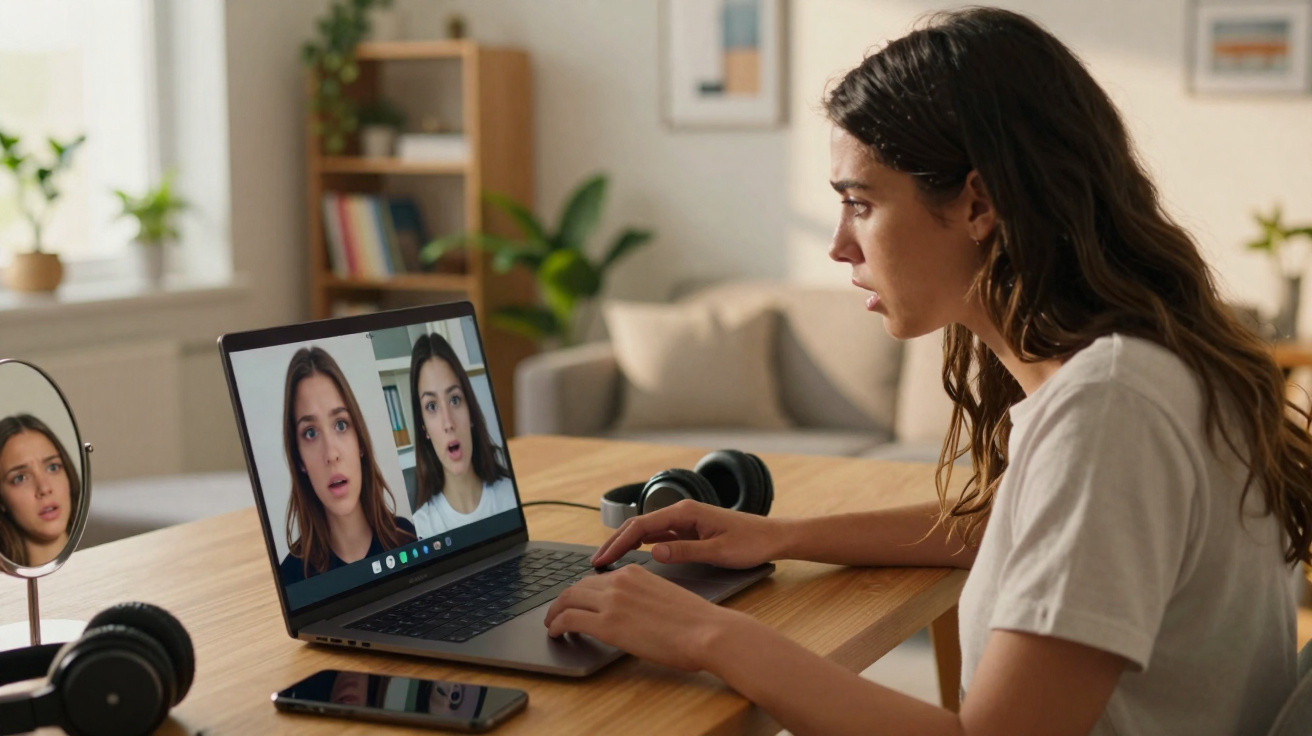
The moment Collien Ulmen-Fernandes first saw her own face in a video she had never filmed feels like something from a Black Mirror script.
Except the actress was not on a set. She was alone with her phone, somewhere between appointments: a push notification, a tap, then silence. The movements, expression and voice all seemed familiar, yet entirely wrong. A stranger’s body pretending to be hers. We know the knot in the stomach when somebody reads our private messages; now imagine that feeling magnified by an entire public watching too. It was the point at which Deepfakes crashed out of the tech niche and into the German mainstream. And Collien became someone who refused to stay quiet. Instead, she asks: who really owns my face?
When your face becomes a toy
For years, Collien has been known as a television personality, presenter, actress and mother, sharing considered glimpses of her life on social media rather than an endless stream. Her image has been professional, witty and slightly removed from relentless self-promotion. That is precisely why the rupture is so stark when the Deepfake appears. A video suddenly circulates that sexualises and distorts her, placing her in a situation she never chose. As a viewer, it is easy to swipe past. For her, it becomes an invisible crack running through everyday life: a false version of herself taking on a life of its own.
We live in a culture that identifies and judges faces in milliseconds. Collien built a career around a publicly recognisable face. Now, that very asset is being turned against her. An algorithm feeds on footage of her, attaches it to somebody else’s body and adds a fantasy narrative: the content is complete. While many users may dismiss the video as “just another fake thing”, something more profound shifts quietly: how people look at her, how the media talks about her and how safe other women feel when posting selfies.
Before we can grasp how deeply Deepfakes can alter public perception, it helps to look briefly at the figures. Studies from recent years show that the overwhelming majority of Deepfakes circulating online are pornographic and target women, often without their knowledge. In tech blogs, this can sound sterile: datasets, algorithms, GPU capacity. In real life, it sounds different. It becomes: “My daughter is afraid to show her face on Instagram.” Or: “I panic when someone searches my name.” Collien brings that vague but pervasive fear to prime-time television because people know who she is.
There is no counter showing how many people have viewed Collien differently since the Deepfake emerged. There are only small signs: hesitation during an interview, a spiteful comment, an ironic remark online accompanied by a winking emoji that pretends none of it is especially serious. Let us be honest: nobody searches the internet every day for misuse of their own face. Most people never even realise they have been deepfaked. With celebrities such as Collien, it is simply more visible, louder and easier to measure. Her experience exposes what has long affected many people without cameras around them.
Deepfakes work so effectively because they exploit something we have all been taught: to trust images. Video still carries the added authority of “it must be true”. When Collien’s supposed self says or does things that do not fit her, it creates cognitive friction. Yet a trace of doubt remains. That is where the harm begins. It is not because everyone believes, “This is 100% real”, but because enough people think, “It might somehow be…” That “maybe” becomes a shadow that can hang over a public figure for a long time. Technology is only the engine; the rest is culture, voyeurism and click-driven logic.
What Collien Ulmen-Fernandes can teach us, even without a camera pointed at us
One point Collien stresses in interviews is that looking away helps nobody. She talks openly about how it feels to have your own face hijacked. This goes beyond celebrity drama. It is guidance for anyone who already suspects that AI-generated images and fake videos are not going away. Anyone with an online presence today, whether they have 200 followers or two million, needs a kind of internal emergency plan. Not constant paranoia, but a clear stance: I will not accept this, I will name it and I will seek help. Shame is the perpetrators’ best friend, not the victims’.
She uses interviews, social media and chat shows to bring the issue into the open. Not for marketing purposes, but because she has realised that if even she, with connections, lawyers and press contacts, has to fight so hard, what happens to a 17-year-old with no reach at all? Her response sends a message: publicity can be a protective space as well as a danger zone. Many of us know the feeling of coming across something online that seems wrong, then scrolling on because we do not know what to do. The first step is often simple: say out loud that it is wrong, and listen to those affected.
What stands out about Collien is that she does not reduce the issue to fear of technology alone. Rather than saying “AI is evil”, she talks about responsibility, power imbalances and structures. She points to media companies, platforms and legislation, as well as to us as the audience. We are all part of the system that gives Deepfakes their reach. A click, a share, a joke. Her personal story therefore touches larger questions: which images do we want to normalise? Whom do we believe? And who retains the right to say “I” when their face is already being used by others?
In one conversation, she put it in words that many people find hard to shake:
“I had always seen my face as part of my job. Suddenly, it felt as if it no longer belonged to me.”
- Talk about it when you see a fake - silence reinforces the perpetrators’ perspective.
- Consider your own clicking behaviour; every view is a small amplifier.
- Learn about legal options, even if you hope never to need them.
- Support those affected publicly instead of retreating into cynicism.
- Expect platforms to provide clear reporting routes and transparent responses.
What this case means for all of us
Collien’s story and the Deepfake are more than a technology anecdote. They mark a moment when society must decide how much control it is willing to surrender over the meaning of its own images. Until recently, “fake” was a term used for poorly executed Photoshop edits or rumours. Now we are talking about videos that look convincing enough to destabilise careers, relationships and entire life stories. Anyone raising children today can sense it: this is no longer the world of shaky camcorders in which we grew up.
Collien uses her reach to make this shift visible. She does so not with moral panic, but as someone who knows the technology is here to stay and that we must adapt. She chooses transparency over suppression, and education over shaming. The sober reality is that we will not remove Deepfakes from the internet. But we can learn to respond to them differently: more critically, more empathetically and with less appetite for sensation. We can also support those whose faces become targets.
Perhaps that is the real value of this case: it forces us to ask questions we have postponed for too long. How do we define “truth” when images can be manipulated? How do we protect people who involuntarily become the protagonists of a show they never signed up for? And how do we deal with our own expanding digital footprint, growing with every selfie, Story and Reel? When we see Collien today, we do not just see a familiar presenter. We also see a woman navigating this absurd and frightening transition on behalf of many others: from an analogue reputation to a digital identity that can be copied at any moment.
| Key point | Detail | Value for the reader |
|---|---|---|
| Deepfakes affect real people | Collien’s case shows how a single video can shift life stories, emotions and public perception | Greater awareness of the consequences behind the “it is only a clip” reflex |
| Publicity can offer protection | Speaking openly removes the perpetrators’ element of surprise and disrupts the cycle of shame | Encouragement not to endure personal or others’ experiences in silence |
| Individual behaviour carries weight | Every click, share and comment shapes how society deals with Deepfakes | A practical way to behave more responsibly towards content in everyday life |

















Comments
No comments yet. Be the first to comment!
Leave a Comment