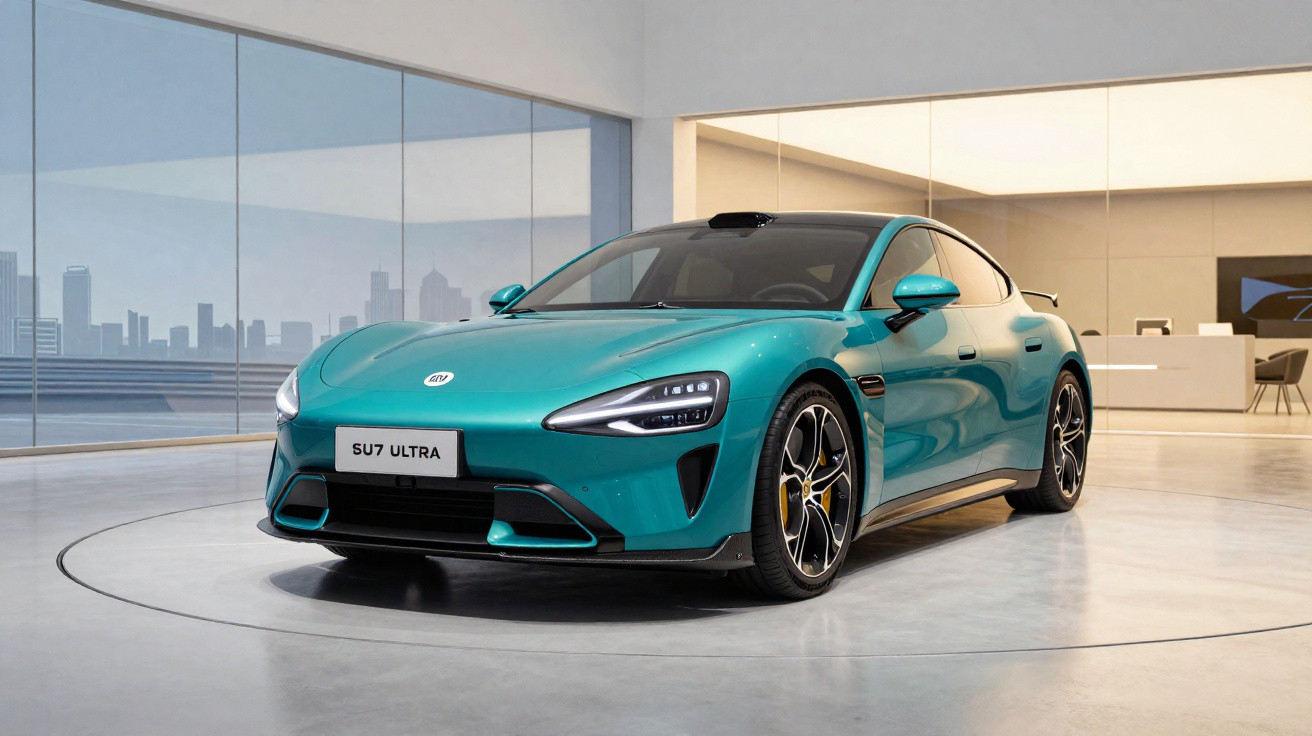
What recently looked like a PR stunt at the Nürburgring has suddenly become very real: the Xiaomi SU7 Ultra is now officially registered in Germany. Until now, it had chiefly been known for its astonishing lap time, but this move opens the door to a market entry by a manufacturer best known for smartphones – and one that now wants to get dangerously close to European premium brands in the electric segment.
From a Nordschleife record to Munich number plates
Technology group Xiaomi has been in the car business for three years. With the SU7, the brand has immediately entered a category otherwise dominated by Porsche, Tesla and others: a large all-electric saloon with sporting ambitions. At the top of the range sits the Xiaomi SU7 Ultra, an exceptionally powerful version intended to showcase the company's technology.
During the summer, a prototype Ultra set a lap of 6:22.091 minutes on the Nordschleife – a major statement in the electric-car world. The subsequent production version completed the circuit in 7:04.957 minutes, putting it at the head of production electric saloons on this track. Cars such as the Porsche Taycan Turbo GT, and even the hypercar icon Rimac Nevera, suddenly became comparison points rather than untouchable benchmarks.
The Xiaomi SU7 Ultra has established itself as one of the world's fastest electric saloons – now not only on the race track, but officially on European roads.
The pivotal development came in early July 2025: the first SU7 Ultra was registered in Munich, receiving German number plates and full road approval under European law. The saloon carries the registration M SU7088E and serves as a development vehicle for the manufacturer.
Xiaomi has already used this car for an approximately 800-kilometre test drive between Berlin, Hamburg and Frankfurt. On an unrestricted section of Autobahn, it reached 260 km/h – legally and in real-world conditions. Yet this individual registration represents more than a one-off: European homologation has, in principle, now been completed, a fundamental requirement for eventual customer sales.
Xiaomi SU7 Ultra supercar figures: 1,548 PS, 350 km/h and more than 600 km of range
On paper, the Xiaomi SU7 Ultra has the specifications of a supercar. According to the manufacturer, the flagship offers:
- Power: 1,548 PS from an all-electric powertrain
- 0–100 km/h: a claimed 1.98 seconds
- Top speed: up to 350 km/h
- Battery: 93.7 kWh CATL Qilin II
- Range: 630 km under the Chinese CLTC cycle
Its range requires some context from a European perspective. The CLTC cycle used in China is more optimistic than the WLTP standard commonly used here. Experts expect the Ultra version to deliver slightly more than 500 kilometres of practical WLTP-equivalent range – still an impressive result for such a powerful saloon.
Alongside the Ultra, Xiaomi is planning several more conventional SU7 versions. They will offer roughly 320 to 690 PS and, depending on battery capacity, are expected to manage up to 902 kilometres in the CLTC cycle. Converted to WLTP, that equates to around 722 kilometres – a figure that could put many established premium electric cars under pressure.
How the Nürburgring has become a marketing stage
Chinese manufacturers are taking different approaches to entering Europe. Some rely on major football sponsorship deals, while others chiefly aim to stand out on price. Xiaomi is clearly pursuing image: Nürburgring records, striking design, substantial power – followed by a comparatively moderate entry price.
The Nürburgring plays a distinctive role in this strategy. Few circuits carry a comparable global myth, particularly among German car enthusiasts. A manufacturer that performs well there is automatically viewed as “credible”. That is precisely Xiaomi's objective: the SU7 Ultra is meant to demonstrate that the brand can do more than make affordable smartphones.
Europe from 2027: premium appeal at a competitive price
Xiaomi has now openly stated that it is targeting a European launch in 2027. The SU7 saloon will be the central model, supported by an SUV called the YU7. To ensure it meets European requirements, the company has established a development and design centre in Munich. Engineers and designers there are tailoring the chassis, driver-assistance systems and interior specifically to the expectations of local customers.
For the SU7 without the Ultra's extreme performance focus, Xiaomi is planning a premium positioning with a comparatively low starting price. A starting price of around €35,000 for the simpler variants is being discussed. If confirmed, the saloon would move directly into the territory of cars such as the Tesla Model 3, Hyundai Ioniq 6 and BMW i4, with a promise of more equipment and range for the same money or less.
An electric premium saloon with more than 700 km of WLTP range at a mainstream price could shake up the market considerably.
What this means for European manufacturers
Xiaomi's record pursuit has not emerged from nowhere. Another Chinese manufacturer, BYD, is already attracting attention and taking records with models such as the Yangwang U9. The chronological Nürburgring ranking shows just how fierce the competition has become – and that European brands need to adjust their pace.
Porsche, BMW, Mercedes, Audi and Tesla are therefore under pressure. On one hand, they need to maintain or extend their technological advantages; on the other, their pricing structures are being challenged. If a Chinese newcomer combines sports-car performance and long range with a starting price in the region of €35,000, existing high-margin models will need rethinking.
What homologation, CLTC and WLTP mean
Several technical terms arise in connection with the SU7 Ultra, and they can appear unwieldy at first glance. A brief explanation helps put their significance into perspective.
| Term | Meaning |
|---|---|
| Homologation | The technical approval of a vehicle for public-road use according to the rules of a particular market, such as the EU. |
| WLTP | Worldwide Harmonized Light Vehicle Test Procedure; the European standard for consumption and range figures. |
| CLTC | China Light-Duty Vehicle Test Cycle; a Chinese test cycle that generally reports higher range figures than WLTP. |
Successful homologation in Germany means Xiaomi already has a handle on the complex EU requirements: crash safety, driver-assistance systems, lighting technology, software security, charging-infrastructure compatibility and more. For potential buyers, this signals that the brand is serious; this is not simply about a few demonstration laps around the Ring.
Risks, opportunities and everyday usability
Despite the striking figures, one question remains: how practical is a car such as the SU7 Ultra in everyday use? More than 1,500 PS can rarely be fully exploited on country roads or motorways. More pertinent considerations include charging speed, software updates, the service network and residual values. This is exactly where newcomers have traditionally had ground to make up.
On the other hand, Xiaomi brings extensive experience from consumer electronics. Connected services, infotainment and smartphone integration are regarded as core strengths. If those capabilities can be transferred cleanly into a car, the brand could particularly appeal to technology-minded customers who are already part of the Xiaomi ecosystem.
Ultimately, the European market will depend on a combination of attractive pricing, a credible service structure, usable everyday range and a safety record that inspires confidence. The official arrival of the SU7 Ultra on European roads marks the point at which it will become clear whether China's record chase is more than a headline from the Nürburgring's Green Hell.













Comments
No comments yet. Be the first to comment!
Leave a Comment