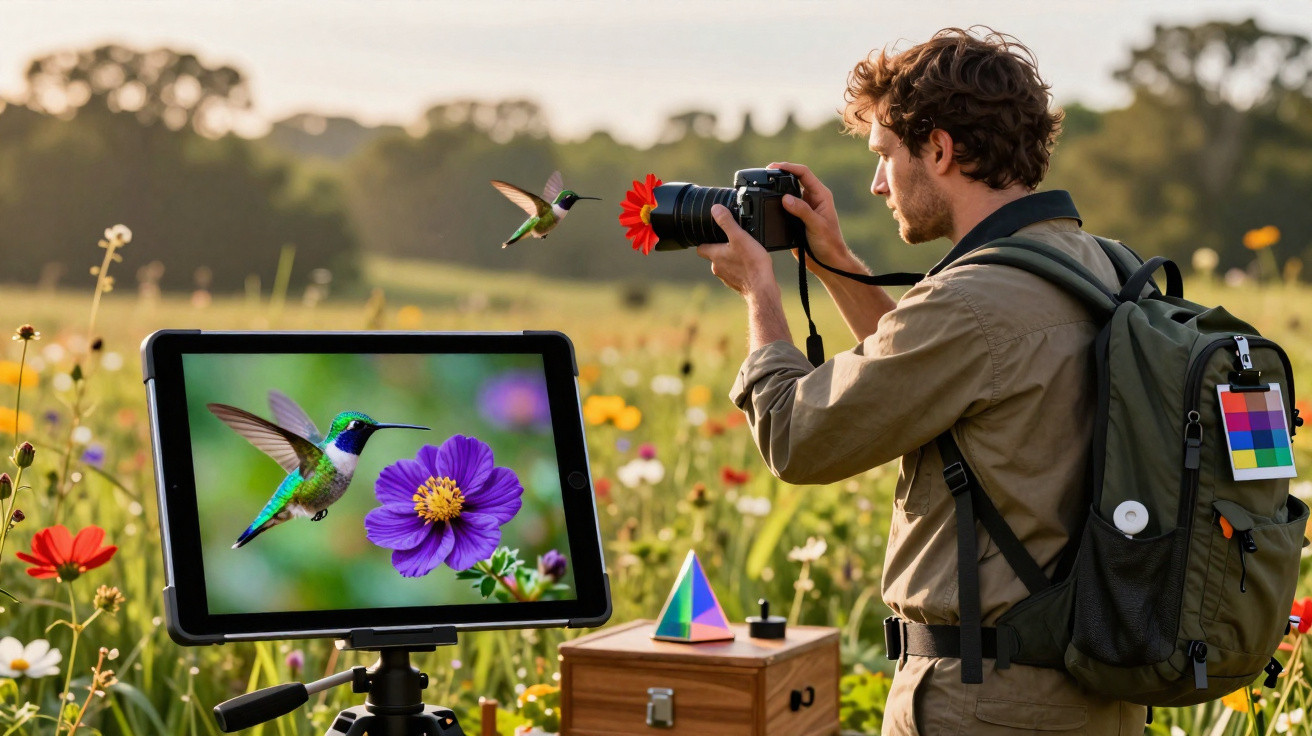
A pioneering camera system now enables people to view colours as animals do, offering a strikingly different window onto the natural world.
The project is led by researcher Vera Vasas, whose work has focused on animal vision for many years. Her new approach is reshaping our understanding of what animals truly see.
Working with fellow researchers at the Hanley Color Lab at George Mason University, Vasas has created a tool that allows people to observe the world from the visual perspective of different species.
How animals see colour
Animals detect colour using photoreceptor cells in their eyes, with the quantity and kind of these cells differing greatly between species.
Humans have three varieties of cone cell, which respond to red, green and blue light. Many animals, however, possess extra types that enable them to perceive colours outside the spectrum visible to people.
Birds, for example, commonly have more advanced colour vision than humans. Their tetrachromatic sight includes the capacity to see ultraviolet light.
That additional visual range is vital for activities such as choosing mates and locating food. Numerous insects, including bees, can also perceive ultraviolet light, allowing them to identify floral patterns that humans cannot see.
Reds, greens and animal colours
Mammals including dogs and cats, by contrast, are dichromats. They cannot tell red from green, similarly to people with red-green colour blindness.
Their narrower colour perception prevents them from seeing the complete range of colours visible to humans, influencing how they engage with their environment.
Recognising these variations is crucial to the study of animal behaviour and ecology. Until recently, though, showing how animals view their surroundings has been a major difficulty.
False-colour imaging has provided limited insights into animal vision, but it has several disadvantages. It takes considerable time, depends on particular lighting conditions and does not capture motion well.
As a result, scientists and filmmakers have found it difficult to depict animal vision accurately.
To overcome these obstacles, Vasas and her team created an advanced camera and software system that can record and process video in natural lighting. It means that colours can now be seen in real time as animals perceive them.
“Our system records in four color channels: blue, green, red, and UV,” explains Vasas. “It then converts this data into ‘perceptual units’ – essentially translating it into a format that replicates animal vision based on known photoreceptor data.”
High accuracy and practical use
When tested against conventional spectrophotometry techniques, the system achieves more than 92% accuracy in predicting the colours perceived by animals.
This is a substantial advance, making the technology both dependable and innovative.
It creates previously unavailable opportunities for scientific study. Researchers can investigate the changing, colourful world experienced by different species, gaining greater insight into animal behaviour and ecology.
The technology could also be hugely valuable to filmmakers. It will allow them to produce more faithful and compelling portrayals of animal vision, helping audiences better understand the natural world.
Soon, documentaries may let viewers experience the ultraviolet patterns that direct bees or the restricted palette of colours seen by dogs.
“This technology bridges the gap between human and animal perception,” says Vasas. “It allows us to not only study animals more effectively but also to educate and inspire people by showing them a world they’ve never seen before.”
A particularly notable feature of the system is its practicality. It is assembled using commercially available cameras within a modular, 3D-printed housing.
This approach makes it available to researchers and filmmakers without the need for costly, specialised equipment.
Animal vision and the colour spectrum
How animals see and interpret colour is central to understanding their strategies for survival.
The mantis shrimp, for instance, has one of the most intricate visual systems known, containing twelve to sixteen kinds of photoreceptor cell.
This enables it to detect polarised light and perceive a spectrum far beyond human vision, helping it identify prey and predators in the complex underwater environment.
Snakes rely on infrared vision to hunt warm-blooded prey at night, whereas reindeer can see ultraviolet light, which helps them detect predators against snow-covered terrain.
Colours, vision and species evolution
Such abilities are vital adaptations developed across millions of years. For any species, the colour spectrum it can perceive may determine the difference between extinction and dominance within an ecosystem.
Evolution has shaped each species’ vision around its particular requirements. Animals acquire distinct colour-vision capabilities according to their habitats and the survival pressures they face. This has produced a broad variety of visual abilities throughout the animal kingdom.
“Understanding how animals see the world helps us make better decisions about conservation and habitat management,” notes Vasas.
“It can inform how we design buildings, roads, and even lighting to minimize negative impacts on wildlife.”
New lens on the natural world
The camera technology created at the Hanley Color Lab makes it possible to see through the eyes of other creatures. It brings people closer to nature while encouraging empathy and understanding.
By continuing to investigate these fresh viewpoints, we can form a stronger connection with the many creatures that share the planet.
Its potential applications are extensive. From scholarly research to immersive educational settings, the technology is expected to change how people see and interact with the animal kingdom.
The complete study was published in the journal PLoS Biology.












Comments
No comments yet. Be the first to comment!
Leave a Comment