
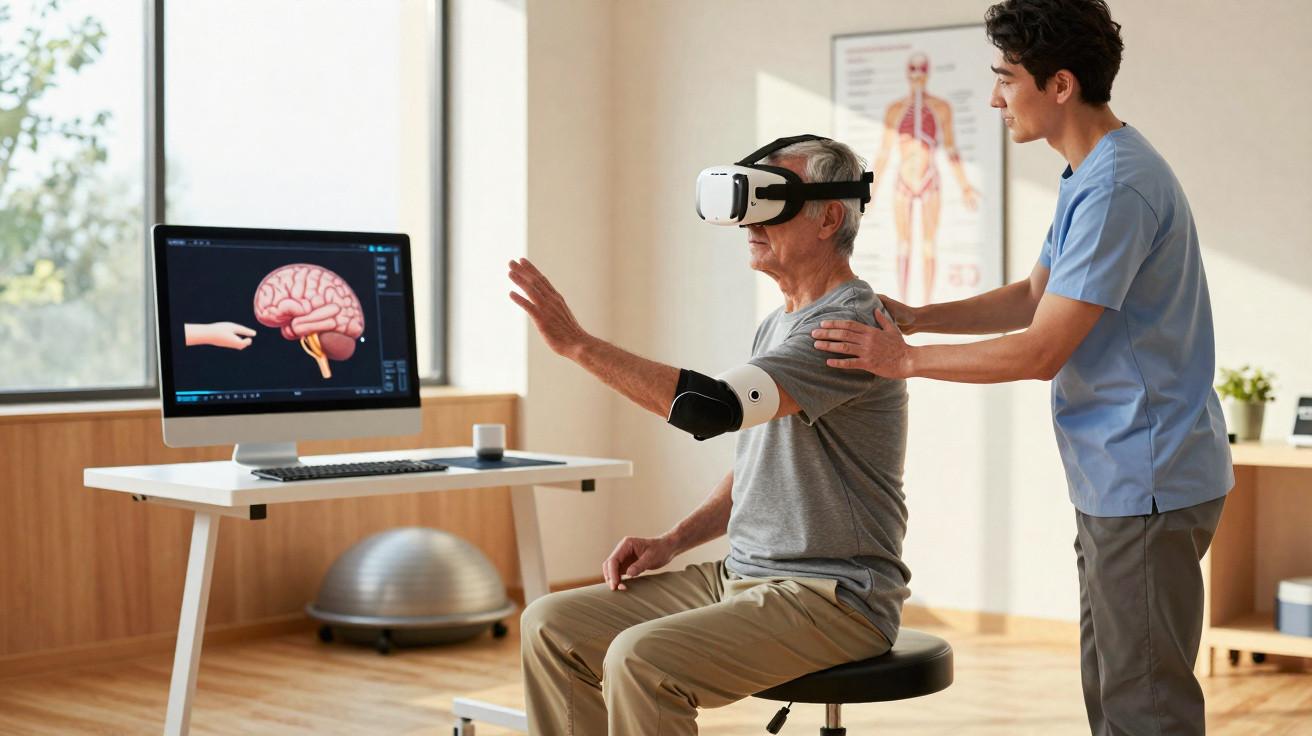
Stroke rehabilitation typically concentrates on helping people regain motion. Clinicians and therapists aim to bring back grip, rebuild strength, and retrain the arm and hand for everyday activities.
Yet a stroke does not only steal movement. Many people also lose their sense of touch, and the brain can struggle to judge where the affected arm sits in space.
A new rehabilitation approach sets out to recover all of these together, by re-educating movement, sensation, and body awareness as a single package.
Movement and touch
Traditional therapy can be effective at reactivating muscles, but it often pays far less attention to sensory recovery. Touch and the brain’s ability to locate a limb may be neglected, even though both strongly influence how useful the hand becomes in practice.
To address that gap, a team led by Stanisa Raspopovic, a neuroengineer at the Medical University of Vienna, created a platform that targets all three dimensions at the same time.
The system, known as MultiSensy, combines fully immersive virtual reality with gentle nerve stimulation delivered via electrodes placed on the skin.
The idea was to treat motor and sensory deficits as one intertwined problem rather than two separate ones. After a stroke, people frequently lose not only movement but also body awareness - the brain’s internal sense of where the arm is.
“MultiSensy was developed to reconnect movement, sensation, and body awareness during rehabilitation,” said Raspopovic.
Inside the VR stroke therapy
Wearing a headset, patients view a virtual version of their own arm and play several simple games. The tasks are built around movements used in daily life, including reaching, grasping, pinching, and rotating the forearm.
What distinguishes the approach is its synchronised touch feedback. Skin electrodes deliver mild pulses to the nerve linked to the thumb and first two fingers, timed to occur the moment the virtual hand touches an object. When a person pinches a virtual block, they receive a real tactile sensation in the palm.
That near-instant alignment between what is seen and what is felt is something earlier systems had not achieved across weeks of training.
Whether the effect comes from convincing the brain that the virtual hand truly belongs to the patient, or through another process, remains under investigation. Even so, motor and sensory improvements appeared to return side by side.
Putting MultiSensy to the test
To evaluate the VR therapy, the researchers enrolled 34 people who had experienced a stroke at least three months earlier. That timing matters: at this stage, recovery is often assumed to have plateaued, although a recent trial suggests that effective therapy can still produce benefits.
Half of the participants trained with MultiSensy. The others received standard care - hands-on physiotherapy and occupational therapy - with session lengths matched exactly, so the technology was the key difference. Both groups trained for three weeks, completing 12 sessions in total.
Assessments were carried out on four occasions: before training began, at the midpoint, at the end of the programme, and again two weeks later to check whether improvements lasted.
Movement was rated using two established stroke scales, while touch and body awareness were evaluated with measures developed by the team.
Stronger gains in movement
The difference in movement outcomes was striking. On the primary motor scale, the MultiSensy group improved by almost double the amount seen with standard care.
All 12 people using the system reached the level clinicians regard as a meaningful improvement, compared with eight of 13 in the standard-care group.
A second assessment, centred on practical tasks such as picking objects up, showed the same trend. Two-thirds of the MultiSensy group achieved a clinically meaningful improvement, versus one-third of those receiving standard care. The edge remained two weeks after training ended.
These results sit at the upper end of what other rehabilitation technologies have produced in people living with long-term stroke effects, including robotic devices and electrical-stimulation approaches.
Immersive VR on its own has appeared encouraging, but a recent review found inconsistent outcomes. The addition of synchronised touch seems to be what pushed these results beyond earlier benchmarks.
Regaining sense of touch
Recovering movement was only part of the aim. A stroke can disrupt the brain’s representation of the affected arm so severely that people may experience it as shorter than it is, or barely notice contact on the palm. Standard rehabilitation often overlooks this sensory component.
According to one review, loss of touch is common after stroke, affecting roughly half of survivors. To measure distorted body awareness, the researchers used a test in which the hand is hidden from view and patients, following verbal instructions, direct a laser towards where they believe their fingertips are located.
After a stroke, people often point significantly short of the true position - as if the arm they feel has shrunk. Following three weeks with MultiSensy, that gap reduced and remained smaller two weeks later.
No comparable change was seen in the standard-care group. Touch also improved: when blindfolded and asked to count pins pressed against the palm, the MultiSensy group performed far better.
Future stroke rehabilitation
During training, the headset recorded how fast and how smoothly each movement was performed, giving clinicians an objective, detailed picture of progress that closely mirrored the formal clinical scores. Relying only on timed clinic-based tests would have missed some of this information.
More broadly, the study suggests that movement and sensation can be rebuilt together rather than tackled sequentially.
No previous system had combined fully immersive VR with precisely timed nerve stimulation over weeks of training, or restored touch and body awareness in this way in people a long time after their stroke.
Because it requires little supervision, the approach could support home-based rehabilitation and reduce pressure on clinics.
This was a small, early-stage study, and larger trials will need to confirm how widely the benefits extend. Even so, it highlights a likely omission in standard rehabilitation: touch, and the brain’s ability to locate and interpret its own body. Recovering these may matter just as much as restoring movement.
Comments
No comments yet. Be the first to comment!
Leave a Comment