
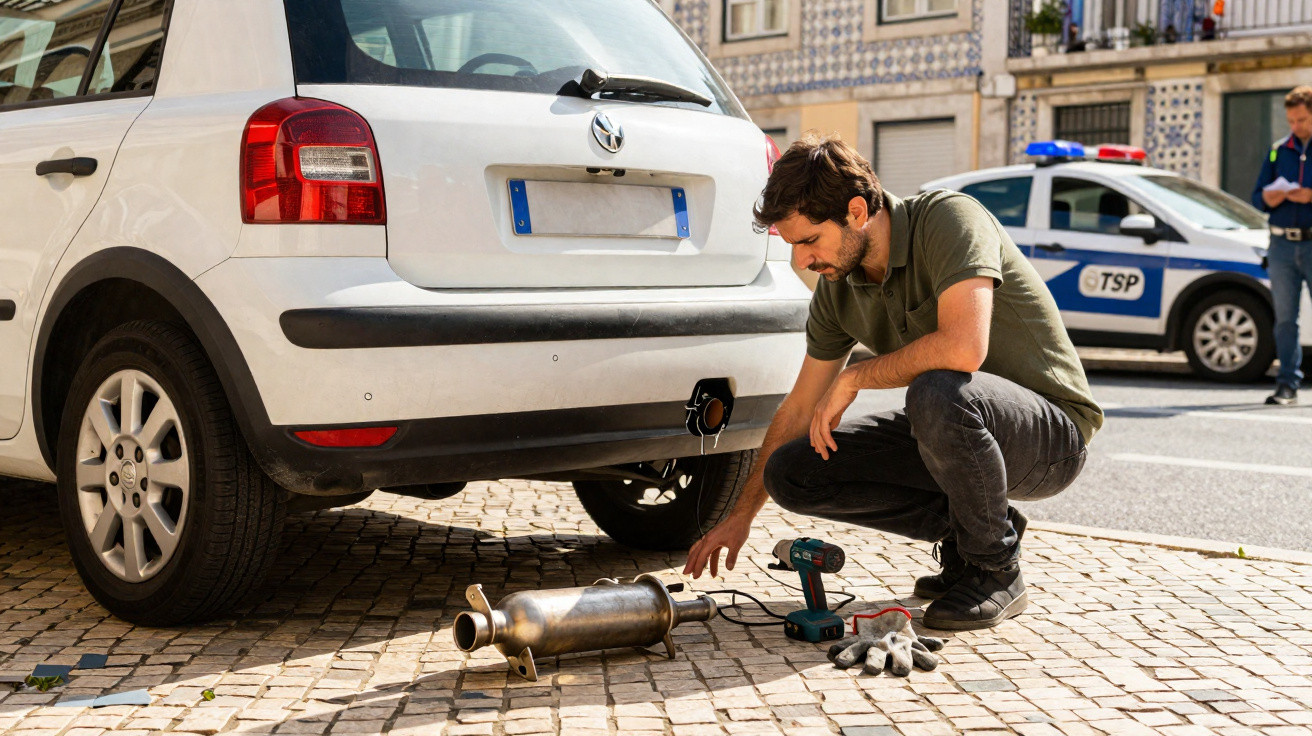
Catalytic converters remain the number-one vehicle part targeted by car thieves. This type of crime is on the rise, driven largely by the surge in raw-material prices.
Because they are made using rare metals such as rhodium, palladium and platinum - among others - catalytic converters have become a “simple” way to access these materials. Figures from the National Republican Guard (GNR), shared with Razão Automóvel, already pointed to an alarming escalation in 2021: an increase of more than 2600% from January to May of that year compared with the same period in 2020.
Razão Automóvel has now obtained more up-to-date information from the Public Security Police (PSP) to understand how this form of criminality has been developing.
A growing problem
When contacted by Razão Automóvel, the PSP confirmed what was already apparent: the number of reported catalytic converter thefts has risen sharply compared with 2021.
It is not only the volume of thefts that is increasing. The PSP also says offenders have become noticeably bolder. Until relatively recently, catalytic converter theft tended to happen mainly at night and in quieter areas. That pattern is changing:
"According to the PSP, in statements to Razão Automóvel, thefts of catalytic converters have been recorded from vehicles parked in busy places and in broad daylight."
The statistics back this up. In 2020, the PSP recorded 839 reports of catalytic converter theft. In 2021, the figures “shot up”. In just the first eight months of the year (up to August 2021), the number of complaints relating to catalytic converter theft reached 3206 - almost four times as many, with four months of the year still remaining.
The authorities’ response
To address the rise in catalytic converter theft - as well as the theft of other components - the PSP set up SRICA: Regional Vehicle Crime Investigation Teams. Their role is to analyse, anticipate and tackle this type of crime.
"Since it was created, the SCRICA has already identified 449 suspects."
Stopping catalytic converter theft is not simply a matter of preventing the physical theft itself. It also requires tackling the organised criminal activity that sustains the phenomenon: those who receive stolen parts, the resellers, and even those who work to disguise the origin of the proceeds (money laundering).
In June of this year, the effectiveness of SRICA’s operations was particularly clear. In an operation across the districts of Porto, Coimbra, Leiria and Santarém, seven people were arrested and more than 500 catalytic converters were recovered, along with 805 kg of components, with a total value of more than 100 000 euros.
On top of this, given that catalytic converter theft also carries environmental consequences - whether because components are removed illegally without meeting environmental safety standards, or because vehicles cannot be used without this part - the PSP stepped up information-sharing with the Portuguese Environment Agency.
The targets
According to the PSP, a significant proportion of recorded thefts took place in the Lisbon metropolitan area. However, the police force stressed - as the GNR had previously told Razão Automóvel - that this is a phenomenon seen from “north to south” across the country.
In the PSP’s view, this is linked to the high mobility of the criminal groups involved.
As for the models most frequently targeted, while the PSP did not provide a specific make and model, it did highlight one statistic that deserves close attention:
"According to the PSP, there is a particular propensity for the theft of catalytic converters from cars registered between 1998 and 2001."
What should you do?
Can you prevent the catalytic converter on your car from being stolen? While there is no guarantee, there are practical steps that can make the “job” harder for thieves.
These are the PSP’s recommendations:
- Anyone who is targeted by this crime - even if it is only an attempted theft - should always file a complaint with the PSP, as this allows an investigation to begin immediately.
- Avoid parking with two wheels on the pavement and two on the road, as this can make it easier to steal a catalytic converter (it removes the need to lift the car with a jack).
- If you notice someone underneath a vehicle, call the PSP straight away. At the same time, gather as much information as possible, such as the number plate of any car involved.
- Signs that a catalytic converter theft may be taking place include: vehicles raised in a car park using a jack; and/or drilling or cutting noises while someone is lying under the car.
- Finally, to help combat this type of theft, it is also important not to use the black market to buy catalytic converters.






Comments
No comments yet. Be the first to comment!
Leave a Comment