
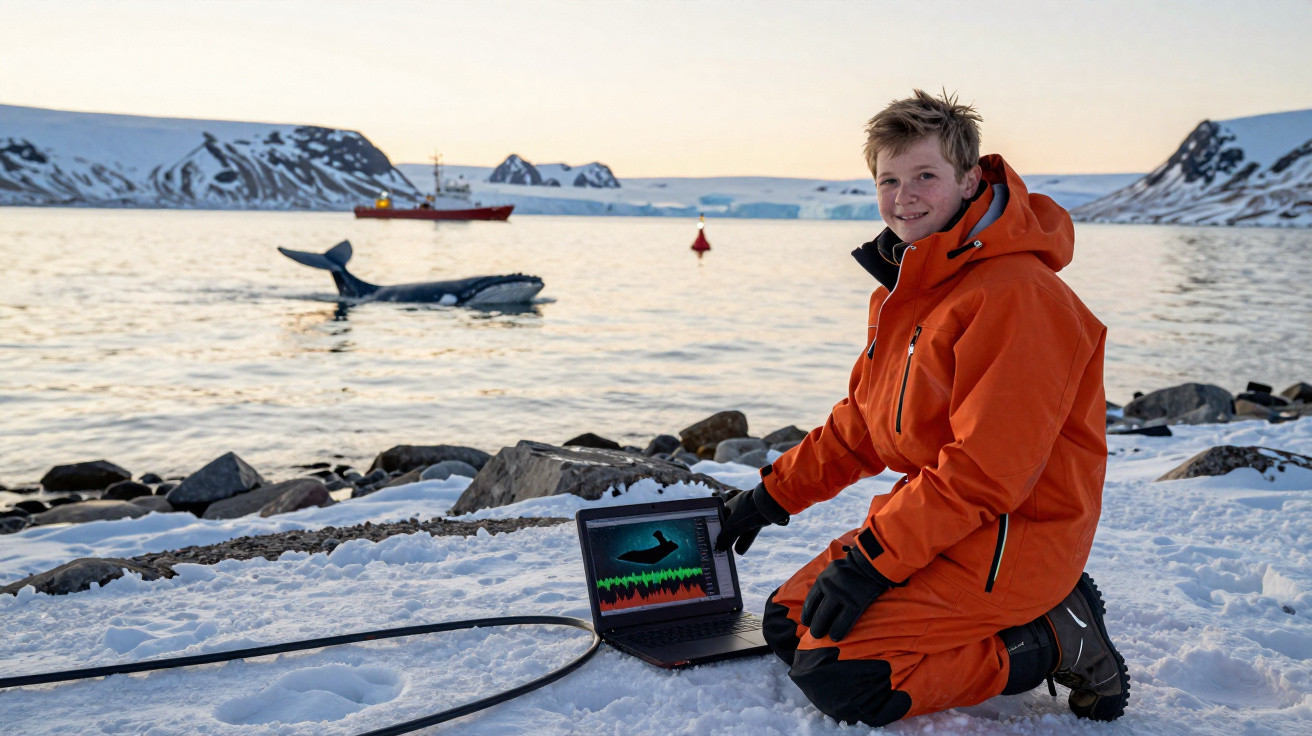
Researchers have demonstrated that it is possible to detect a silent whale-one that is not making any sound-by measuring the weak pressure wave produced as its body swims through the water above a seabed fibre-optic cable. In the Arctic, a blue whale remained trackable even after it stopped calling and slipped into deeper water.
Up to now, locating a whale acoustically has depended on it vocalising; if a whale swam quietly, conventional listening equipment had nothing to register. By reading the animal’s wake instead, scientists could broaden how they count whales and improve the ability to warn ships away from them.
A cable that listens
The fibre-optic cable lies along the seabed off Svalbard, a Norwegian archipelago far into the Arctic, and it was installed for communications rather than wildlife research. It carries everyday internet and telephone traffic.
A team at the Norwegian University of Science and Technology (NTNU) found that the same glass fibre can double as a long, continuous array of underwater microphones.
All of this can be done with a single instrument: it sends laser pulses through the fibre and monitors tiny changes in the returning light as the glass is minutely stretched and compressed by passing vibrations.
Known as distributed acoustic sensing, the approach effectively converts one cable into thousands of listening points spaced along the seafloor.
Detecting silent whales
Back in 2020, the researchers showed these cables could record the low, powerful moans of vocalising whales. Earlier work also demonstrated that the fibres could pick up ships, storms and even distant earthquakes.
Detecting a whale that is not calling is more challenging. The new study focuses on a much lower-frequency range: slow pressure waves created when a large body moves through the water.
Martin Landrø, who leads NTNU’s Centre for Geophysical Forecasting and is the study’s senior author, explained the mechanism in straightforward terms.
As a whale swims, it forces water aside and disturbs the soft sediments; the team looks for the faint imprint of that motion reaching the cable, even when the animal is silent.
Although the signal is subtle, it is still measurable at the fibre. “If the whales are silent, their body movement causes disruptions in the water and the sediments, so that we can detect them, even if they aren’t making any noise,” said Landrø.
Reading a wake
These low-frequency signals weaken quickly with distance, which is one reason they have not traditionally been used to search for whales. Robin André Rørstadbotnen, a postdoctoral researcher at the centre and the study’s first author, linked the challenge to sheer size.
A whale and a ship can be similar in overall shape, yet the difference in mass is huge. “A big ship is easy to detect as it moves a lot of water, but a whale is much smaller, so that it moves a lot less water,” said Rørstadbotnen.
Close to the surface, a smaller whale produces only a slight effect; it becomes most apparent when it passes near the cable or descends into deeper water. To calibrate what they were seeing, the team relied on a familiar reference: ships.
Large vessels routinely broadcast their identity, position and speed via transponders, so each passing hull comes with an accurate, independent track.
Ships showed the way
The fibre was already capturing the vibrations from cruise ships travelling through the same Arctic waters. What the researchers had not previously analysed was the far lower-frequency component beneath that rumble: the pressure wave driven ahead of each hull.
The fibre detected that as well. “The big surprise was that this fiber could detect this,” said Landrø.
To interpret the observation physically, the team drew on an equation published by Lord Rayleigh in 1917 to describe collapsing bubbles in water.
They found that the same mathematics could describe a hull-or a body-displacing water. Because each ship’s speed and location were known precisely, they could adjust the equation until the model matched the cable’s measurements.
The silent blue whale
The clearest test came from a single well-timed encounter. A blue whale was calling near the surface within range of the cable, then fell silent and dove into deeper water.
“We were lucky to find a whale, a blue whale, that was vocalizing close to the surface, and then when it stopped vocalizing, it dove down,” said Landrø.
Initially, the whale’s calls stood out in the acoustic data in the same way the group has detected singing whales for years. Once the calls ceased, a standard listening-only system would typically have lost the animal at that point.
Instead, the researchers switched to the slower, lower-frequency signature. The whale continued to appear as a faint trace moving through the data as it descended. When processed through Rayleigh’s equation, that trace yielded a track the team could follow.
No-one had previously tracked a whale by the water it displaced rather than by the sound it produced. Here, even after the animal became silent, it did not disappear from view-closing the gap between a whale going quiet and a whale effectively vanishing.
This advance builds on the group’s earlier results. In 2023, the team used two parallel seabed cables off Svalbard, each about 260 kilometres long, to follow eight calling fin whales for five hours and determine their positions to within roughly 90 metres. In that case, every whale needed to be vocalising to be detected.
Helping protect whales
Whale population counts are difficult because whales traverse vast ocean areas and are often unobserved. A technique capable of detecting silent animals as well could deliver far more complete estimates of how many whales pass along a given coastal stretch.
The same measurements could also reduce the risk of ship strikes. As sea ice retreats, Arctic shipping is increasing, while whales are remaining in northern waters later into the year-bringing large animals and large hulls into the same routes. A cable that identifies a silent whale near a busy corridor could be used to send warnings to vessels before a collision occurs.
The researchers emphasise that the work is still at an early stage, with much more to understand. Tracking one cruise ship-Le Commandant Charcot-across three seasons provided a practical reference point for interpreting these faint signals.
What the team has already demonstrated is tangible. “Over three cruise seasons, we obtained a lot of very valuable information that could help us better understand these low-frequency signals,” said Rørstadbotnen.
Before this study, once a whale stopped calling it effectively dropped off the map. Now, a glass strand on the seabed can keep tabs on it via the water it pushes aside-without requiring any sound at all.
Because the world’s oceans are already criss-crossed by these cables, much of the necessary hardware to monitor whales in this way is already in place on the seafloor.





Comments
No comments yet. Be the first to comment!
Leave a Comment