
The top digital cameras on sale can take a photograph by opening the shutter for roughly 1/4,000 of a second.
To capture the motions of atoms, though, you would need a shutter that fires vastly faster.
In 2023, scientists introduced a method that reaches an effective shutter speed of a trillionth of a second - about 250 million times quicker than those digital cameras. That speed is key for observing a major topic in materials science: dynamic disorder.
Dynamic disorder, put simply, describes how groups of atoms shift and “dance” within a material in particular patterns over a span of time - for instance, when set off by a vibration or a change in temperature. Researchers do not yet have a complete picture of the phenomenon, but it plays an essential part in how materials behave and react.
Why a faster shutter matters for atoms
The shorter the shutter time, the more precisely you can freeze a moment - which is exactly what you need when the subject is something as quick and jittery as atoms. In everyday photography, a slow shutter during a sporting event, for example, produces players smeared into blur rather than sharply defined.
How the variable shutter atomic pair distribution function (vsPDF) works
To get to these extreme speeds, the new system does not rely on conventional photography. Instead, it uses neutrons to determine where atoms are.
By tracking how neutrons strike and travel through a material, scientists can infer the arrangement of nearby atoms. Adjustments to the neutrons’ energy levels act as the equivalent of changing shutter speed.
Those variable shutter settings matter just as much as the trillionth-of-a-second limit: they are crucial for separating dynamic disorder from the related but distinct static disorder - the ordinary background jiggling of atoms around fixed positions that does not improve a material’s performance.
The team calls the approach the variable shutter atomic pair distribution function, shortened to vsPDF.
"It's only with this new vsPDF tool that we can really see this side of materials," said materials scientist Simon Billinge from Columbia University in New York.
"With this technique, we'll be able to watch a material and see which atoms are in the dance and which are sitting it out."
"It gives us a whole new way to untangle the complexities of what is going on in complex materials, hidden effects that can supercharge their properties," said Billinge.
What vsPDF uncovered in germanium telluride (GeTe)
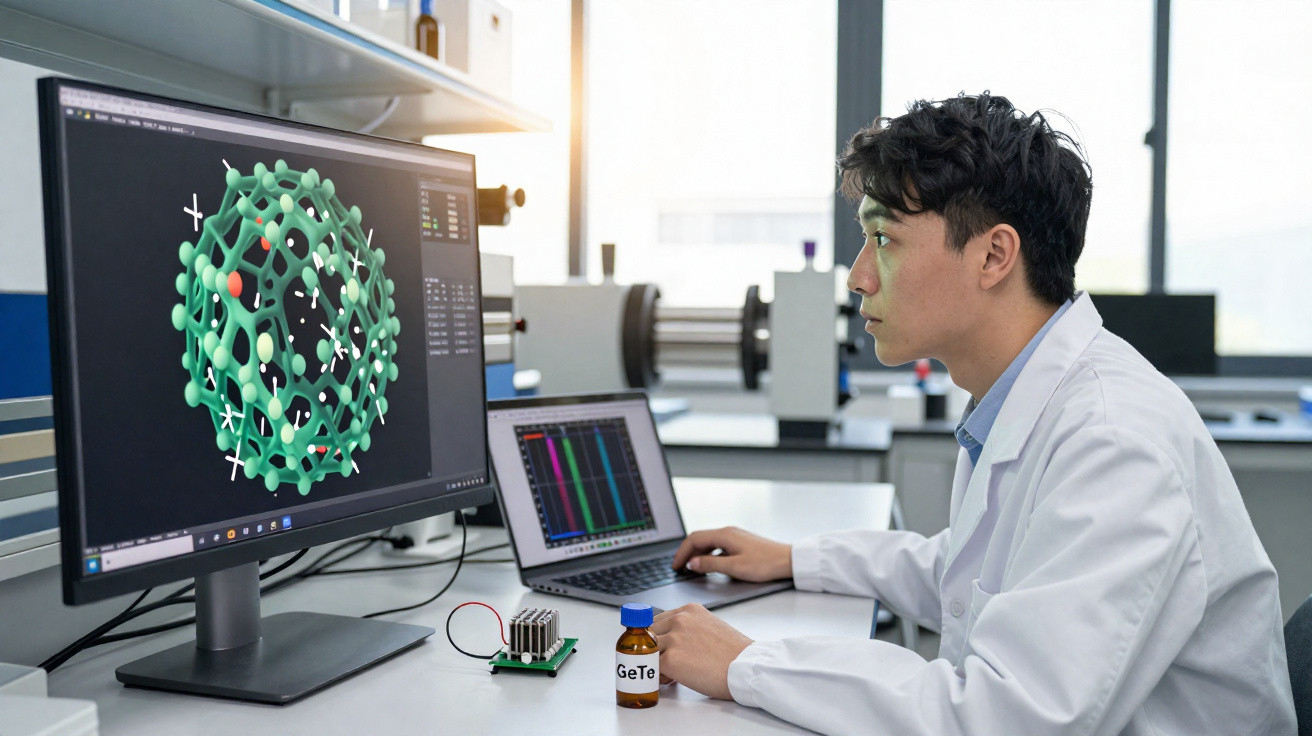
To demonstrate the method, the researchers pointed their neutron “camera” at germanium telluride (GeTe). Thanks to its particular characteristics, GeTe is widely used to convert waste heat into electricity, or to turn electricity into cooling.
The measurements showed that GeTe stayed crystalline, on average, across all temperatures. At elevated temperatures, however, the material exhibited increased dynamic disorder: atoms transferred motion into thermal energy along a gradient aligned with the direction of the material’s spontaneous electric polarisation.
Why this matters for thermoelectrics and real-world devices
A clearer view of these physical structures improves understanding of how thermoelectrics function, which in turn supports the development of better materials and equipment - including the power sources used for Mars rovers when sunlight is not available.
Using models built on what the new “camera” observes, researchers can refine scientific explanations of the materials and the processes involved. Even so, there is still substantial work ahead before vsPDF becomes a routine testing method.
"We anticipate that the vsPDF technique described here will become a standard tool for reconciling local and average structures in energy materials," the researchers explained in their paper.
The research was published in Nature Materials.
An earlier version of this article was published in March 2023.






Comments
No comments yet. Be the first to comment!
Leave a Comment