
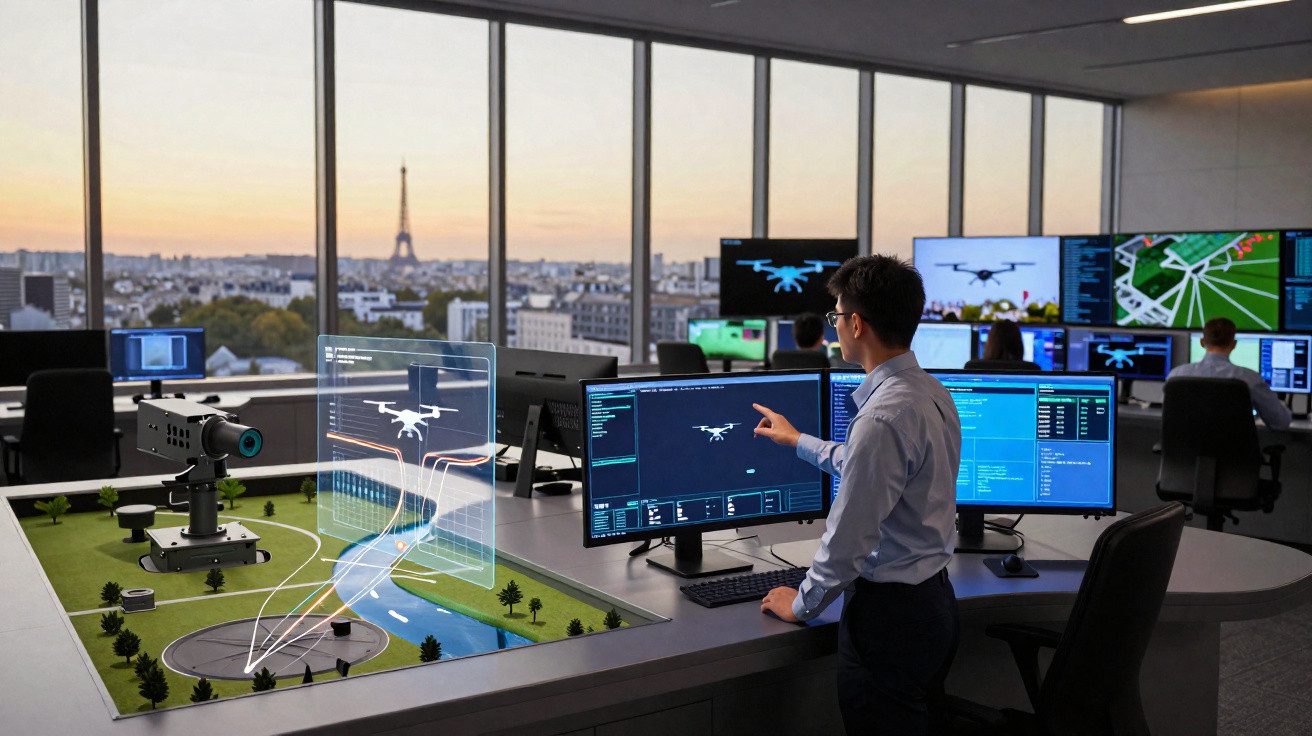
MARSS, a leading company in technology fusion, protection solutions and multi-domain C2, was among the standout exhibitors at Eurosatory 2026. Building on its track record and a strong innovation culture, MARSS presented its newest developments in Paris-now operating as part of Electro Optic Systems (EOS).
Zona Militar had the chance to speak with Johannes Pinl, MARSS founder and CEO, who offered a detailed overview of the company’s product portfolio, the scope of the integration with EOS, and the key short- and medium-term challenges posed by the fast-growing threat from unmanned systems.
Pinl underlined that MARSS is an early mover in counter-drone protection technology. He noted that its solutions have been tested for several years in the Middle East, where they have been used to protect critical infrastructure against attacks by unmanned aerial systems.
MARSS at Eurosatory 2026
MARSS NiDAR: command-and-control (C2) for multi-domain protection
One of MARSS’s flagship offerings is its NiDAR command-and-control platform, described as “…a comprehensive solution that combines intelligence and surveillance to provide an overall view of the situation, thereby strengthening defence, security and protection…”. Shown at Eurosatory 2026, the system brings together multiple sensors and effectors spanning the multi-domain spectrum.
For nearly two decades, MARSS has developed and introduced innovations across its protection solutions-an approach that is particularly relevant today given the constant evolution of technology applied to unmanned systems. The move into EOS is set to broaden MARSS’s capabilities through deeper integration of sensors and effectors.
Merger with EOS
On 20 May, MARSS announced that it had joined Electro Optic Systems (EOS) after the Australian company completed the acquisition of MARSS’s defence business. MARSS stated at the time: “…By combining MARSS’s expertise in software-based C2 with EOS’s strengths in hardware and systems integration, the new EOS business unit will provide an end-to-end capability, from detection and tracking through to neutralisation…”.
Together, MARSS and EOS “…will be positioned to compete as a global leader in large-scale, integrated solutions for customers in the military, national security, government, airport and critical infrastructure sectors worldwide…”.
EOS is among the leading companies developing stabilised multi-sensor systems, C-UAS systems, high-power lasers, and platform integration for land and naval applications. With MARSS’s portfolio added, EOS’s ability to deliver comprehensive protection solutions expands significantly.
Challenges in Europe and the Middle East
At Eurosatory 2026, Johannes Pinl drew attention to an issue affecting both Europe and the Middle East: the accelerating integration of AI technology, the push towards full automation, and the current constraints in the West when responding to threats that are already present.
MARSS was among the first to apply AI across its protection and security platforms, and it continues to advance in this area to maintain momentum amid new challenges and strong demand for integrated systems. As it progresses towards automation, the company has moved from the “Man in the Loop” concept to “Man on the Loop”, where human involvement is largely reduced to the final decision due to response-time requirements.
This shift represents a natural-and necessary-evolution as AI is increasingly embedded in systems used by a range of state and non-state adversaries. These actors operate without restrictions because they are not bound by regulations that impose constraints. For that reason, Western nations must develop systems capable of meeting these challenges, which in turn demands continual development and sustained innovation.
Given current conditions in Europe and the Middle East, today’s challenges also focus on building industrial bases that are established and able to scale in response to demand that appears to have no ceiling. In this context, MARSS’s CEO emphasised the company’s existing capacity, as well as the execution of multiple strategies-among them, leveraging COTS components.
In a highly fluid environment, MARSS is committed to continuing to deliver solutions for current and future threats, applying experience gained on battlefields while introducing ongoing innovations.




Comments
No comments yet. Be the first to comment!
Leave a Comment