
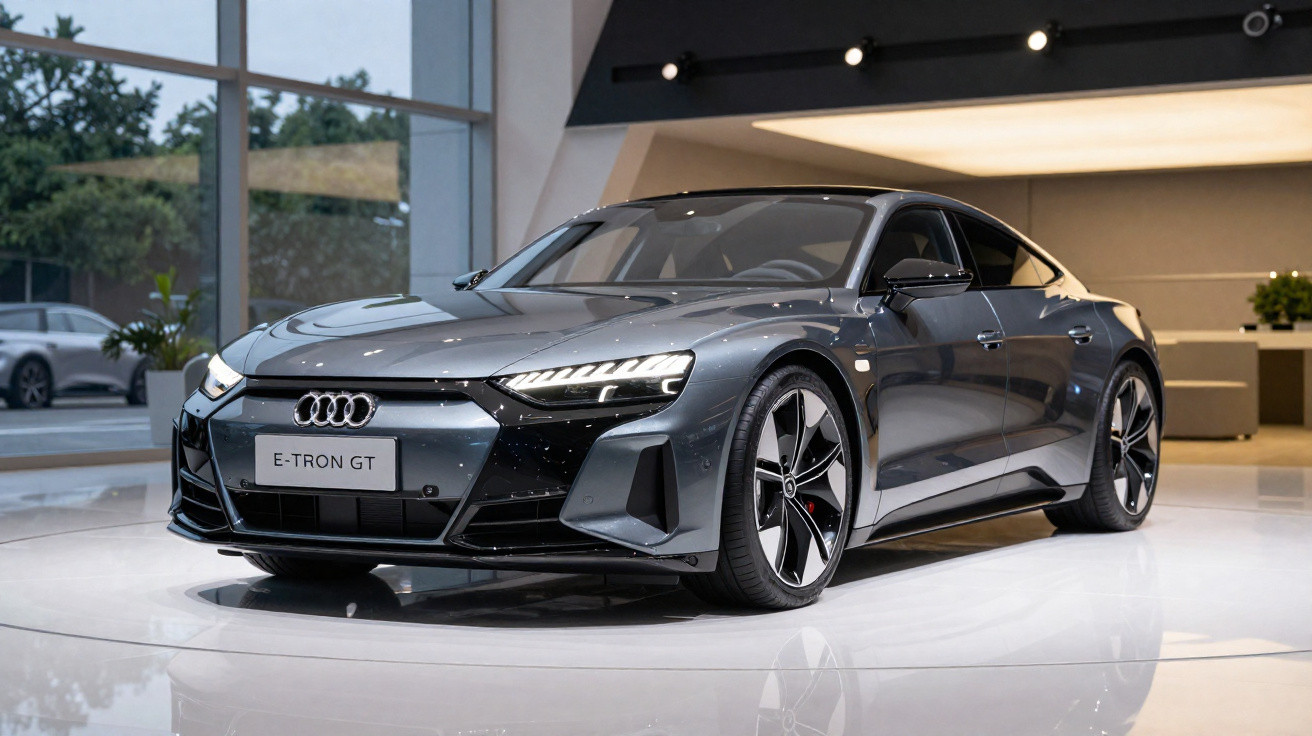
As well as testing the Audi e-tron GT in its most sporting RS guise, we were also given the opportunity by the German brand to speak with two of the people responsible for this German model.
One was Stefan Gsell, who created the e-tron GT’s driving sound and told us that “the real world inspires digital sounds”.
The other was Alexander Breuer, Production Director for the Audi e-tron GT, who cannot help but point out that “it is incredible to build the e-tron GT and the R8 on the same assembly line”.
In this interview, they explain more about their work and reveal some details about Audi’s new electric model.
Technology and nature working “hand in hand”
How do you create the sound for a sporting electric car?
Stefan Gsell (SG): The more we investigated possible solutions, the more we realised that sounds taken from nature could best match what we wanted to accompany a journey in the e-tron GT.
The car has a very assertive design, and we wanted its sound to follow the same approach. We used a broad sound spectrum to cover the various driving situations, ensuring it was not overly intrusive while remaining distinctive and emotional enough.
We reserved low frequencies for the more sporting performance moments, while mid and high frequencies help signal the car’s presence in urban environments. This allows other road users, such as pedestrians and cyclists, to be aware that the Audi e-tron GT is approaching.
Was the research into acoustic frequencies more digital or analogue?
SG: We worked with pipes, fans and helicopter blades, achieving some surprising results.
Quite often, the most unlikely object produces the most suitable sound. However, unlike an isolated sound, a car has to sound continuous, so we ultimately developed our own software - because it did not exist, we had to create it.
We believe the final sound speaks for itself. We used 32 tracks for the recordings, combining synthesizers, musical instruments, pipes, etc.
In brief, how does the system work?
SG: One loudspeaker projects all sound outside the vehicle in order to meet legal requirements - up to 20 km/h in Europe and 32 km/h in the United States. Dedicated acoustic models were developed for each market in terms of frequency and volume, even though the underlying pattern is quite similar. Above 60 km/h, however, it is no longer audible, partly because tyre noise against the road surface and aerodynamic noise take over.
An optional sound package adds another exterior loudspeaker and two at the rear of the cabin, delivering a more immersive acoustic experience.
What was the greatest challenge you encountered during this process?
SG: We did not want to go too far and produce something that sounded excessively like “science fiction”, so resisting that temptation was one of the biggest challenges.
It was equally important to differentiate Audi’s sound from Porsche’s. In fact, we preferred not even to know what each team was doing, in order to avoid unwanted influences.
Is there only one sound, or can the driver choose or download others?
SG: The driver can influence the sound by selecting the “Efficiency”, “Auto” or “Dynamic” driving mode, or another setting, with a sound character that suits that mood and attitude both inside and outside the car.
We could have made different sound types available, but I believe we made the best choice, not least because a range of legal requirements must always be met.
It is also interesting that the sound inside and outside the car is not always identical. Inside, it is only heard in “Dynamic” - not in “Comfort” or “Efficiency” - and even then it merely complements the sound generated outside.
People and machines on the Audi e-tron GT production line
In summary, what are the stages involved in producing the Audi e-tron GT?
Alexander Breuer (AB): It all starts with body production at Böllinger Höfe. The body is then sent to Neckarsulm - only a handful of kilometres away - for painting, before returning to Böllinger Höfe for final assembly alongside the R8.
After all, these are Audi’s two most powerful series-production models ever.
What did you do differently to make that possible?
AB: This was the Audi that moved into series production most quickly, thanks to virtual testing, which made it possible to bypass many physical tests involving real prototypes.
A dedicated assembly line was installed for this electric car. The body and chassis go through the production line twice, in processes that are fully automated both inside and outside.
The first pass is for fitting interior components, while the second is for exterior items. There are 10 robots and 32 tools, meaning every robot can perform more than one task: on the first pass it may be welding, while on the second it could be fastening a component.
Will robots replace people on the assembly lines of the future?
AB: The R8 has an aluminium and carbon-fibre-reinforced plastic space frame and is built almost entirely by hand, whereas the Audi e-tron GT uses a structure made from several types of ultra-high-strength metal and is assembled almost entirely automatically.
Yet human skill remains irreplaceable in certain areas. Welding the B-pillar is highly complex, so our specialist R8 craftspeople weld these aluminium components, drawing on all their years of experience.
Then, before the car moves to the paint station, there is an attachment-fitting area where elements such as doors, bumpers and the bonnet are installed. Once again, every surface has to be 100% perfect, making the human eye and touch essential.
In any case, this is an ultra-modern assembly operation that does away with conventional continuous lines. Instead, it uses a series of autonomous vehicles to transport components and even bodies, delivering them to the correct location with great flexibility and functionality.
But do you recognise the contribution made by new technologies in manufacturing any modern car?
AB: Of course, digitalisation played a fundamental role in this new assembly line. The assembly area was completely digitised in a computer programme, and even the production start-up was studied entirely virtually, for the first time at Audi.
Another example is 3D printing: someone simply designs a part in the computer programme, sends it to the 3D team and, a few hours later, we have it in our hands ready to fit to the car.
Which of the two models takes longer to produce?
AB: The R8 takes a little longer because fitting the carbon-fibre components requires additional time.





Comments
No comments yet. Be the first to comment!
Leave a Comment