
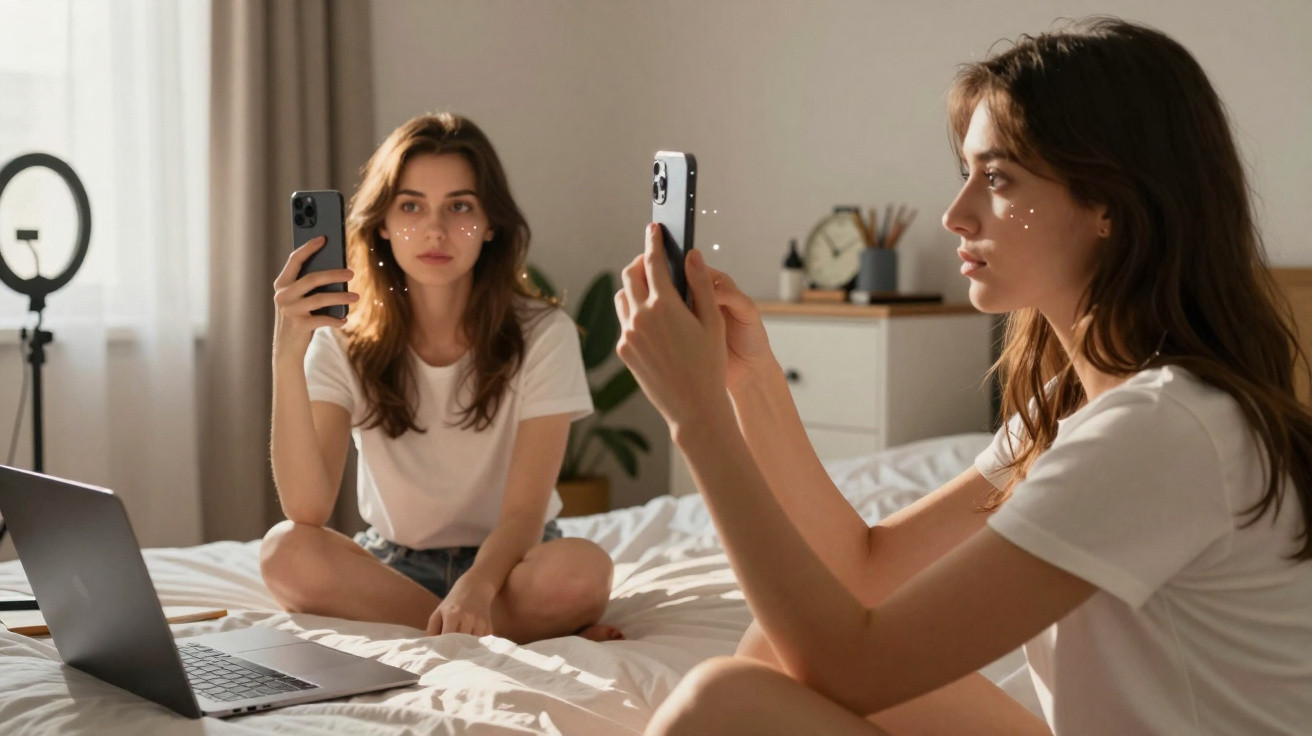
Spending an hour a day scrolling Instagram is routine for millions. Many also carry a quiet sense that this habit can distort how they feel about their face - something researchers have been reporting for years.
What had not been examined was whether that distortion goes beyond personal opinion - beyond the judgements people make about their appearance - and reaches into the brain processes that allow someone to recognise a face as their own.
A deeper worry
For a long time, social media research has largely centred on body image: the way platforms encourage people to measure themselves against an endless stream of carefully curated strangers.
Across repeated studies, heavier use is associated with greater body dissatisfaction and more fragile self-esteem.
This research group set out to look beyond appearance. The study was led by Dr Maria Sansoni at the Catholic University of the Sacred Heart in Milan, and coordinated by Professor Giuseppe Riva, who heads its Humane Technology Lab. Their question was whether screen time can cut deeper than vanity.
They describe the hypothesis as the Digital Erosion of Bodily Identity. In their view, years of viewing, editing and comparing faces online could gradually soften the perceptual boundaries the brain relies on to tag one face as uniquely “mine”.
Inside the experiment
The researchers recruited 95 young adults - men and women - with a mean age of 26. By their own accounts, they were typical users: nearly eight years on Instagram and roughly an hour a day on the app.
Before using any headset, participants completed questionnaires covering their bodies, their mood and their Instagram habits. They also performed a silent heartbeat counting task, a standard measure of interoception - how precisely a person detects signals arising from within the body.
After that came the unusual element. In one procedure, volunteers in virtual reality watched an unfamiliar face while a brush touched their real cheek and the cheek shown on screen at the same time. In another procedure, synchronised touches were delivered to the stomach while participants viewed a virtual body.
Tricking the brain
These procedures draw on a long-standing set of body illusions in neuroscience. The best-known example is the rubber hand illusion: when a fake hand is stroked in synchrony with a person’s hidden real hand, the fake can begin to feel convincingly like part of the self.
Such effects occur because the brain is continually integrating what it sees, what it feels on the skin and what it senses internally to decide where the body ends and the outside world begins. Provide matching information from the wrong location, and the perceived boundary can shift.
The ease with which someone experiences these illusions is informative: it reflects how rigid or flexible their self-boundaries are. A stronger sense of self tends to withstand the manipulation. A more permeable one yields - temporarily incorporating a foreign hand, or a foreign face, as “self”.
The face finding
In this study, the data produced something not previously demonstrated in healthy adults. More years spent on Instagram were linked with a greater tendency to accept the stranger’s face as one’s own during the illusion - a clear dose–response relationship expressed over time.
What failed to predict the effect is equally notable. The number of minutes per day on Instagram did not matter. The pull towards the stranger’s face related to how long participants had been using Instagram overall, rather than how active their feed was in recent days.
Just as important was where the shift appeared. It was not observed across the whole body. The association emerged specifically for the face - the feature people use to recognise themselves in a mirror and the feature by which others identify them.
“It is through our faces that we recognize ourselves in the mirror, construct our individuality, and are recognized by others,” said Riva.
In other words, the drift touched the body part most tightly tied to personal identity, not a comparatively neutral limb.
What remains uncertain
None of this is definitive. The sample was modest - 95 participants - and the group was largely White, European and university-educated, leaving ample scope for the pattern to look different in a more diverse population.
Because the study assessed people at a single point in time, it cannot demonstrate erosion unfolding across years. A small subset who relied on beauty filters reported feeling more control over the virtual body; however, with only 12 such participants, this is a tentative lead rather than a robust result.
The face and full-body procedures also used different experimental set-ups, so they are not directly comparable. Even so, the study opens up new territory - including the possibility that the brain’s interpretation of internal signals, which one review describes as a pillar of the bodily self, could be shaped by prolonged screen-based living. Whether the observed link reflects a biological change in the brain or another pathway the study was not designed to capture remains unresolved.
What could change
Setting aside the caveats, one genuinely new finding stands out. Before this work, no one had connected the number of years spent on an image-driven platform with a measurable loosening in how the brain lays claim to its own face.
“The participants involved in the study belong to the first generation to grow up with social media,” said Sansoni.
Her sharper concern is what comes next: children encountering these platforms much earlier and remaining on them for much longer.
Heavy social media use may therefore carry a broader risk than previously assumed - affecting not only how teenagers evaluate their looks, but also how firmly their brains hold on to a stable sense of self.
As screens reach children at younger ages, clinicians and researchers may need to monitor a new dimension alongside body image: identity itself.



Comments
No comments yet. Be the first to comment!
Leave a Comment